Thursday, January 7, 2016

On The Art Of Keeping Your Head Down-Joanne Woodward and Paul Newman’s WUSA


DVD Review

From The Pen Of Sam Lowell

WUSA, starring Joanne Woodward, Paul Newman, Anthony Perkins, 1970

Sometimes films give a slice of life at a certain period in history and don’t age well like the black and white films from the 1950s that dealt with the Cold War and you could almost feel the frost then (and the menace behind that frost if it defrosted and somebody let the big one go off, the big one then as now be a nuclear weapon or weapons). Now the younger generation, hell, maybe even some of us of the older generation who have forgotten, wonder what all the fuss was about as they deal with the age of up front and on-going wars on terror. Other films like the one under review, Joanne Woodward and Paul Newman’s WUSA while clearly of certain period, in this case the later 1960s, have subject matter that could be hot off the current presses (or whatever alternative social media people are tuned into for their information these days). The subject matter here (beyond the question of keeping one’s head down when a struggle is brewing, an eternal and controversial theme) is the relationship between the media represented by the WUSA radio station of the story and various right-wing causes, conspiracies and plots.

Here is the way this one plays out. Rheinhardt, played by Paul Newman, is guy on the drift, just going along to get along, who winds up by the force of his personality getting a job as an announcer at WUSA in New Orleans. That personality, or an aspect of it allowed him to move up the corporate food change even though he disagreed with the right-wing drift of the politics and ownership of the radio station. Along the way, as drifters will do since they play the edges of society rather closely, he meets a heart of gold independent hooker who has been around the block a few times, Geraldine, played by Joanne Woodward, and they eventually get under the sheets before long and thereafter wind up playing house together. (As an aside the chemistry between Woodward and Newman here is palpable unlike some other films they played in together.) Part of “playing house” happened when they rent an apartment in a building which spoke of some 1960s counter-culture madness along the fringes of Bourbon Street but more importantly meet a fellow tenant, Rainey, played by Anthony Perkins who had finally gotten over his Psycho fixations, an idealistic guy who was working some social betterment program for the black community of New Orleans.

As Rainey finds out along the way, finds out the hard way, he is a small cog, even if unintentional on his part, of the owner of WUSA and of his plan to unleash some kind of race riot on the way to attempt to overthrow the government on the backs of the white rednecks and cranks who listen to the words put out by WUSA which is like music to their deeply resentful ears. Sound familiar. Through all of this, or almost all of this, Rheinhardt is going along, troubled a bit maybe, but keeping his head down to keep his job.

Then “judgment day” comes. The owner of WUSA and his pals stage a rally in order to rile up the brethren. Rainey who now is wise to the purposes he was used for decides to take matters in hand and tries to kill the owner during the rally. Pandemonium ensues. Then old head down Rheinhardt got “religion,” a little, decided to rock the boat and break from his keeping his head down world, although in the end he only loses his job and is on the bum again. But not everybody is a survivor. Geraldine is caught up in the melee of the rally holding some dope and is arrested and jailed. In jail, facing who knows what, this delicate world wary flower, commits suicide. Rheinhardt is saddened by the event but you know some guys are organically incapable of not keeping their heads down, at least for long, and he will go on somewhere else. That is an eternal problem. Yeah, this one is a slice of life one with a message for today.     

Wednesday, January 6, 2016


Out In The Be-Bop 1950s Night- The Time Of Motorcycle Bill-An Encore


From The Pen Of Joshua Lawrence Breslin

There was a scourge in the land, in the 1950s American land. No, not the dreaded but fatalistically expected BIG ONE that would send old mother earth back to square one, or worst, coming from the Russkies. Sure that was in the air and every school boy and girl had their giggling tales of having to hide, hide ass up, under some desk or other useless defense in air raid drill preparations for that eventually. Sure, as well, the air stunk of red scare, military build-up cold war “your mommy is a commie turns her in.” But that was not the day to day scare for every self-respecting parent from Portland to the Pacific. That was reserved for the deadly dreaded motorcycle scare that had every father telling his son to beware of falling under the Marlon Brando sway and spiraling down to a life, a low life of crime and debauchery (of course said son not knowing of the word, the meaning of debauchery, until much later just shrugged his innocent shoulders). More importantly every mother, every blessed mother, self-respecting or not (with a gentle nod from Dad) warned off their daughters against this madness and perversity.

Of course that did not stop the sons from mooning over every Harley that rode the ride down Main Street, Olde Saco (really U.S. Route One but everybody called it Main Street and it was) or the daughters from mooning (and maybe more) over the low- riders churning the metal on those bad ass machines. Even prime and proper Lily Dumont, the queen of Saint Brigitte’s Catholic Church rectitude on Sunday and wanna-be “mama” every other waking minute of late. And the object of her desire? One “Motorcycle Bill,” the baddest low- rider in all of Olde Saco.

Now baddest in Olde Saco (that’s up in ocean edge Maine for the heathens and others not in the know) was not exactly baddest in the whole wide world, nowhere as near as bad as say Sonny Barger and his henchmen outlaws- for- real bikers out in Hell’s Angels Oakland as chronicled by Doctor Gonzo (before he was Gonzo), Hunter S. Thompson in his saga of murder and mayhem sociological- literary study Hell’s Angels. But as much is in life one must accept the context. And the context here is that in sleepy dying mill town Olde Saco mere ownership, hell maybe mere desire for ownership, of a bike was prima facie evidence of badness. So every precious daughter was specifically warned away from Motorcycle Bill and his Vincent Black Lightning 1952 (although no mother, and maybe no daughter either, could probably tell the difference between that sleek English bike and a big pig Harley). But Madame Dumont felt no need to do so with her sweet sixteen Lily who, maybe, pretty please maybe was going to be one of god’s women, maybe enter the convent over in Cedars Of Lebanon Springs in a couple of years after she graduated from Olde Saco High along with her Class of 1960.


But that was before, walking home to Olde Saco’s French- Canadian (F-C) quarter, the Acre, on Atlantic Avenue with classmate and best friend Clara Dubois, Lily heard the thunder of Bill’s bike coming up behind them, stopping, Bill giving Lily a bow, and them revving the machine up and doing a couple of circle cuts within a hair’s breathe of the girls. Then just a suddenly he was off, and Lily, well, Lily was hooked, hooked on Motorcycle Bill, although she did not know it, know it for certain until that night in her room when she tossed and turned all night and did not ask god, or any of his associates, to guide her in this matter.


One thing about living in a sleepy old town, a sleepy old dying mill town, is that everybody knows everybody’s business at least as far as any person wants that information out on the public square. Two things are important before we go on. One is that everybody in town that counted which meant every junior and senior class high schooler in Olde Saco knew that Bill had made a “play” for Lily. And the buzz got its start from none other than Clara Dubois who had her own hankerings after the motorcycle man (her source of wonder though was more, well lets’ call it crass than Lily’s, Clara wanted to know if Bill was build, build with sexual power like his motorcycle. She had innocently, perhaps, understood the Marlon mystique). The second was that Bill, other than his bike, was not a low life low- rider but just a guy who liked to ride the roads free and easy. See Bill was a freshman over at Bowdoin and he used the bike as much to get back and forth as to do wheelies in front of impressionable teenage girls from the Acre.

One day, a few days after their Motorcycle Bill “introduction,” when Lily and Clara were over at Seal Rock at the end of Olde Saco Beach (not its real name but given it because it was the local lovers’ lane and many things had been sealed there including a fair share of “doing the do”) Bill came up behind them sans his bike. Now not on his bike, without a helmet, and carrying books, books of all things, he looked like any student except maybe a little bolder and a little less reserved. He started talking to Lily and something in his demeanor attracted her to him. (Clara swore, swore on seven bibles, that Lily was kind of stand-offish at first but Lily says no.) They talked for a while and then Bill asked Lily if she wanted a ride home. She hemmed and hawed but there was just something about him that spoke of mystery (who knows what Clara thought). She agreed and they walked a couple of blocks to where he was parked. And there Lily saw that Vincent Black Lightning 1952 of her dreams. Without a word, without anything done except to tie her hair back she climbed on the back of the bike at Bill’s beckon. And that is how one Lily Dumont became William Kelly’s motorcycle “mama.”


ARTIST: Richard Thompson
TITLE: 1952 Vincent Black Lightning
Lyrics and Chords

Said Red Molly to James that's a fine motorbike

A girl could feel special on any such like

Said James to Red Molly, well my hat's off to you

It's a Vincent Black Lightning, 1952

And I've seen you at the corners and cafes it seems

Red hair and black leather, my favorite color scheme

And he pulled her on behind

And down to Box Hill they did ride

/ A - - - D - / - - - - A - / : / E - D A /

/ E - D A - / Bm - D - / - - - - A - - - /

Said James to Red Molly, here's a ring for your right hand

But I'll tell you in earnest I'm a dangerous man

I've fought with the law since I was seventeen

I robbed many a man to get my Vincent machine

Now I'm 21 years, I might make 22

And I don't mind dying, but for the love of you

And if fate should break my stride

Then I'll give you my Vincent to ride

Come down, come down, Red Molly, called Sergeant McRae

For they've taken young James Adie for armed robbery

Shotgun blast hit his chest, left nothing inside

Oh, come down, Red Molly to his dying bedside

When she came to the hospital, there wasn't much left

He was running out of road, he was running out of breath

But he smiled to see her cry

And said I'll give you my Vincent to ride

Says James, in my opinion, there's nothing in this world

Beats a 52 Vincent and a red headed girl

Now Nortons and Indians and Greeveses won't do

They don't have a soul like a Vincent 52

He reached for her hand and he slipped her the keys

He said I've got no further use for these

I see angels on Ariels in leather and chrome

Swooping down from heaven to carry me home

And he gave her one last kiss and died
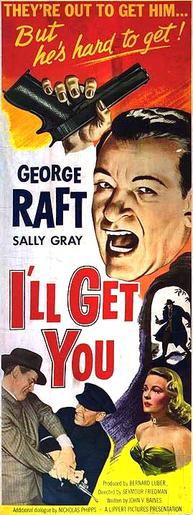
I’ll Get By- George Raft’s I’ll Get You A Film Review


DVD Review

From The Pen Of Sam Lowell

I’ll Get You, starring George Raft, Sally Gray, 1952


I have been running the rack on the old black and white film noir genre the past several years mainly grabbing stuff from the Netflix archives (“running the rack” a term learned in my pool hall days when I hung around with corner boys who hung around pool halls although I was never much of a player, mainly a hanger-on and bettor, a bettor against a guy like Red Radley who lost me more money than I could shake a stick at-not realizing until much later that Red was cheating, was threating murder and mayhem against whoever he was playing against and he was big enough to enforce his edicts). At this point since I have been pretty steady in my attempts to see plenty of them I have moved down, or been forced by Hollywood’s tastes to move down, the A classics like The Postman Always Rings Twice,  The Big Sleep, Out Of The Past and a few others and hit the B-films of late. Maybe B minus as is the case here in this police procedural out of London town I’ll Get You starring old time 1930s heavy gangster George Raft.

This time out Raft plays an undercover FBI guy working on an international kidnapping case in London. And if you are talking about FBI guys working on anything in the 1940s and 1950s then you are talking about something related to the red menace, the Cold War, the Soviet Union and its nefarious plans for world conquest (according to the Washington propaganda campaign and what did we know about such plans and if there such plans when it came right down to it) as the Cold War got icier as the decade after World War II went on. Here Raft, posing as a scientist after giving the Brits the slip entering London finally winds up working along with a fetching woman British agent (okay, okay, MI5) played by Sally Gray to find out what the hell happened to a few nuclear scientists who were abducted and sent behind the Iron Curtain. Sent there obviously to be grilled, and maybe more, by the bad guys who wanted to get the latest up-to-date information on whatever level the Americans had worked out making nuclear weapons even more deadly.    

Naturally the hook here has to be a sinister Mister Blank, Grand in the story line but everybody over the age of twelve knows that is strictly a front, an alias, who is manipulating the action behind the scenes and trying to keep the Anglo-American attempts to get the scientists back from succeeding. The whole story line is run as a bunch of cover plays and ploys with one side leading the other on wild goose chases until Raft pulls the hammer down. Naturally as well when there is a female agent involved whether here on in a James Bond vehicle there is romance in the air. Despite that slight diversion Raft and the boys grab the bad guys and all is well for a while-until the next turn in the Cold War battles. So you can see now why this one is a strictly B effort, not more. Got it.   


*****In The Hills And Hollows Again- With Mountain Music Man Norman Blake In Mind    


Recently in discussing Sam Lowell’s relationship with mountain music, the music from down in the hills and hollows of Kentucky where his father and his people before him had lived dirt poor, almost beyond dirt poor one they settled in and had forsaken any betterment by heading further west once the land gave out , land that they did not provide very good guardianship for since they made every mistake in the agricultural book before it turned to dust, for generations eking almost nothing out of the land that had been abandoned decades before by some going west driven spirits who played the land out and moved on, some moving on until they reached ocean edge California, Bart Webber noticed that he had concentrated a little too heavily on the music of Sam’ s father’s  Kentucky hills and hollows.

Sure a lot of the music came almost intact from the old country, old country here being some place in the British Isles, music that a guy like high Brattle Street Brahmin Francis Child collected and that if you give some serious attention to you will find that the core narratives presented there could be heard come any Saturday night Hazard red barn dance. But there were other places down south like in the Piedmont of North Carolina where a cleaner picking style had been developed by the likes of Etta Baker and exemplified more recently by Norman Blake who has revived the work of performers like Aunt Helen Alder and Pappy Sims by playing the old tunes. Some other places as well like down in the inner edges of Tennessee and Georgia where the kindred also dwelled, places as well where if the land had played out there they, the ones who stayed behind in there tacky cabins barely protected against the weathers, their lack of niceties of modern existence a result not because they distained such things but down in the hollows they did not know about them, did not seem to notice the bustling outside world.

They all, all the hills and hollows people, just kept plucking away barely making ends meet, usually not doing so in some periods, and once they had abandoned cultivating the land these sedentary heredity “master-less men” thrown out their old countries, like Bart mentioned mainly the British Isles, for any number of petty crimes, but crimes against property and so they had to go on their own or face involuntary transportation they went into the “black god” mines or sharecropping for some Mister to live short, nasty, brutish lives before the deluge.

But come Saturday night, come old Fred Brown’s worn out in need of paint red barn the hill people, the mountain people, the piedmont brethren, hell, maybe a few swamp-dwellers too, would gather up their instruments, their sweet liquor jugs, their un-scrubbed bare-foot children or their best guy or gal and play the night away as the winds came down the mountains. This DNA etched in his bones by his father and the kindred is what Sam had denied for much of his life.          

But like Bart had mentioned as well when discussing the matter with Sam one night sometimes “what goes around comes around” as the old-time expression had it. Take for example Sam Lowell’s youthful interest in folk music back in the early 1960s when it had crashed out of exotic haunts like Harvard Square, Ann Arbor, Old Town Chi Town and North Beach/Berkeley out in Frisco. Crashed out by word of mouth at first and ran into a lot of kids, a lot of kids like Sam, who got his word from Diana Nelson who got it from a cousin from North Adamsville nearer Boston who frequented the coffeehouses on Beacon Hill and Harvard Square, especially the famous "cheap date" Joy Street Club and Turk's Head on the hill and the equally "cheap date" Clue Blue and Club Nana in the Square after the Club 47 got too expensive once everybody and their brother and sister wanted to go there, who had “hipped” her to this new folk music program that he had found flipping the dial of his transistor radio one Sunday night.

See Sam and Diana were tucked away from the swirl down in Carver about thirty miles as the crow flies from Boston and Cambridge but maybe a million social miles from those locales and had picked up the thread somewhat belatedly. He, along with his corner boys, had lived in their little corner boy cocoon out in front of Jimmy Jack’s Diner figuring out ways to get next to girls like Diana but who were stuck, stuck like glue to listening to the “put to sleep” music that was finding its way to clog up Jimmy Jack’s’ hither-to-fore “boss” jukebox. Christ, stuff like Percy Faith’s Moon River that parents could swoon over, and dance to. Had picked the folk sound up belatedly when they were fed up with what was being presented on American Bandstand and WJDA the local rock station, while they were looking for something different, something that they were not sure of but that smelled, tasted, felt, and looked different from a kind of one-size-fits-all vanilla existence.

Oh sure, as Bart recognized once he thought about it for a while, every generation in their youth since the days when you could draw a distinction between youth and adulthood a century or so ago and have it count has tried to draw its own symbolic beat but this was different, this involved a big mix of things all jumbled together, political, social, economic, cultural, the whole bag of societal distinctions which would not be settled until the end of that decade, maybe the first part of the next. That big picture is what interested him. What had interested Sam then down there in in Podunk Carver about thirty miles south of Boston was the music, his interest in the other trends did not come until later, much later long after the whole thing had ebbed and they were fighting an unsuccessful rearguard action against the night-takers and he was forced to consider other issues. And Sam had been a fighter against what Che Guevara, a hero to Sam's generation and later ones too in desperate need of heroes when the night-takers went berserk, called the "the belly of the beast of the world's problems in America, ever after. 

The way Sam told it one night a few years back, according to Bart, some forty or so years after his ear changed forever that change had been a bumpy road. Sam had been at his bi-weekly book club in Plymouth where the topic selected for the next meeting was the musical influences, if any, that defined one’s tastes and he had volunteered to speak then since he had just read a book, The Mountain View, about the central place of mountain music, for lack of a better term, in the American songbook. He had along with Bart and Jack Dawson also had been around that time discussing how they had been looking for roots as kids. Musical roots which were a very big concern for a part of their  generation, a generation that was looking for roots, for rootedness not just in music but in literature, art, and even in the family tree.

Their parents’ generation no matter how long it had been since the first family immigration wave had spilled them onto these shores was in the red scare Cold War post-World War II period very consciously ignoring every trace of roots in order to be fully vanilla Americanized. So their generation had had to pick up the pieces not only of that very shaky family tree but everything else that had been downplayed during that period.

Since Sam had tired of the lazy hazy rock and roll that was being produced and which the local rock radio stations were force- feeding him and others like him looking to break out through their beloved transistor radios he had started looking elsewhere on the tiny dial for something different after Diana had clued him in about that folk music program. Although for a while he could not find that particular program or Carver was out of range for the airwaves. But like a lot of young people, as he would find out later when he would meet kindred in Harvard Square, the Village, Ann Arbor, Berkeley he fortunately had been looking for that something different at just that moment when something called folk music, roots music, actually was being played on select stations for short periods of time each week and so it was before long that he was tuned in.

His own lucky station had been a small station, an AM station, from Providence in Rhode Island which he would find out later had put the program on Monday nights from eight to eleven at the request of Brown and URI students who had picked up the folk music bug on trips to the Village (Monday a dead music night in advertising circles then, maybe now too, thus fine for talk shows, community service programs and odd-ball stuff like roots music to comply with whatever necessary FCC mandates went with the license.) That is where he first heard the likes of Bob Dylan, Joan Baez, Tom Paxton, Dave Von Ronk, a new guy named Tom Rush from Harvard whom he would hear in person many times over the years, and another guy, Eric Von Schmidt whom he would meet later in one of the Harvard Square coffeehouses that were proliferating to feed the demand to hear folk music. Those coffeehouses were manna from heaven, well, because they were cheap for guys with little money. Cheap alone or on a date, basically as Sam related to his book club listeners for a couple of bucks at most admission, the price of a cup of coffee to keep in front of you and thus your place, maybe a pastry if alone and just double that up for a date except share the pasty you had your date deal all set for the evening hearing performers perfecting their acts before hitting the A-list clubs.

He listened to it all, liked some of it, other stuff, the more protest stuff he could take or leave depending on the performer but what drew his attention, strangely then was when somebody on the radio or on stage performed mountain music, you know, the music of the hills and hollows that came out of Appalachia mainly down among the dust and weeds. Things like Bury Me Under The Weeping Willow, Gold Watch and Chain, Fair and Tender Ladies, Pretty Saro, and lots of instrumentals by guys like Buell Kazee, Hobart Smith, The Charles River Boys. Norman Blake just starting his rise along with various expert band members to bring bluegrass to the wider younger audience that did not relate to guys like Bill Monroe and his various band combinations, and some other bluegrass bands as well that had now escaped his memory.

This is where it all got jumbled up for him Sam said since he was strictly a city boy, made private fun of the farm boys, the cranberry boggers, who then made up a significant part of his high school. He furthermore had no interest in stuff like the Grand Ole Opry and that kind of thing, none. Still he always wondered about the source, about why he felt some kinship with the music of the Saturday night red barn, probably broken down, certainly in need of paint, and thus available for the dance complete with the full complement of guitars, fiddles, bass, mandolin and full complement too of Bobby Joe’s just made white lightening, playing plainsong for the folk down in the wind-swept hills and hollows.  

Then one night, a Sunday night after he had picked up the Boston folk program station on the family radio (apparently the weak transistor radio did not have the energy to pick up a Boston station) he was listening to the Carter Family’s Wildwood Flower when his father came in and began singing along. After asking Sam about whether he liked the song and Sam answered that he did but could not explain why his father told him a story that maybe put the whole thing in perspective. After Sam’s older brother, Lawrence, had been born and things looked pretty dicey for a guy from the South with no education and no skill except useless coal-mining his father decided that maybe they should go back to Kentucky and see if things were better for a guy like him there. No dice, after had been in the north, after seeing the same old tacky cabins, the played out land, the endless streams of a new generation of shoeless kids Sam’s father decided to head back north and try to eke something out in a better place. But get this while Sam’s parents were in Kentucky Sam had been conceived. Yeah, so maybe it was in the genes all along.          


Out In The 1950s L.A. Noir Night-Samuel Fuller’s The Crimson Kimono


DVD Review

From The Pen Of Zack James

The Crimson Kimono, starring Victoria Shaw, James Shigeta, Glenn Corbett

Sam Lowell, now that he had turned the day to day operations of his small law office to a younger associate, had during the previous couple of years been deep in the search for old time black and white films, mainly film noir, that he had seen as a kid growing up in Carver down in southeastern Massachusetts at the local Majestic Theater on Thornton Street. The main vehicle for igniting that interest had been through Netflix, either grabbing DVDs or by streaming, although many of the films that interested him were not available on that latter source. At some point he had run through what he called the primo classics, the ones that make the top one hundred Hollywood films of all time like Sunset Boulevard, Casablanca, To Have and Have Not, Double Indemnity,   The Big Sleep, Out Of The Past, The Maltese Falcon stuff like that. He then started going after what he, and Hollywood critics as well, would call B films, films made on a shoestring or which just didn’t have enough storyline, good acting or cinematography to make that primo list.

As usual there was plenty more B material around than classics especially from that black and white film era when the crush for double-feature films every week or so led to some cutting of corners. The film under review, Sam Fuller’s The Crimson Kimono, is just such a film although it does have a twist that you generally did not see in Hollywood films in the hard-boiled red scare Cold War 1950s night.

Usually Sam would just grab a DVD, look at it, maybe write a few hundred words about some aspect of the film that interested him, storyline, acting, camera work, or when he wanted up front and personal one and all to know he had panned had it. The Crimson Kimono though although thin on the acting by well-known B actors had a twist that he wanted his friend from high school days in Carver, Bart Webber, who also had some interest in those black and white films since he would when younger accompany Sam on Saturday afternoons to the double-feature at the Majestic. (Later, in high school, when going to the movies was the essence of a cheap “hot date” with some girl of interest each man had to fend for himself although they occasionally double-dated in the “pits,” the balconies at night so-called for obvious reasons.)

One night Bart went on one of his periodic visits from Carver where had had resided almost all of his life up to Cambridge where Sam lived to go to Jack’s and have a few drinks and talk about whatever there was to talk about. That night Sam was hot on the trail of discussing what he had thought of The Crimson Kimono. Here’ what Sam had to say when Bart told me about it later:         

How are you going to hate a movie, a film noir even, a police procedural, that was set in Los Angeles, not in the flamed out 1940s slumming streets of The Big Sleep and other Raymond Chandler classics but the 1950s when the place was starting to jump from a sleepy old town of the homegrown, Okies, Arkies and whoever else hightailed it out of wherever they were from to get to the “garden of Eden.” So you got the sprawl as backdrop but also since you were dealing with tinsel-town, Hollywood, you also got the refuge, the fates of those who did not make it up onto the big screen but still had nowhere else to go after they busted flat or else preferred to slum it than go back to Peoria or Lima, Ohio or wherever they hailed from. That too is the back-drop to the town’s seamy side. Here’s an add-on though and this is what will eventually separate this film out a bit from others for we get a look, a small but positive look, at L.A.s Japan Town. That in itself would be worthy of note because remember the Pacific War was still pretty fresh in everybody out on the West Coast’s mind and remember too most of those denizens of Japan Town also had etched into their brains that they were different-were different enough in World War II to wind up in the concentration camps set up in the West.       

Who knows where an urban ethnic enclave ends and where the low-life haunts begin. Remember when we used to come up to Boston to see the strip shows in what they rightly called the Combat Zone right next to the squabble of Chinatown. Well in L.A. the strip joints and “clip” joints, really the same thing as you know, were adjacent to Japan Town. One night one of the strippers, this Sugar Torch, a looker and with a bumps and curves shape that guys in the ‘50s were crazy for wound up, after fleeing for her life, dead, very dead, from a couple of slugs on the seamy streets of L.A.

Naturally the coppers, buddies who had been in Korea and now roomed together, in this case a white cop, played by Glenn Corbett, a good-looking guy who played cop and detective parts with a sneer, who you probably have seen in a few of these B films, and get this, a Japanese cop, played by Jimmy Shigeta, who are called on to investigate the murder ran into a few dead ends before they figured the thing out, or rather got the thing figured out for them. See this honey, this Sugar Torch, was looking for a new gimmick, a new tease to replace the one she had been doing which was getting old fast with the regular customers. So she planned to do some exotic Geisha girl strip. Of course she was clueless about anything Japanese so she went to the library where one of the librarians, a guy, Hansel, helped her get the details down right. That was our Sugar’s fatal mistake though. This Hansel’s girlfriend, a wigmaker, thought old Sugar was making a play for Hansel and got gun happy. No way but that was how the deal went down, how things played out for motive on this one.

Along the way the cops had brought in a student artist, Christine, played by Victoria Shaw who seemed too old and mature to be a student, but who knows, to make a sketch of the supposed murderer, who everybody thought was Hansel. No go-it was the girlfriend like I said. She got antsy about what Hansel might say once the cops grabbed him. She started firing away. Here’s a strange part after the Japanese cop gunned her down she laid on the seamy street just like the stripper-in a heap. I figure that was Sam Fuller going for effect.             

Here is where this one is a little different from most police procedurals, most noir too, since they usually want to hone in on the murder and mayhem part. In this though solving the murder is kind of backdrop to the main action-the triangle love affair business. See this student artist Christine was a looking, smart too, so first Glenn took a run at her, figured he had it made, then Jimmy took a run as well. That part, the racial part, which gets a big play when the two cops finally realize what was happening, is what separates this one out because in the end the Japanese guy wins the hand of the fair Wasp maiden. Go figure in the 1950s

Tuesday, January 5, 2016

Wasn’t That A Time-With Woody Allen’s Midnight In Paris In Mind


From The Pen Of Zack James 

Sam Lowell, who had usually an easy going guy when not preoccupied with his profession, his lawyerly profession, was frustrated. No, better, was, had been, beside himself with frustration for a fairly long time. He had, as he wound down the management of the day to day operations of the small independent law firm that he had helped start with a fellow law school student, Ben Ames, decided that finally he could begin to pursue an avocation as a writer that he had been eager to do since high school. Back then the war, the Vietnam War if anybody is asking, intervened, and had caught him up in the draft call and after his tour of duty into the counter-culture night around San Francisco which had set him back several years when he couldn’t/did not want to face the return to the “real” world for a while.

More than that Sam found as he foundered and as his new “real” world foundered that he needed to move on. Moving on in the direct sense by taking up the law career that his mother, grandfather and several others had been harping on him since his youth. But he still hankered after that idea of being a writer, being a writer maybe in Paris, San Francisco, or some other town where blossoming the written word counted, counted a lot. But time and tide had passed that idea by and it had only been the previous decade or so that he got back to writing just for the hell of it.

Fortunately the times he choose to come back in were very propitious for amateur writers, writers who were not making their livelihoods trying to eke out a living at so many words per day. He had over the course of that decade, first very sporadically then more consistently, joined several writing-oriented blog and other self-publishing enterprises.        

That return to recreational writing however was really what Sam had been frustrated by. Or rather as he took his writing more seriously he realized that he had come to a block in the road, not a writer’s block fortunately because one way or another he could still produce the words, sometimes a torrid of words, but an understanding that he would always be a first rate third rate writer as somebody back in the day had said about some public servant whom the person who said the words was trying to smear.

This is the way Sam explained it to his long-time companion Laura, Laura Perkins, who had encouraged him in his writing as best she could. He had just written a short story based on a few episodes in the current love life of his old schoolboy friend, Bart Webber, from Carver where they grew up together. Bart had had a short torrent affair with a fellow student in their class, Melinda Loring, whom he had rekindled a relationship with after their 50th anniversary class reunion. The affair, in the end, floundered on Bart’s inability to meet Melinda’s demands that they think about marriage which Bart, having suffered through three failed marriages (and more alimony, child support and college tuitions than any man should have rightly been required to do in that loveless legal world Sam inhabited along with some nasty judges),    was adamantly against, although he was open to the idea of living together or some such non-legal arrangement. Bart’s position set off a firestorm from which the relationship could never recover.

Bart, in telling Sam the details of the split up between him and Melinda, mentioned that he suddenly realized what the author Thomas Wolfe meant when he titled one of his books You Can’t Go Home Again. That idea, that hook, the notion that in some things you cannot go back stirred Sam into the thought of writing up a sketch, duly fictionalized, about Bart’s affair as some kind of cautionary tale for the generation of ‘68 now filled with plenty of regrets and sorrows about their pasts-and time to think about them as well. Bart agreed, although he was skeptical that anybody could learn anything from the exposition. In any case Sam wrote the piece up, about three thousand words, let Bart look it over and make corrections as well as check for any incidents revealed that might be tied to anything real that had happened in the Bart-Melinda relationship.

Bart satisfied, Sam sent the piece to various publishing outlets where there was a certain small interest expressed in publishing the story especially by one young female editor. It was a comment by that editor, Julie Stern, which riled Sam and set off his latest round of frustration. She said that the way he wrote the story, the way he defended his protagonist Jack Callahan, the piece as a whole read like, and this is a direct quote, “the closing argument of legal brief.”          

Initially stung by the comment Sam later, after several days’ reflection, realized that Julie was right, was right not only about that piece which she had read but after looking over some of his other earlier writings he had the same sense that she was onto something. All the years of dry legal writing had atrophied his creative writing skills, had left him thinking strictly inside the box. Had made him realize that he was a prime example of that first rate third rate writer he dreaded that he might become when he was young despite his junior and senior year English teacher, Miss Soros, at Carver High encouraging him in his creative endeavors.        

Sam thought it was funny that back in high school he had had such creative bursts, had stirred Miss Soros and his classmates with a few of his efforts mostly about the absurdities of teenage life, angst and alienation. He had fashioned himself, maybe imitated is a better word, after various heroic writers that he had read. In those days he was crazy for Ernest Hemingway’s sleek style, meaning crisp dialogue, clear short sentences yet with words that were power-packed to descript not only the action of the story but the environment in which the characters worked out their particular problems. Sam had been crazy to study about the Spanish Civil War after he had picked that event as the subject of his first term paper in high school. Along the way he found out that many Americans, not all of them communists or socialists, had supported the Republican side against the Nazi-infested Fascists and that Hemingway was one of them. Had written For Whom The Bells Toll as a result of his experiences (Sam would not find out until later that the American Communist Party and the Abraham Lincoln Battalion of the International Brigades were not at all happy about Hemingway’s work on that book, its’ what would be today called its political incorrectness. Many years later when he had run into a veteran of the Lincolns at a conference at Brandeis where the Lincoln Archives were housed he had been still incensed that Hemingway had slighted them.

Sam had not known Hemingway’s work before his efforts around his term paper except maybe some film adaptation of one of his short stories, The Killers, but he was in thrall ever after, thought everybody wherever they might end up on their literary journeys should write following his style. Naturally, something that Sam was inclined to do when he was “hot’ on a writer he would read (and re-read later several times) all Hemingway’s works that he could get his hands on. Never could then though figure out why a guy who could write like a whirling dervish, a mad monk if you don’t like the dervish description, took his own life. That was then and like in a lot of things later Sam could understand that a person with declining stamina, some form of writer’s block, and a feeling that his best work was behind him, could take that way out. Not a way Sam’s would be inclined to take for those reasons since a first rate third rate writer would only bring laughter from the crowds upon himself if he fancied himself enough of a driven writer to contemplate that.    

Jesus, Sam thought, thinking back to the time when he first heard about how guys like Hemingway and Fitzgerald abandoned the vacuity of post-World War I America for the bright lights of Paris, or France anyway. Yeah, if Hemingway gave Sam pause on style then Fitzgerald was the master of the narrative, of telling a great story letting the reader sink beneath the pauses. Like the first time he read The Great Gatsby and realized that Jay Ganz was just like a lot of guys he knew, corner boy guys who had big dreams. Except Jay driven did more than dream about what he wanted. He had had to read that famous last page about the Dutch sailors reaching the New World around New York Harbor way and seeing the possibilities of the fresh new start once they had seen that unsullied “fresh green breast.”  Yeah, Fitzgerald knew a certain milieu and worked that minefield for all it was worth.

As Sam dozed off a bit while thinking about all the great literature around, all the stuff that was worthy of being read he was dazzled by the progression of great writers who had influenced him at various time. Thomas Wolfe, Edith Wharton (even though he was not at all familiar with Brahmin life), Dorothy Parker and her Big Blonde, the max daddy detective story writers Raymond Parker and Dashiell  Hammett (who Sam swore learned their dialogue  craft from Hemingway after reading The Maltese Falcon  and the Big Sleep by them) and a whole bunch of others. And now he is to go without a bang but with a whimper, maybe better a sigh. Sighs the fate of first rate third rate writers.

From The Music Archives-Richard Thompson's Vincent Black Lightning, 1952


From The Pen Of Joshua Lawrence Breslin:

Several years ago, maybe about eight years now that I think about it, I did a series of sketches on guys, folk-singers, folk-rockers, rock-folkers or whatever you want to call those who weened us away from the stale pablum rock in the early 1960s (Bobby Vee, Rydell, Darin, et al, Sandra Dee, Brenda Lee, et al) after the gold rush dried up in what is now called the classic age of rock and roll in the mid to late 1950s when Elvis, Jerry Lee, Buddy, Chuck, Bo and their kindred made us jump. (There were gals too like Wanda Jackson but mainly it was guys in those days.) I am referring of course to the savior folk minute of the early 1960 when a lot of guys with acoustic guitars, some self-made lyrics, or stuff from old Harry Smith Anthology times gave us a reprieve. The series titled Not Bob Dylan centered on why those budding folkies like Tom Rush, Tom Paxton, Phil Ochs, Jesse Winchester and the man under review Richard Thompson to name a few did not make the leap to be the “king of folk” that had been ceded by the media to Bob Dylan and whatever happened to them once the folk minute went south after the combined assault of the British rock invasion (you know the Beatles, Stones, Kinks, hell, even Herman’s Hermits got play for a while),   and the rise of acid rock put folk in the shade (you know the Jefferson Airplane, the Dead, The Doors, The Who, hell, even the aforementioned Beatles and Stones got caught up in the fray although not to their eternal musical playlist benefit). I also did a series on Not Joan Baez, the “queen of the folk minute” asking that same question on the female side but here dealing with one Richard Thompson the male side of the question is what is of interest.

I did a couple of sketches on Richard Thompson back then, or rather sketches based on probably his most famous song, Vincent Black Lightning, 1952 which dove-tailed with some remembrances of my youth and my semi-outlaw front to the world and the role that motorcycles played in that world. Additionally, in light of the way that a number of people whom I knew back then, classmates whom I reconnected on a class reunion website responded when I posed the question of what they thought was the great working-class love song since North Adamsville was definitely a working class town driven by that self-same ethos I wrote some other sketches driving home my selection of Thompson’s song as my choice.

The latter sketches are what interest me here. See Thompson at various times packed it in, said he had no more spirit or some such and gave up the road, the music and the struggle to made that music, as least professionally. Took time to make a more religious bent to his life and other such doings. Not unlike a number of other performers from that period who tired of the road or got discourage with the small crowds, or lost the folk spirit. Probably as many reasons as individuals to give them. Then he, they had an epiphany or something, got the juices flowing again and came back on the road.  That fact is to the good for old time folk (and rock) aficionados like me.

What that fact of returning to the road by Thompson and a slew of others has meant is that my friend and I, (okay, okay my sweetie who prefers that I call her my soulmate but that is just between us so friend) now have many opportunities to see acts like Thompson’s Trio, his current band configuration, to see if we think they still “have it” (along with acts of those who never left the road like Bob Dylan who apparently is on an endless tour whether we want him to do so or not). That idea got started about a decade ago when we saw another come-back kid, Geoff Muldaur of the Jim Kweskin Jug Band, solo, who had taken something twenty years off. He had it. So we started looking for whoever was left of the old folks acts (rock and blues too) to check out that question-unfortunately the actuarial tables took their toll before we could see some of them at least one last time like Dave Von Ronk.

That brings us to Richard Thompson. Recently we got a chance to see him in a cabaret setting with tables and good views from every position, at least on in the orchestra section, at the Wilbur Theater in Boston with his trio, a big brush drummer and an all-around side guitar player (and other instruments like the mando). Thompson broke the performance up into two parts, a solo set of six or seven numbers high-lighted by Vincent Black Lightning, and Dimming Of The Day which was fine. The second part based on a new album and a bunch of his well-known rock standards left us shaking our heads. Maybe the room could not handle that much sound, although David Bromberg’s five piece band handled it well a couple of weeks before, or maybe it was the melodically sameness of the songs and the same delivery voice and style but we were frankly disappointed and not disappointed to leave at the encore.  Most tunes didn’t resonant although a few in all honesty did we walked out of the theater with our hands in our pockets. No thumbs up or down flat based on that first old time set otherwise down. However, damn it, Bob Dylan does not have to move over, now.  Our only consolation that great working-class love song, Vincent Black Lightning, still intact.

Which brings us to one of those sketches I did based on Brother Thompson’s glorious Vincent Black Lightning. When I got home I began to revise that piece which I have included below. Now on to the next act in the great quest- a reunion of the three remaining active members of the Jim Kweskin Jug Band, Jim Maria Muldaur, and of course Geoff at the Club Passim (which traces its genesis back to the folk minute’s iconic Club 47 over on Mount Auburn Street in Harvard Square. We’ll see if that gets the thumbs up.