Monday, December 28, 2015


In The Time Of B-Film Forgotten Noir-Fingerprints Don’t Lie-Do They? 


DVD Review

From The Pen Of Sam Lowell

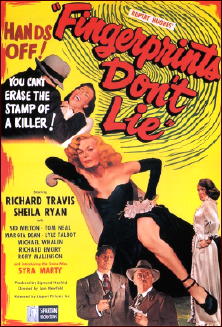
Fingerprints Don’t Lie, starring Richard Travis, Sheila Ryan, 1951


FINGERPRINTS DON'T LIE


Well of course since we are in the age of science, the age when various rational ways of investigating phenomena is much preferred over vacant daydreaming, ideology or acts of God. This same process applies to the investigation of criminal activity since despite the advances of humankind we are still stuck with crime and the criminal mind. Plus we have come a long way, at least I used to think we have come a long way from using racks, thumbscrews and such as the way to separate the guilty from the innocent although lately that proposition has been turned on his head more times than I like to remember. All of this by way of looking at the scientific method of fingerprinting which in its time represented that advance over thumbscrews and dark jail cell beating to get a confession from the innocent or the guilty that I just mentioned in the film under review whose title tells the tale here, Fingerprints Don’t Lie.   

Everybody knows, or should know, that each person’s fingerprints are essentially unique and for law enforcement purposes if you can match a set of a suspect’s prints with some object involved in a crime well then it is only a question then of how long a jail sentence, or how quick the big step off in the big house when the lights go dark, will be if you capture that miscreant. This film despite its title turns that proposition on its head, for a while. See Matt, who is in love with the Mayor of Gotham City’s daughter, had a beef with the good mayor over his martial intensions with that mayor’s daughter. Here is  where Matt gets into trouble though, gets himself set up for the big step off, because he was the last person seen leaving the mayor’s office the night of the beef. Problem: the mayor turned up dead, very dead the next morning and guess who the prime suspect is. And the basis for that suspicion and subsequent trial where Matt falls down for the count, is going to the big house to await his terminal fate was a set of fingerprints found on the telephone that turned out to be the murder weapon.       

Here is where Matt is both hung out to dry and eventually cleared. The fingerprint expect, Robert Jordan, testified in open court that the set on the telephone matched Matt’s. Done. Done, despite the fact that Matt endlessly proclaimed his innocence. But don’t they all. I guess though that the mayor’s daughter Theresa bought Matt’s story and begged Jordan to see if he had made an error. Now most guys, most fingerprint guys, men of science guys, women of science too, would have blown her off but Theresa’s begging finally payed off. Once Jordan saw the possibility of error, went beyond the hard fingerprints on the telephone angle he went might and main to figure it out. To not leave you guessing since where love is involved no way a good-looking kid like Matt is going to take the fall, not in Hollywood in the 1950s, it turned out that the old regime police commissioner the Mayor had been elected to root out, Jack Callahan, figured as the villain. See as the old story goes Jack had some frail he was playing around with and needed plenty of dough, and to keep his job (which as anybody but a goof knows includes plenty of graft) to keep her in style. So Jack fudged the evidence, did some scientific mumbo-jumbo of his own. Naturally rather than take the fall, take the big step himself he tried to escape when he was cornered with the evidence. But Jordan not only was handy with an inkpad but with a rod and wasted the guy. So if anybody asks you if fingerprints don’t lie you can say that they do not-except sometimes.     

Some Guys Just Don’t Like Women-A Lot- The Sniper- A Film Review


DVD Review

From The Pen Of Sam Lowell

The Sniper, starring Adolph Menjou

I have been running the rack (a term learned in my pool hall days when I hung around with corner boys who hung around pool halls although I was never much of a player, mainly a hanger-on and bettor against Red Radley making many combinations and lost my shirt many times but in the long haul probably break a little less than even) on the old black and white film noir genre the past several years mainly grabbing stuff from the Netflix archives. At this point since I have been pretty steady in my attempts to see plenty of them I have moved down from, or been forced by Hollywood’s tastes to move down, the A classics like The Postman Always Rings Twice,  The Big Sleep, Out Of The Past and a few others and have hit the B-films of late. Maybe B minus as is the case here in this police procedural The Sniper.   

It is not that the subject matter is not important here, a surprising 1950s film which deals with a serious social issue-a man’s hatred, hatred to the point of murder, his social pathology against women just because they are women. So yes an attempt to deal with a social problem. The problem is that we get a very little, and that indirectly about what made our sniper, Jeff Mullins, go out and target, and I mean that literally, women for serial destruction. What we get is plenty of the police procedural part, the part where there is a maniac on the loose and the cops led by Inspector Dubois (played by Adolph Menjou in the twilight of his career) are one, maybe two steps behind until Jeff’s torment leaves him totally distraught. So when our cleansers’ delivery man, Jeff’s daytime job which allows him access to many women’s homes and to scout things before he totally goes off the wall and just randomly plucks them off the street, who had a previous history of torment and had been institutionalized goes on his spree the good Inspector and his men go out to try to figure this one out. They do in the end but I am still baffled by the lack of insight into why the guy was doing those serial shootings. I’ll  pass on saying more on this one.          

Sunday, December 27, 2015

*****Lady Day Is In The House-With Torch Singer Billie Holiday In Mind


From The Pen Of Josh Breslin 
 
 
I remember one day many years ago now, although it could have been any number of years before or since given the woman who I want to talk about, talk about Lady Day, and how she made me feel better about things, about blue things going on in my life those many years ago that I am thinking of, or many years before or many years after that. By the way although I know that this is confessional age, an age when every emotion seemingly has to be publicly wrought out over no matter how private this is not about my blues, or not much but about the lady in question, Lady Day helped chase some of them away and I will leave it to the reader to decide whether I am running a confessional scene like some errant Catholic schoolboy, a faith that I grew up in incense and high Latinisms and all but which probably was trumped by that finer Irish Catholic grandmother heritage of not "airing the damn, her term, family's or your dirty linen in public." Yeah, I do believe the latter prevailed in the long haul. So, yes, I want to talk about a woman whom I never knew personally since she was of my parents generation and thus removed by at least a generation from any possibility of being a direct influence unlike my Olde Saco, Maine corner boys, was hanging out in New York City a place I never went to until my high school years long after she was a shade and was black a condition that would not have played well in that Irish Catholic grandmother-etched neighborhood where I grew up. Had moreover had never been that aware of her as a performer although I believe I heard her one wisp of a time on the Ed Sullivan Show but don’t quote me on that.

Yeah, talk about how a lady from my parents time, from a foreign city and a foreign color chased away my blues, unlike a number of women who I have known from my own time and place, and white too, Irish Catholic red-headed women mostly who have given me endless heartache (although having grown up in a different time and eventually place than grandmother's Irish Catholic-etched Olde Saco neighborhood streets I did had a couple of black women who gave me that same endless heartache), more than once before that day I am thinking about and did so after. This particular day Lady Day came in very handy, it must have been a winter day for sure since I still can feel the frosty feeling, the snow whirling outside and inside my brain I had while the events were unfolding.

So add that to the depression I was feeling over the latest serious quarrel I had had with my wife, the chill and bluster of that winter day had me down as well, as I entered a bookstore in Harvard Square, I think the Harvard Bookstore which is still there although it could have been the Paperback Book Smith which is long gone as Square fixture. That wife very soon thereafter to be my ex-wife, an ex-wife who with her alimony demands and child support would continue to have plenty to do with my blues for a long time thereafter, but who just that moment had plenty to do with the particular depression I felt that time so don’t blame the winter for that, but don’t ask for the particulars of the dispute, that time, that is another story, a story already done and wrapped up in a bow. And don’t blame Billie for either the cold or subsequent divorce since people have blamed Billie enough for what ails them and I have come today to honor that fresh flower lady day.

Now that I think about it on that blustery day I have it ass backwards I think I was entering the old long gone Paperback Booksmith store but it might have been the still there Harvard Book Store up the street so don’t hold me to the particular bookstore just know that it was a bookstore, in Harvard Square, in the cold raw winter (and you know about the depression part so onward).

In any case that is the day and place where I heard this low sad torchy female voice coming out of the sound system most of those places had (have) to liven things up while you were (are) browsing (or “cruising” as I found out later when somebody told me bookstores were the “hot” spot if you were looking for a certain kind of woman [or man], needless to say my kind of woman, bookish, sassy and, well, a little neurotic but the dating circling ritual among the bookish, sassy whatevers is also a story for another day). 

A smoky voice for smoky darkly lit rooms where the smoke hangs on the walls through daylight but best seen in low wattage light  and where romances might burst open (or at least be an inexpensive cheap date at a couple of cups of coffee and a pasty or a couple of glasses of sweet red wine hopefully not just out of the press and more hopefully loosen her up, loosen up that hot date you had been moving heaven and hell to get to for weeks,for the night’s anticipations) reminding me of cafés and coffeehouses in places like New York, Boston, San Francisco. New York around the Village when smoking was “cool,” when cigarettes smokers like me (heavily at times especially whisky drinking or dope pulling times all now mercifully quieted) ruled the roost with regulation butt hanging out of side of one's mouth in the old con man or French gangster imitating Chicago gangster style (and now pity for French style smokers now banished, now desperate refugees in the outer edge of the outdoor café tables, rain or shine, destroying the whole noir cinema night).

When smoky rooms lived and jazz (okay, okay jazz and some rarified urban blues too not the country bumpkin Delta kind every black person who could follow the northern star was fleeing from to break Mister James Crow’s grip) was king and such a rasp-edged cut the air with a knife voice would be  swaying in the background amidst the cling of glasses, small wine glasses bulb-like with slender stems filled maybe one third of the way with some house blend (again hopefully not newly pressed) and sturdy whisky shot glasses which spoke of hard-edged ethnic enclaves, workingmen drowning themselves in sorrows to break the hunger sorrows of their lives and their sons taking right up where they left off except maybe since café prices unlike men’s taverns were dear sipping the edges of the glass more slowly. A voice to cut through the edge of the air around the small murmurs of collective voices (two, three, four but an uncomfortable fit to a table times whatever number Bob, Ray or Sam could squeeze into the space without the fire marshal raising hell about capacity or asking for a bigger extortionous pay-off)  talking of the news of the day (Jesus, that damn war is starting to heat up), the current hardship of life (Christ, the damn rent man was looking for his draw and I barely culled him out of the damn thing), the latest lost romance (divorces, two-timings, will write when I get a chance, waiting by the midnight phone the damn thing growing out of the ear waiting for that prisoner’s one call) or just cheesy chitchat. Yeah just the dross of daily life until the singer (you already know who she is because I set it up that she is smoky-voiced, can cut the air with the damn thing), yeah, until she hits that high white note and for one second, maybe today the time a nanosecond but whatever the count the room is silent, no glasses tinkling (some slender dame almost ready to put the stem of the glass to her mouth, some guy, maybe Red Radley who was famous for the slow whisky sipping and all of the bartender in town dreaded his appearance at their doors because he would take up a table or a stool and the tip would be nada), no dishes clanging (those pastries with two forks almost gone and the parties asking why they had bothered to order the damn thing since it tasted like last week’s stale remainders at some Salvation Army Harbor Lights retreat, which I can tell you is pretty stale, no voices chattering their hearts out (that midnight waiting suspended in the air) but stopped against that neck-turning sound.

The hushed patrons searching the dark smoky night for the source finally fixing in on an ill-lit stage, a joke of a stage put together slap-dash, a few boards, a little varnish, raised just enough to see whoever was performing, hell, to see Lady Day performing she was practically indentured to the owner since he had advanced her seven weeks pay when she had to see the “fixer man” to get well, in order not to cut down on the number of café tables that could be squeezed into the space, a third-rate bass player strumming his beat message (that’s all Harry could afford he said then ranting about the musicians' union scale but what were you going to do  otherwise she would have to hoof it alone), likewise the pitter-patter of the second-rate drummer not playing too loudly in order avoid drowning out the voice in front of him (see he had been her lover before that “fixer man” became her true lover, gave her that smoky voice, let the night air be cut by her voice), and a first-rate big sexy sax man (a second cousin to Johnny Hodges and so had something big and high white culled in his genes) blowing his brains out and mentally taking note that amid the clutter of daily life, the insolvability of the hardships and the need to go on to find the next romance that for that one moment those concerns were suspended.

Yeah, a voice, now that he had been through his own troubles with sister cocaine (hence the knowledge of slow whisky sipping a la Red Radley, Salvation Army Harbor Light retreats, and if you could get through the “detox” then the screwy message they had to spread the gospel that you had to listen to and no Sky’s Miss Sarah Brown all pert, petite, and pious, and of waiting around midnight phones after the twelfth “cure” had not taken and your own Miss Sarah Brown has abandoned ship, has moved onto some other Eddie whose only virtue, and maybe no virtue was that he was not you, that his nose was clean [a pun] and that she would at least have a breather until whatever fatal weakness he was hiding took hold) having just an edge fortified by some back room dope (she was trying to ease off “boy”, H, heroin to the squares and so the “fixer man” was squeezing sweet cousin cocaine into her brain) to break the monotony of the day (and who knows maybe the life, maybe of everything that had led her to this dark, ill-lit stage filled with too many tables, no room to breathe, no drink in hand to get through the numbers until the break as her cousin was wearing off after that early rush) with its phrasing (strange how the phrasing separated out those who could reach that high white note, not every night like this night for she would know but the silence, by the absence of glass clanging, the shuffling of dishes, the small murmurs all in suspension except those clouds of smoke rising to meet her, and her wishing to chase down that damn drink with a nice mellow cigarette to calm her fucking nerves), pleading with you like in some biblical battle between heaven’s angels and hell’s like something old revolutionary divine John Milton would think up but which she just the deliverer of high white notes not some literary light to take your blues away.

Like in that second (okay to be all up to date nanosecond) aside from whatever the dope that was still running round her brain could do she had a space there in that frail shimmering body with its pit-marked skin that could end that fucking war, could make that rent man disappear, could sent that guy a dime to drown that midnight phone madness, hell, could make the decision between red or white for the living room walls, to solve your pain, to take yours on, and get rid of hers.  

Not placing the alluring voice in that bookstore that day since my torch singers of choice then were the likes of Bessie Smith, Dinah Washington, Eartha Kitt, Helen Morgan, or Peggy Lee I asked one of the clerks who the person who was singing that song, the old Cole Porter tune, Night and Day with such sultry, swaying feeling on the PA sound system. She, looking like a smarmy college student, probably a senior ready to graduate and enlighten us, the heathens some way, and therefore wise to the worldly world who didn’t mind the job she was doing while waiting for her small change fame but was not in the habit of answering questions about who or what was being played over the loudspeaker since she had been hired to cater to help patrons find where such-and-such a best seller, academic, or guide book was located, looked at me like I was some rube from the sticks when she said Billie Holiday, of course (and she could have added stupid, which is what that look meant).      

Now that event was memorable for two things, listening to that song and a follow-up one, All of Me (which she did not hit the high white note on in that PA version), almost immediately thereafter got me out of my funk despite the fact that the subjects of the songs were about love, or romance anyway, something I was at odds with just that moment (remember the wife, ex-wife business). The other, as is my wont when I hear, see, read something that grabs my attention big time also was the start of my attempt to get every possible Billie Holiday album or tape (yeah, it’s been a while since that wintry day of which I speak) I could get my hands on. So thereafter any time that I felt blue I would put on a Billie platter or tape and feel better, usually.

In my book, and I am hardly alone on this, Billie Holiday is the torch singer's torch singer. Maybe it is the phrasing on her best songs (like I heard in that first song that got me thinking back to old time cafes and coffeehouses). That well-placed hush, the dying gasp. The hinted fragrant pause which sets the next line up. Maybe it is the unbreakable link between her voice when she is on a roll and the arrangements which with few exceptions make me think whoever else might have been scheduled to cover the song the composer had Billie in the back of his or her mind when they were playing the melody in their heads. Hell, maybe in the end it was the dope that kept her edge up but, by Jesus, she could sing a modern ballad of love (Cole Porter show tunes, Irving Berlin goof stuff, Gershwin boys white boy soul), lose, or both like no other.

And if in the end it was the dope that got her through the day and performance, let me say this- a “normal” nice singer could sing for a hundred years and never get it right, the way Billie could get it right when she was at her best. Dope or no dope. Was she always at her best? Hell no, as a review of all her recorded material makes clear. Some recordings, a compilation, for example, done between 1945 and her death in 1959 for Verve show the highs but also the lows as the voice faltered a little and the dope put the nerves over the edge toward the end.

Here is the funny thing though, no, the strange thing now that I think about the matter, the politically correct strange thing although those who insist on political correctness in everyday civil life should lay off anybody’s harmless cultural preferences and personal choices if you ask me. One time I was touting Billie’s virtues to a group of younger blacks, a mixed group, who I was working with on some education project and the talk came around to music, music that meant something other than background noise, other than a momentarily thrill and I mentioned how I had “met” Billie and the number of times and under what circumstances she had sung my blues away when times were tough. A few of these young blacks, smart kids who were aware of more than hip-hop nation and interested in roots music, old time blues, Skip James on the country end and Howlin’ Wolf on the city end, to an extend that I found somewhat surprising, when they heard me raving about Billie startled me when they wrote her off as an empty-headed junkie, a hophead, and so on. Some of their responses reflected, I think, the influence of the movie version of her life (Lady Sings the Blues with Diana Ross) or some unsympathetic black history ‘uplift,’ “you don’t want to wind up like her so keep your eyes on the prize and stay away from dopers, hustlers, corner boys and the like, or else” views on her life that have written her off as an “addled” doper.

I came back on them though, startled them when I said the following, “if Billie needed a little junk, a little something for the head, a little something to get through the night, to keep her spirits up I would have bought her whatever she needed just to hear her sing that low, sultry and sorrowful thing she did in some long lost edgy New York café that chased my blues away.” Enough said.     

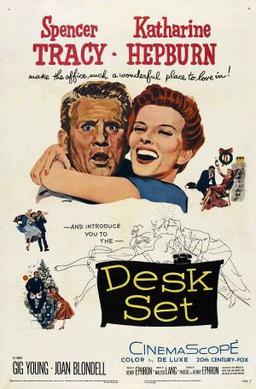
Before The Age of The Internet There Was…Katherine Hepburn and Spencer Tracey’s Desk Set


DVD Review

From The Pen Of Sam Lowell


Desk Set, starring Katherine Hepburn, Spencer Tracey, 1957  


Yes, to answer the question posed by the title of this sketch, before the Internet, before the whole web of now baffling sets of social networking and media outlets to while away the hours there was, well, a love story involving computers, and their uses back in the day, back in the 1950s days when one computer was housed in a whole room of some dimensions. Hard as it is to believe now that you can get a million times more information off of your smart phone than the humongous machines were capable of producing back in the 1950s this whole modern “information superhighway” superstructure posed certain questions then continue to haunt us today. That is the subtext to the film under review, Desk Set, the sophisticated romantic comedy starring the famous Hollywood acting couple Katherine Hepburn and Spencer Tracey.     

Ironically the story line of this film is set in the New York network broadcasting industry at a time when that medium, when conventional television, was “king of the hill” and which is now embattled with about six million other ways of getting information available at the click of a button. But like all business enterprises then and now, the bottom line was, and is, to get the biggest profits the most effective and cost-productive way possible. Enter automation, enter the replacement of the human factor with the efficiencies of the machine. Sound familiar? The way this one plays out is that Sam (played by Tracey), a crackerjack engineer who helped create the then first word in computers, was hired by the broadcast company to streamline its operations with the new machines (then mainly produced when they were of monstrous size by IBM) and one of the first targets was the research department headed by crackerjack head researcher Bunny (played by Hepburn and where the scriptwriters got the name Bunny for the very proper Miss H can only be accounted for by the old Wasp network of Sunnys, Bunnys, Muffys in horse country places or at institutions like Bryn Mawr). Thus the battle is joined.               

Sam and Bunny do their dance, the dance around the subtext message at first about the uses of computers to streamline the research work process which had Bunny and her co-workers (three very smart women who nevertheless in the 1950s wound up as clerks in the research department rather than upstairs running things in the executive suites) worried about their jobs, and rightly so. That worry gets resolved rather simply when the obvious truth about information machines (then, now it might be a bit more problematic)-they are only as good as the humans who put the information in and analyze it meant they would  have more work to do rather than less and would have a higher rate of productivity to satisfy that bottom line. (That same condition applies today although on a global basis begging the question of who will be doing that more productive work-some Seven Sisters graduate or some up and coming smart woman in Mumbai.)     

Nice theme but let’s get back to reality for after all whether using computers or books as the subtext Hollywood is looking for a romantic resolution to a romantic comedy and while we can love our modern technology the fate of the computer is not going to fill seats in a movie theater. But the love triangle pitch certainly will. Bunny was, well, hung up on this guy, Mike, who was on his way up in the company but who couldn’t commit to a serious relationship (a serious relationship meaning one that ended in marriage) until Sam came on the scene and started making Bunny think twice about her status as Mike’s easy thing, as his dishrag. Naturally despite all the travails with the computers gumming up the works and the situation with Mike Bunny and Sam wound up as an “item” of gossip for the water cooler break crowd. See 1950s Hollywood didn’t let us down.  


Saturday, December 26, 2015

What’s A Woman To Do?-Barbara Stanwyck’s Jeopardy

What’s A Woman To Do?-Barbara Stanwyck’s Jeopardy  


DVD Review

From The Pen Of Sam Lowell


Jeopardy, starring Barbara Stanwyck, Barry Sullivan, Ralph Meeker,


Okay, okay here is the riddle, a woman’s very serious riddle where she has to do whatever is necessary under the circumstances to save her man, to keep him from being her ex-man, from being RIP. The answers aren’t always pretty in life, or as here, in the movies in the film Jeopardy which is a good enough word for the title of this black and white exposition on situational morality. Barbara thinks she made the right choice, and let the church-based moralists be damned.        

Yeah, let’s call her Barbara since she is going to have to stand the gaff from those frowning neighbors when she gets back home, gets back home with her man, her very much alive man Barry. Yeah, let’s call him Barry because not only is he going to have to defend his wife against the witches but he is going to also wonder how lucky he was to get a wife who went the distance for him, although you know as well as I do that there will always be a little doubt, nothing big, but still a thought in the air about what really happened back at the abandoned hacienda. Back where Barbara got that unexpected help from Ralph, a guy not known for the goodness of his heart if you must know, yeah, let’s run the table and call him Ralph because, well, just because.  

Here’s the set-up. Barbara and Barry and their son Johnny, a totally respectable red scare Cold War night middle class white picket fence family although without the dog that usually completes this picture, decided to go to the Baja, the Baja down Mexico way, on a family outing, a camping trip to get away from the nine to five routine, to get away from that white picket fence existence. Great idea, a little sweaty sun, a little spraying ocean, some fishing, maybe a little boating, a little bonding with Johnny who Barry has kind of neglected in his rush to get ahead in the world, maybe a little bonding of another kind with Barbara now that he is not all keyed up and notices her charms. Nice, a nice family picture, no question.

Then the whole thing kind of unwinds, some ill-fated wind coming out of the Baja to snag the gringos’ mal suerte (their bad luck) and the necessity for Barbara hard-bitten choices. Blame it on Johnny if you don’t want to blame it on luck, or an act of God, or the fellahin of the world but Johnny is the direct cause of the dilemma. See once they get to the campsite and investigate the surroundings bonehead Johnny decided to check out the rotting pier not far from their campsite. Wouldn’t you know though that Johnny would get his foot caught in one of the decaying boardwalk slats. And Barry being Barry went to rescue his son like any good father. But as the old saying goes no good turn goes unpunished and so Barry wound up being trapped by a collapsing portion of the pier. Normally no problem if the collapse had occurred closer to shore but as it turned out it was too far out-and the tide was coming in.      

Everybody, me too, would have to admit that Barbara and Johnny moved heaven and earth at that moment to get Barry unhinged from his dilemma. No go, nada nunca nada. They came up with an idea thought involving the lever principle of a plank as a wedge to pluck Barry out by using the car as the power to move the plank. Problem: no rope to tie the plank to the power of the car. But there was an half abandoned hacienda back up the road on which they came and maybe some rope could be found there. So Barbara went back on that fateful journey to see about getting some, or some help.    

Well, after speeding back to the hacienda because that tide is really coming Barbara does find the rope-and Ralph. Ralph however is not nature’s nobleman and he wants the car to aid in his getaway since he is a stone-cold killer who has just escaped from the federales. And they are looking for him intensely, looking for a three time loser who really did have nothing to lose. So Barbara began what would become the dance of the seven veils to get Ralph to help her. Nothing worked through a whole series of incidents on the way back toward where Barry and Johnny. Nothing worked until desperate Barbara, knowing that Ralph had not been with a woman for a while made her fateful decision. Now this was a 1950s film so the Barbara’s compromise, her proposition was not shown but everybody over the age of twelve could  figure out she let him at her because in the very next scene Ralph and Barbara are rocketing back to save Barry. You have to say this for Ralph he might not have been nature’s nobleman but whatever promise he made to Barbara for her favors, as the old saying went, he kept to it. Did yeoman’s work to get Barry out before the sea swallowed him up. Then had to hightail it since the federales had picked up his trail. And Barbara? On some very cold nights when Barry is back to work and back to the old nine to five routine she must wonder if she did the right thing. On other hotter nights she might lie awake wondering about Ralph’s fate. Yeah, jeopardy is the right word.      

*****The Big Sur Café- With The “King Of The Beats” Jeanbon Kerouac In Mind  


From The Pen Of Zack James

Josh Breslin, as he drove in the pitch black night up California Highway 156 to connect with U.S. 101 and the San Francisco Airport back to Boston. On arrival there then from there up to his old hometown of Olde Saco to which he had recently returned after long years of what he called “shaking the dust of the old town” off his shoes like many a guy before him, and after too, thought that it had been a long time since he had gotten up this early to head, well, to head anywhere. He had in an excess of caution decided to leave at three o’clock in the morning from the hotel he had been staying at in downtown Monterrey near famous Cannery Row (romantically and literarily famous as a scene in some of John Steinbeck’s novels from the 1920s and 1930s, as a site of some of the stop-off 1950s “beat” stuff if for no other reason than the bus stopped there before you took a taxi to Big Sur or thumbed depending on your finances and as famed 1960s Pops musical locale where the likes of Jimi Hendricks and Janis Joplin roe to the cream on top although now just another tourist magnet complete with Steinbeck this and that for sullen shoppers and diners who found their way east of Eden) and head up to the airport in order to avoid the traffic jams that he had inevitably encountered on previous trips around farm country Gilroy (the garlic or onion capital of the world, maybe both, but you got that strong smell in any case), and high tech Silicon Valley where the workers are as wedded to their automobiles as any other place in America which he would pass on the way up.

This excess of caution not a mere expression of an old man who is mired in a whole cycle of cautions from doctors to lawyers to ex-wives to current flame (Lana Malloy by name) since his flight was not to leave to fly Boston until about noon and even giving the most unusual hold-ups and delays in processing at the airport he would not need to arrive there to return his rented car until about ten. So getting up some seven hours plus early on a trip of about one hundred miles or so and normally without traffic snarls about a two hour drive did seem an excess of caution.

But something else was going on in Josh’s mind that pitch black night (complete with a period of dense fog about thirty miles up as he hit a seashore belt and the fog just rolled in without warnings) for he had had the opportunity to have avoided both getting up early and getting snarled in hideous California highway traffic by the expedient of heading to the airport the previous day and taken refuge in a motel that was within a short distance of the airport, maybe five miles when he checked on his loyalty program hotel site. Josh though had gone down to Monterey after a writers’ conference in San Francisco which had ended a couple of days before in order travel to Big Sur and some ancient memories there had stirred something in him that he did not want to leave the area until the last possible moment so he had decided to stay in Monterrey and leave early in the morning for the airport.

That scheduled departure plan set Josh then got an idea in his head, an idea that had driven him many times before when he had first gone out to California in the summer of love, 1967 version, that he would dash to San Francisco to see the Golden Gate Bridge as the sun came up and then head to the airport. He had to laugh, as he threw an aspirin down his throat and then some water to wash the tablet down in order to ward off a coming migraine headache that the trip, that this little trip to Big Sur that he had finished the day before, the first time in maybe forty years he had been there had him acting like a young wild kid again.        

Funny as well that only a few days before he had been tired, very tired a condition that came on him more often of late as one of the six billion “growing old sucks” symptoms of that process, after the conference. Now he was blazing trails again, at least in his mind. The conference on the fate of post-modern writing in the age of the Internet with the usual crowd of literary critics and other hangers-on in tow to drink the free liquor and eat the free food had been sponsored by a major publishing company, The Globe Group. He had written articles for The Blazing Sun when the original operation had started out as a shoestring alternative magazine in the Village in about 1968, had started out as an alternative to Time, Life, Newsweek, Look, an alternative to all the safe subscription magazines delivered to leafy suburban homes and available at urban newsstands for the nine to fivers of the old world for those who, by choice, had no home, leafy or otherwise, and no serious work history.

Or rather the audience pitched to had no fixed abode, since the brethren were living some vicarious existences out of a knapsack just like Josh and his friends whom he collected along the way had been doing when he joined Captain Crunch’s merry pranksters (small case to distinguish them from the more famous Ken Kesey mad monk Merry Pranksters written about in their time by Tom Wolfe and Hunter Thompson) the first time he came out and found himself on Russian Hill in Frisco town looking for dope and finding this giant old time yellow brick road converted school bus parked in a small park there and made himself at home, after they made him welcome (including providing some sweet baby James dope that he had been searching for since the minute he hit town).

Still the iterant, the travelling nation hippie itinerants of the time to draw a big distinction from the winos, drunks, hoboes, bums and tramps who populated the “jungle” camps along railroad tracks, arroyos, river beds and under bridges who had no use for magazines or newspapers except as pillows against a hard night’s sleep along a river or on those unfriendly chairs at the Greyhound bus station needed, wanted to know what was going on in other parts of “youth nation,” wanted to know what new madness was up, wanted to know where to get decent dope, and who was performing and where in the acid-rock etched night (groups like the Dead, the Doors, the Airplane leading the pack then). That magazine had long ago turned the corner back to Time/Life/Look/Newsweek land but the publisher Mac McDowell who still sported mutton chop whiskers as he had in the old days although these days he has them trimmed by his stylist, Marcus, at a very steep price at his mansion up in Marin County always invited him out, and paid his expenses, whenever there was a conference about some facet of the 1960s that the younger “post-modernist”  writers in his stable (guys like Kenny Johnson the author of the bests-seller Thrill  were asking about. So Mac would bring out wirey, wiley old veterans like Josh to spice up what after all would be just another academic conference and to make Mac look like some kind of hipster rather than the balding “sell-out that he had become (which Josh had mentioned in his conference presentation but which Mac just laughed at, laughed at as long as he can keep that Marin mansion. Still Josh felt he provided some useful background stuff now that you can find lots of information about that 1960s “golden age” (Mac’s term not his) to whet your appetite on Wikipedia or more fruitfully by going on YouTube where almost all the music of the time and other ephemera can be watched with some benefit.

Despite Josh’s tiredness, and a bit of crankiness as well when the young kid writers wanted to neglect the political side, the Vietnam War side, the rebellion against parents side of what the 1960s had been about for the lowdown on the rock festival, summer of love, Golden Gate Park at sunset loaded with dope and lack of hubris side, he decided to take a few days to go down to see Big Sur once again. He figured who knew when he would get another chance and at the age of seventy-two the actuarial tables were calling his number, or wanted to. He would have preferred to have taken the trip down with Lana, a hometown woman, whom he had finally settled in with up in Olde Saco after three, count them, failed marriages, a parcel of kids most of whom turned out okay, plenty of college tuitions and child support after living in Watertown just outside of Boston for many years.

Lana a bit younger than he and not having been “washed clean” as Josh liked to express the matter in the hectic 1960s and not wanting to wait around a hotel room reading a book or walking around Frisco alone while he attended the conference had begged off on the trip, probably wisely although once he determined to go to Big Sur and told her where he was heading she got sort of wistful. She had just recently read with extreme interest about Big Sur through her reading of Jack Kerouac’s 1960s book of the same name and had asked Josh several times before that if they went to California on a vacation other than San Diego they would go there. The long and short of that conversation was a promise by Josh to take her the next time, if there was a next time (although he did not put the proposition in exactly those terms).            

Immediately after the conference Josh headed south along U.S. 101 toward Monterrey where he would stay and which would be his final destination that day since he would by then be tired and it would be nighttime coming early as the November days got shorter. He did not want to traverse the Pacific Coast Highway (California 1 for the natives) at night since he had forgotten his distance glasses, another one of those six billion reasons why getting out sucks. Had moreover not liked to do that trip along those hairpin turns which the section heading toward Big Sur entailed riding the guardrails even back in his youth since one time having been completely stoned on some high-grade Panama Red he had almost sent a Volkswagen bus over the top when he missed a second hairpin turn after traversing the first one successfully. So he would head to Monterrey and make the obligatory walk to Cannery Row for dinner and in order to channel John Steinbeck and the later “beats” who would stop there before heading to fallout Big Sur.

The next morning Josh left on the early side not being very hungry after an excellent fish dinner at Morley’s a place that had been nothing but a hash house diner in the old days where you could get serviceable food cheap because the place catered to the shore workers and sardine factory workers who made Cannery Row famous, or infamous, when it was a working Row. He had first gone there after reading about the place in something Jack Kerouac wrote and was surprised that the place actually existed, had liked the food and the prices and so had gone there a number of times when his merry pranksters and other road companions were making the obligatory Frisco-L.A. runs up and down the coast. These days Morley’s still had excellent food but perhaps you should bring a credit card with you to insure you can handle the payment and avoid “diving for pearls” as a dish-washer to pay off your debts.      

As Josh started up the engine of his rented Acura, starting up on some of the newer cars these days being a matter of stepping on the brake and then pushing a button where the key used to go in this keyless age, keyless maybe a metaphor of the age as well, he had had to ask the attendant at the airport how to start the thing since his own car was a keyed-up Toyota of ancient age, he began to think back to the old days when he would make this upcoming run almost blind-folded. That term maybe a metaphor for that age. He headed south to catch the Pacific Coast Highway north of Carmel and thought he would stop at Point Lobos, the place he had first encountered the serious beauty of the Pacific Coast rocks and ocean wave splash reminding him of back East in Olde Saco, although more spectacular. Also the place when he had first met Moonbeam Sadie.

He had had to laugh when he thought about that name and that woman since a lot of what the old days, the 1960s had been about were tied up with his relationship to that woman, the first absolutely chemically pure version of a “hippie chick” that he had encountered. At that time Josh had been on the Captain Crunch merry prankster yellow brick road bus for a month or so and a couple of days before they had started heading south from Frisco to Los Angeles to meet up with a couple of other yellow brick road buses where Captain Crunch knew some kindred. As they meandered down the Pacific Coast Highway they would stop at various places to take in the beauty of the ocean since several of the “passengers” had never seen the ocean or like Josh had never seen the Pacific in all its splendor.

In those days, unlike now when the park closes at dusk as Josh found out, you could park your vehicle overnight and take in the sunset and endlessly listen to the surf splashing up to rocky shorelines until you fell asleep. So when their bus pulled into the lot reserved for larger vehicles there were a couple of other clearly “freak” buses already there. One of them had Moonbeam as a “passenger” whom he would meet later that evening when all of “youth nation” in the park decided to have a dope- strewn party. Half of the reason for joining up on bus was for a way to travel, for a place to hang your hat but it was also the easiest way to get on the dope trail since somebody, usually more than one somebody was “holding.” And so that night they partied, partied hard. 

About ten o’clock Josh high as a kite from some primo hash saw a young woman, tall, sort of skinny (he would find out later she had not been so slim previously except the vagaries of the road food and a steady diet of “speed” had taken their toll), long, long brown hair, a straw hat on her head, a long “granny” dress and barefooted the very picture of what Time/Life/Look would have used as their female “hippie” poster child to titillate their middle-class audiences coming out of one of the buses. She had apparently just awoken, although that seemed impossible given the noise level from the collective sound systems and the surf, and was looking for some dope to level her off and headed straight to Josh. Josh had at that time long hair tied in a ponytail, at least that night, a full beard, wearing a cowboy hat on his head, a leather jacket against the night’s cold, denim blue jeans and a pair of moccasins not far from what Time/Life/Look would have used as their male “hippie” poster child to titillate their middle-class audiences so Moonbeam’s heading Josh’s way was not so strange. Moreover Josh was holding a nice stash of hashish. Without saying a word Josh passed the hash pipe to Moonbeam and by that mere action started a “hippie” romance that would last for the next several months until Moonbeam decided she was not cut out for the road, couldn’t take the life, and headed back to Lima, Ohio to sort out her life.

But while they were on their “fling” Moonbeam taught “Cowboy Jim,” her new name for him many things. Josh thought it was funny thinking back how wedded to the idea of changing their lives they were back then including taking new names, monikers, as if doing so would create the new world by osmosis or something. He would have several other monikers like the “Prince of Love,” the Be-Bop Kid (for his love of jazz and blues), and Sidewalk Slim (for always writing something in chalk wherever he had sidewalk to do so) before he left the road a few years later and stayed steady with his journalism after that high, wide, wild life lost it allure as the high tide of the 1960s ebbed and people drifted back to their old ways. But Cowboy Jim was what she called Josh and he never minded her saying that.

See Moonbeam really was trying to seek the newer age, trying to find herself as they all were more or less, but also let her better nature come forth. And she did in almost every way from her serious study of Buddhism, her yoga (well before that was fashionable among the young), and her poetry writing. But most of all in the kind, gentle almost Quaker way that she dealt with people, on or off drugs, the way she treated her Cowboy. Josh had never had such a gentle lover, never had such a woman who not only tried to understand herself but to understand him. More than once after she left the bus (she had joined the Captain Crunch when the bus left Point Lobos a few days later now that she was Cowboy’s sweetheart) he had thought about heading to Lima and try to work something out but he was still seeking something out on the Coast that held him back until her memory faded a bit and he lost the thread of her).          

Yeah, Point Lobos held some ancient memories and that day the surf was up and Mother Nature was showing one and all who cared to watch just how relentless she could be against the defenseless rocks and shoreline. If he was to get to Big Sur though he could not dally since he did not want to be taking that hairpin stretch at night. So off he went. Nothing untoward happened on the road to Big Sur, naturally he had to stop at the Bixby Bridge to marvel at the vista but also at the man-made marvel of traversing that canyon below with this bridge in 1932. Josh though later that it was not exactly correct that nothing untoward happened on the road to Big Sur but that was not exactly true for he was white-knuckled driving for that several mile stretch where the road goes up mostly and there are many hairpin turns with no guardrail and the ocean is a long way down. He thought he really was becoming an old man in his driving so cautiously that he had veer off to the side of the road to let faster cars pass by. In the old days he would drive the freaking big ass yellow brick road school bus along that same path and think nothing of it except for a time after that Volkswagen almost mishap. Maybe he was dope-brave then but it was disconcerting to think how timid he had become.

Finally in Big Sur territory though nothing really untoward happen as he traversed those hairpin roads until they finally began to straighten out near Molera State Park and thereafter Pfeiffer Beach. Funny in the old days there had been no creek to ford at Molera but the river had done its work over forty years through drought and downpour so in order to get to the ocean about a mile’s walk away Josh had to take off his running shoes and shoes to get across the thirty or forty feet of rocks and pebbles to the other side (and of course the same coming back a pain in the ass which he would have taken in stride back then when he shoe of the day was the sandal easily slipped off and on) but well worth the effort even if annoying since the majestic beauty of that rock-strewn beach was breath-taking a much used word and mostly inappropriate but not this day. Maybe global warming or maybe just the relentless crush of the seas on a timid waiting shoreline but most of the beach was un-walkable across the mountain of stones piled up and so he took the cliff trail part of the way before heading back the mile to his car in the parking lot to get to Pfeiffer Beach before too long. 

Pfeiffer Beach is another one of those natural beauties that you have to do some work to get, almost as much work as getting to Todo El Mundo further up the road when he and his corner boys from Olde Saco had stayed for a month after they had come out to join him on the bus once he informed them that they needed to get to the West fast because all the world was changing out there. This work entailed not walking to the beach but by navigating a big car down the narrow one lane rutted dirt road two miles to the bottom of the canyon and the parking lot since now the place had been turned into a park site as well. The road was a white-knuckles experience although not as bad as the hairpins on the Pacific Coast Highway but as with Molera worth the effort, maybe more so since Josh could walk that wind-swept beach although some of the cross-currents were fierce when the ocean tide slammed the defenseless beach and rock formation. A couple of the rocks had been ground down so by the oceans that donut holes had been carved in them.                          

Here Josh put down a blanket on a rock so that he could think back to the days when he had stayed here, really at Todo el Mundo but there was no beach there just some ancient eroded cliff dwellings where they had camped out and not be bothered  so everybody would climb on the bus which they would park by the side of the road on Big Sur Highway and walk down to Pfeiffer Beach those easy then two miles bringing the day’s rations of food, alcohol and drugs (not necessarily in that order) in rucksacks and think thing nothing of the walk and if they were too “wasted” (meaning drunk or high) they would find a cave and sleep there. That was the way the times were, nothing unusual then although the sign at the park entrance like at Point Lobos (and Molera) said overnight parking and camping were prohibited. But that is the way these times are.

Josh had his full share of ancient dreams come back to him that afternoon. The life on the bus, the parties, the literary lights who came by who had known Jack Kerouac , Allan Ginsberg, Lawrence Ferlinghetti and the remnant of beats who had put the place on the map as a cool stopping point close enough to Frisco to get to in a day but ten thousand miles from city cares and woes, the women whom he had loved and who maybe loved him back although he/they never stayed together long enough to form any close relationship except for Butterfly Swirl and that was a strange scene. Strange because Butterfly was a surfer girl who was “slumming” on the hippie scene for a while and they had connected on the bus except she finally decided that the road was not for her just like Moonbeam, as almost everybody including Josh figured out in the end, and went back to her perfect wave surfer boy down in La Jolla after a few months.

After an afternoon of such memories Josh was ready to head back having done what he had set out to which was to come and dream about the old days when he thought about the reasons for why he had gone to Big Sur later that evening back at the hotel. He was feeling a little hungry and after again traversing that narrow rutted dirt road going back up the canyon he decided if he didn’t stop here the nearest place would be around Carmel about twenty-five miles away. So he stopped at Henry’s Café. The café next to the Chevron gas station and the Big Sur library heading back toward Carmel (he had to laugh given all the literary figures who had passed through this town that the library was no bigger than the one he would read at on hot summer days in elementary school with maybe fewer books in stock). Of course the place no longer was named Henry’s since he had died long ago but except for a few coats of paint on the walls and a few paintings of the cabins out back that were still being rented out the place was the same. Henry’s had prided itself on the best hamburgers in Big Sur and that was still true as Josh found out.

But good hamburgers (and excellent potato soup not too watery) are not what Josh will remember about the café or about Big Sur that day. It will be the person, the young woman about thirty who was serving them off the arm, was the wait person at the joint. As he entered she was talking on a mile a minute in a slang he recognized, the language of his 1960s, you know, “right on,” “cool,” “no hassle,” “wasted,” the language of the laid-back hippie life. When she came to take his order he was curious, what was her name and how did she pick up that lingo which outside of Big Sur and except among the, well, now elderly, in places like Soho, Frisco, Harvard Square, is like a dead language, like Latin or Greek.

She replied with a wicked smile that her name was Morning Blossom, didn’t he like that name. [Yes.] She had been born and raised in Big Sur and planned to stay there because she couldn’t stand the hassles (her term) of the cities, places like San Francisco where she had gone to school for a while at San Francisco State. Josh thought to himself that he knew what was coming next although he let Morning Blossom have her say. Her parents had moved to Big Sur in 1969 and had started home-steading up in the hills. They have been part of a commune before she was born but that was all over with by the time she was born and so her parents struggled on the land alone. They never left, and never wanted to leave. Seldom left Big Sur and still did not.

Josh said to himself, after saying wow, he had finally found one of the lost tribes that wandered out into the wilderness back in the 1960s and were never heard from again. And here they were still plugging away at whatever dream drove them back then. He and others who had chronicled in some way the 1960s had finally found a clue to what had happened. But as he got up from the counter, paid his bill, and left a hefty tip, he though he still had that trip out here next time with Lana to get through. He was looking forward to it though.               
Friday, December 25, 2015

*****Got Them Down-Hearted Blues-With The Empress Of The Blues Bessie Smith In Mind  


From The Pen Of Sam Eaton

Sure 1920s guys, gals too, black guys, black gals sweating out their short, brutalized lives on Mister’s 28,000 acres of the best bottomland along the river in Mississippi or some such number of acres,  probably it didn't matter to have an official count on the acres to them because all of the land went endlessly to the horizon and the work too had plenty to have the blues about. Had suffered the double whack of having to put up with Mister's Mister James Crow laws to boot which only added to the misery of those endless acres. Sure maybe some woe begotten poor white trash down in hard-boiled Appalachia in those famed hills and hollows had plenty of blues too although they did not call them that even in those few integrated evenings when the whole town went to Rence Jackson's dirty red barn in need of a serious paint job but this is about the blues, the musical blues and not some general social issues commentary. So those “no account” whites don’t play a role here at this time, don't play except as devotes of generic old country British Isles ballads like the ones collected by Francis Child back in the 1850s which thrilled the Brahmins of Brattle Street on a wild utilitarian Saturday night. Actually whites in general don't play a role in the blues since their access to such songs by the likes of the various Blinds, Robert Johnson, and the belting barrelhouse mamas would be minimal in an age when "race" record pieced everybody off into their own tangent. They will not play a role until the music heads north in a generation, or so,  and the “white negro” hipsters (to use big daddy Norman Mailer’s term for the little daddies who hung around the back streets of cool, Harlem 125th Street cool at that time), “beats (to use Jack Kerouac term hustled from some dead-pan beat down hustler, a white negro hipster if it came right down to it named Huncke via high brow John Clellon Holmes for Christ sake),” folkies (to use the Lomaxes’, father and son, expression), college students (to use oh I don’t know the U.S. Department of Education’s expression), and assorted others (junkies, grifters, midnight sifters, drifters on the wing, winos trying to sober up, good time prostitutes, the denizens of Hayes-Bickford's, the Automat, places like that, no hip as a rule) decided that that beat in their heads had Mother Africa who spawned us all had to be investigated but all that indeed was later.

Like I said the real blues aficionados, if only by default, had their say, had their lyrics almost written for them by the events of everyday human existence what with talking in their own "code words" about how Mister and his Mister James Crow laws fitted him, Mister, and his just fine at the expense of those black guys, their women and their righteous children (righteous when they, his children and their children smote the dragon come freedom summer times, come Mississippi and Alabama too goddamn times but that is a story for their generations to tell I want to talk about the great-grand pa’s and ma’s and their doings).

Here is how the scene played out as near as I can figure from a wide-ranging reading of most of the lyrics from that time (and always remember when you speak of "blues," speak of the folk in general this is mostly an oral tradition handed down and bastardized as it gotten handed down so there are very few definitive lyrics but rather more a sense of what miseries were being talked about. How Mister James Crow said every day of the week, even the Lord’s Day, Sunday that if you were black, get back, if you were white and right you were alright and proved it by separate this and separate that, keeping his street clear of stray “negros,” yeah, with small “n” if he was being kind that day, another today socially not acceptable expression if not, telling the brethren to go here, not go there, look this way but not that (and by all means not peeking at his womenfolk), walk there but not here, or face nooses and slugs for his troubles.

So yeah the blues almost cried out to be the order of things. Working all day for chump change in Mister’s fields or worse share-cropper-ing and having Mister take the better portion and leaving the leavings he didn’t want, meaning what he couldn’t sell to his profit as the rest.

Yeah, so there is no way that black guys could not have had the blues back then except some old nappy Tom who didn’t get the word but they were far fewer than you might think the others just fumed at who knows what psychic costs (now too but that in dealt with by the step-child of the blues, maybe second step-child via in your face if there is space hip-hop nations, the angry ones who put words to the rages of the modern “post racial” American society that somebody has jerked them around with lately). Hey and to Mister’s miseries, very real, very scary when the nightriders came, woman trouble (maybe at night the worse kind of trouble if Mister wasn’t in your face all day with her where you been, do this, do that, put it right here, put it right there), trouble with Sheriff Law (stay off the sidewalks, keep your head down, stay down in the bottom lands or else) and trouble with Long Skinny Jones if you mess with his woman, get your own (or face his razor and gun down on Black Mountain).

Plenty of stuff to sing about come Saturday night after dark at Smilin’ Billy’s juke joint complete with his home-made brew, freshly batched, which insured that everybody would be at Preacher Jack’s  Sunday service to have their sins, lusts, greeds, avarices, covets, swaggers, cuts, from the night before (or maybe just minutes before) washed clean under the threat of damnation and worse, worse for listening to the “devil’s music” (funny because come the white rock and roll teen explosion a generation later Mister, some Mister, said that too was the devil’s music which confused those clean cut angelic angst-filled teens although not enough to stop listening to Satan and his siren song) by a guy like Charley Patton, Son House (who had the worst of both worlds being a sinner, loving his whiskey more than somewhat which Howlin’ Wolf took him to task for down in Newport one year in the early 1960s at a jam session, and a preacher man), Lucky Quick, Sleepy John, Robert J, and lots of hungry boys who wanted to get the hell out from under Mister and his Mister James Crow laws by singing the blues and making them go away.          

That’s the guys, black guys and they had a moment, a country blues moment back in the 1920s and early 1930s when guys, white guys usually as far as I know, from small label record companies like Paramount, RCA, the radio company looking to feed the hours on their stations with stuff people would listen to (could listen to in short wave range times and hence regional roots work). They were agents who were parlaying two ideas together getting black people, black people with enough money  (and maybe a few white hipsters, Village, North Beach, Old Town denizens tired of the same old, same old if they were around and if they were called that before the big 1950s “beat” thing), buy, in this case, “race records,” that they might have heard on that self-same radio, nice economics, scoured the South looking for talent and found plenty in the Delta (and on the white side of that same coin plenty in the Southern hill-billy mountains, and hills and hollows too).

But those black blues brothers were not what drove the race label action back then since the rural poor had no money for radios or records for the most part and it was the black women singers who got the better play, although they if you look at individual cases suffered under the same Mister James Crow ethos that the black guys did. There they were though singing barrelhouse was what it was called mostly, stuff with plenty of double meanings about sex and about come hither availability and too about the code that all Southern blacks lived under. And the subjects. Well, the subjects reflected those of the black guys in reverse, two-timing guys, guys who would cut their women up as soon as look at them, down-hearted stuff when some Jimmy took off with his other best girl leaving her flat-footed, the sins of alcohol and drugs (listen to Victoria Spivey sometime on sister cocaine and any number of Smiths on gin), losing your man to you best friend. Some sound advice too like Sippy Wallace’s don’t advertise your man, and some bad advice about cutting up your no good man and taking the big step-off that awaited you, it is all there to be listened to.   

And the queen, the self-anointed queen, no, better you stay with the flow of her moniker, the empress, of barrelhouse blues was Bessie Smith, who sold more records than anybody else if nothing else. But there is more to her claim than mere record sales since she left a treasure trove of songs, well over two hundred before her untimely early death in the mid-1930s (untimely in the Mister James Crow South after an car accident and they would not admit an empress for chrissakes into a nearby white hospital, yes, rage, rage against the night unto the nth generation-black lives matter).

Guys, sophisticated guys, city guys, black guys mainly, guys like Fletcher Henderson, Tin Pan Alley kind of guys in places like high holy Harlem and Memphis, Saint Louis would write stuff for her, big fat sexy high white note sax and chilly dog trombone players would back her up and that was that. Sure Memphis Minnie could wag the dog’s tail with her lyrics about every kind of working guy taking care of her need (and you know she needed a little sugar in her bowl just like Bessie and a million, million other women, and a quick listen to any of a dozen such songs will tell you what that need was or you can figure it out and if you can’t you had better move on), the various other Smiths could talk about down-hearted stuff, about the devil’s music get the best of them, Sippy Wallace could talk about no good men, Ivy Stone could speak about being turned out in the streets to “work” the streets when some guy left town, address unknown, and Victoria Spivey could speak to the addictions that brought a good girl down but Bessie could run it all.

From down-hearted blues, killing her sorrows with that flask of gin, working down to bed-bug flop houses, thoughts of killing that no good bastard who left her high and dry, seeing a good Hustlin’ Dan man off to the great yonder after losing that bout with TB coughing, blowing high and heavy in the thick of the Jazz Age with the prince of wails, looking for a little sugar in her bowl, and every conceivable way to speak of personal sorrows.

Let me leave it like this for now with two big ideas. First if you have a chance go on YouTube and listen and watch while she struts her stuff on Saint Louis Woman all pain, pathos and indignity as her good man throws her over for, well, the next best thing. That will tell you why in her day she was the Empress. The other is this-if you have deep down sorrows, some man or woman left you high and dry, maybe you need a fixer man for what ails you, you have deep-dyed blues that won’t quite unless you have your medicine then you have to dust off your Billie Holiday records and get well. But if the world just has you by the tail for a moment, or things just went awry but maybe you can see the light of day then grab the old Bessie Vanguard Record or later Columbia Record multiple albums (four double record sets from beginning to end) and just start playing you won’t want to turn the thing off once Bessie gets under your skin.

That’s what I done more than once when I was down on my luck living in flea-bitten rooming house in a cold-water flat with me and my bed, bureau, desk and chair and a battered old RCA record player and just let it wail, let the fellow stew-ball tenants usually behind on their rents anyway howl against the night. Bessie was on the square.