Wednesday, November 22, 2017

On The 50th Anniversary- Julie Christie and Alan Bates’ Film Adaptation of Thomas Hardy’s “Far From The Madding Crowd” (1967)


DVD Review

By Senior Film Critic Sandy Salmon

Far From The Madding Crowd, starring Julie Christie, Alan Bates, Peter Finch, Terence Stamp, based on the novel of the same name by Thomas Hardy, 1967   

I am sure sometimes readers of these reviews must wonder why a certain film is being reviewed, especially older films which while a big deal in the old days may not seem classical enough to warrant coverage forty, fifty, sixty years later. There are many reasons for choices but for the film adaptation of Thomas Hardy’s Far From The Madding Crowd there is one, and only one, reason. I had a big time “crush” on actress Julie Christie. That crush started not on this film but for her part in David Lean’s Doctor Zhivago about the turbulent period around the Russian Revolution and the early part of Stalin’s reign based on a book, a forbidden book under Stalin if I recall, by Russian writer Boris Paternak. If memory serves I almost lost a girlfriend, the girlfriend that I saw the film under review with, over my unbridled gushing on and on about Ms. Christie’s blue eyes (that gal’s eye were brown and she had come from an all brown-eyed world in Manhattan), figure (hers was very good as well but no young woman then, maybe now as well although body shaming is rightly considered social error, if not political liked to have some other woman’s body commented upon) and long blonde hair (hers again brown from that brown-eyed Manhattan Lower East Jewish quarters world). Not a good move no question but what could you expect of wet-behind-the ears high school student from New Jersey who was a “late bloomer” in the dating/sexual allure world.                

So much for young romantic love misadventures, although I rekindled that crush in re-watching this film so many not so young romantic misadventures since I went on and on to my longtime companion about those blue eyes (hers are brown) although she has that same ethereal beauty Ms. Christie had (and maybe still has since I have not seen her in anything recently). So maybe I am an eternal wet-behind-the ears guy. My big idea in taking this date to see this film is another little quirk I had. We had just finished reading Thomas Hardy’s Mayor of Casterbridge (Casterbridge the scene of many of Hardy’s novels) which I had been enthralled with, had devoured well before the class was supposed to finish the novel and I was trying to see if it was worthwhile for me to read the book this film was based on. I did that a lot then although now it is more likely to be the reverse, to read the book and then see the film adaptation which sometimes, actually many times, is not true to the author’s intention or plotline. That is a story for another day though.    

As Sam Lowell, the previous senior film critic now emeritus, is always found of saying let’s get the “skinny” on this one. Let’s get to why I was enthralled by Thomas Hardy’s novels and this film adaptation beyond short-cuts and Ms. Christie’s blue eyes. I grew up in the city, in urban Trenton (actually just outside but close enough to consider myself a city boy as did my friends) so reading about the rural life in 19th century England was almost like I was reading a space adventure. The film in some scenes like when the shepherd Gabriel, Allan Bates’ role, loses all his flock when his sheep dog goes berserk and drives them over a cliff into the sea, or when Bathsheba’s, Ms. Christie’s role as the inherited from her uncle landowner, sheep come down with a disease that lays them low and harvesting wheat graphically showed what I had imagined when I read my first Thomas Hardy novel.         

But what we have here in this film is really well beyond some idyllic agricultural ideal a city boy had about the country. Let’s face it and deal with the real subject-the romantic endeavors of Bathsheba’s three, count them, three suitors and her attitude toward each one (and the reason that long ago almost lost girlfriend and the miffed longtime companion both loved the film). As noted poor girl Bathsheba inherited a landed estate from her deceased uncle. Being young and energetic she was determined to run the place herself and show what she was made of against the views of her fellow male landowners, male tenants and employees who believed she was in over her head. And at times, like that sheep sickness time, she relied despite her own judgement, she had to depend on Gabriel who after being spurned on his marriage proposal by Bathsheba before she inherited that land and losing his flock to that berserk dog found himself in her employ. Spurned love number one down.   

While tending to her land the precocious Bathsheba gathered in another suitor, the older bachelor neighboring landowner, Mr. Boldwood, played by Peter Finch, who developed a late life obsession about her. Spurned love number two. Along comes number three, a young man, Frank, played by bad boy Terence Stamp, a rather dashing cavalry sergeant and she is smitten beyond reason. (As was that almost lost girlfriend and that current longtime companion to Stamp’s blue eyes but I will just charge that to their respective reactions to my going on and on about Ms. Christie.) They eventually marry and this proves a marriage not made in heaven as he is something of a wastrel and philander. Or so it seemed until Fanny, a young woman from Bathsheba’s estate, whom he had gotten with child as they used to say delicately in the old days and was to marry came back to claim her man. Too late since she was very ill and passed away along with that child she bore. That began Frank’s gnashing of teeth over her death and he subsequent alleged drowning at sea.

End of story for the widowed Bathsheba (although since the body was not found she would have to wait the legal seven years in order to remarry). Or so I would think. Re-enter that besotted Boldwood and another marriage proposal. Spurned again. End of story now. Well no that bastard Frank actually had not died but had taken off for parts unknown and wouldn’t you know showed up just when Bathsheba was ready to conditionally accept Boldwood’s marriage proposal. End of Frank as the enraged Boldwood pulled the old rooty-toot-toot and he fell down. Off to the gallows and probably some measure of relief for the unlucky Boldwood. You can’t have a romance end on a sour note, or at least you couldn’t in a 19th century romantic novel so with two departed lovers finished dear fickle, there is no other word for it, Bathsheba finally, finally gets under the sheets with Gabriel something that kept getting telegraphed throughout the movie as they threw those meaningful glances as each other. And maybe Ms. Christie batted those blues eyes. A fine if long film version of well-done book.   

Tuesday, November 21, 2017

Murder Anyway You Cut It- With The French Film Tell No One In Mind


By Zack James

Phil Larkin, the locally well-known private investigator from Gloversville about sixty miles west of Boston, loved to go to the National Private Investigators Association (NPIA) annual conventions not so much to inspect the inevitable new technological gizmos which were touted as the P.I.s next best friend by their producers but to gather up old acquaintances and over a few whiskies to find out about some new interesting case one or more of them might be working on. They are not all interesting by any means whatever the individual P.I. might be hyping about by virtue of his or her prowess in solving the riddle of the age –usually some missing husband who was ready to go home after a couple of months with some floozy who spent all his dough and blew for places unknown, a guy who fled town for some reason and wants to remain missing but something got him up from the underground, some scared kid who blew home and is out in Topeka somewhere and can’t get out of the caboose until some adult accompanies him or her home, or a skipper you would be amazed at how much P.I. work is “repo” stuff which keeps many guys in clover and a full scotch bottle in that bottom desk drawer for those long stretches between jobs. Or about a case they might have heard about. That is how he heard from his old friend Artie Shaw about the Beck case, the case that had half the public coppers, gendarmes they call them there, in France baffled and Artie too until things fell into place by virtue of that over-rated prowess that every P.I. hung out like single in front of his or her shabby sixth floor office in some seen its day office building filled with failed dentists, cheapjack insurance agents, seedy repo men (guys who do it full-time) and discount wholesale jewelers.

[By the way for those who are confused, or only know of the more famous American Forensic Investigators Organization (AFIO), the one the famous detectives Jack Dolan, Robert Parker, and Shane Chandler, the latter a distant relative of the crime writer Raymond who practically invented the hard-boiled detective genre that has misled several generations of readers and average citizens about the real lives of P.I.s, belong to, the NPIA and AFIO work two very different tracks. The AFIO had split, an acrimoniously split, from the NPIA over the issue of working with the public coppers. The NPIA historically had deferred, meaning “butted out on,” once a case went onto the police blotter. The AFIO made up of a bunch of “hot-doggers” who spit on the public coppers and their half-ass work went on the premise that all cases were better done through private hands. Phil an old time public cop himself would have been railroaded out of business in Gloversville if he had made step one to mess with the open police cases in that town. Would have been run out of town on a rail if not put under some very loose ground especially when Nick Devine was chief copper in that burg and was so “connected” to the boys with grunts and funny noses that he well might have done it himself-or had it done.]     

Every NPIA member in attendance could hardly wait for the banquet that closed each convention to hear the words, to hear the deep dark secret of the profession that the difference between the actual numbers of cases between the two organizations was minuscule or NPIA’s were better. The reality was that despite the few headline cases like the Galton kidnaping and ransom case which some guy, some almost amateur sleuth named Ross MacDonald solved there was as much co-operation between AFIO and public coppers as the NPIA.             

Artie, originally from Boston, had worked with Phil when he had started out on a couple of cases, key-hole peeping cases which in the 1950s was bread and butter work for most private detectives in the days when getting a divorce was heavy lifting without an army of reasons adultery being the primo reason a court would accept. Phil eventually moved on from that work saying to anybody who would listen that he would rather try to solve mass murder cases, solve serial murder stuff than have to swallow the lies associated with guys and gals shacking up once they got to court and practically accused him of breaking up happy homes or being the fall guy for some kind of abuse.  Less strain on the nerves. Artie, knowing his limitations, always stuck with key-hole peeping which is how in a roundabout way he got the Beck case.

The wife of a big Boston international banker had hired him to get the goods on her husband and his French mistress whom said banker had established, had set up in a Paris apartment for when he travelled there on business. Artie, really a pro then at getting the dope, getting the photos necessary to close a divorce case in court, rapped that one up tight, no problem. What Artie had found out in Paris as the 1950s turned into the 1960s was that there was still much key-hole peeping work to found there through the still pretty much intact cumbersome French Napoleonic civil code and so he stayed around there to pick up the pieces, especially when that Boston banker’s divorcee set up herself in Montmatre.      

That banker’s ex-wife connection got him the Beck case, got it to him at least indirectly through her lawyer in Paris who was also the lawyer that this Doctor Beck had retained once he got into serious trouble, or rather he and his sister, Anne, a devotee of the horsey set, but loaded with dough from her husband’s fortune had retained. The case would have seemed to be on the face of it way over Artie’s head as it involved a “cold case,” a case that the French gendarmes had closed up tight. But the ex-banker’s wife and Beck’s lawyer both agreed that a non-French P.I. would have less hurdles to cross than some Parisian private dick who was bound by law to turn everything over to the coppers under penalty of losing his or her license. (Artie was working off his U.S. permit courtesy of influence with the public coppers by a friend of that banker’s ex-wife).

Artie had moreover gotten on the case after the thing had been dead for about seven, eight years. Years after this Doctor Beck was cleared as far as could be of his wife’s murder out in the country while they were out for a swim on the lake. The doctor’s story then had been that he had been knocked unconscious by a party unknown and dumped into the lake when he heard his wife’s screams. Except he was found on the dock. As such things went the public coppers had to let it go when they couldn’t shake his story and his wife’s father, a public copper himself, identified his daughter’s body and vouched for his son-in-law.           

Then a couple of bodies surfaced in that same area and a couple of cops from the old case started to put two and two together and come up with the doctor. The frame was on but the point was how was Artie to get enough evidence to get the doctor off the hook. As it turned out a couple of pieces of evidence surfaced that got the ball rolling. The doctor’s wife, who along with his sister were seriously into steeplechase horse shows, had been beaten badly by someone a few weeks prior to her death. The coppers figured that Doc Beck did the deed, a wife-beater not uncommon among certain high profile types. As it turned out the wife, Margot was her name, had had his sister take photographs of the wounds but had also swore her to secrecy that this horse set guy, this Phillip Neuville, the son of Baron Neuville, a guy with a pile of money as well had done the beating when she confronted him with evidence of child sexual abuse of a bunch of kids who worked the stables as a part of program she was involved with.     

That confrontation as it turned out resulted in the death of young Philip. The photographs were taken after the Doc’s wife had killed the bastard.  

Switch up to the film made of the Beck case minus, at his request since it might be bad for his business in America do, Artie….


Nowadays in order for a thriller to pass muster there have to be many little twists and turns or else the film get very tedious, get very boring, never gets, as a friend of mine who is into both written and cinematic thrillers has suggested, off the slow-moving track which spells death to the film, makes one reach for the remote very quickly. That is not the case with the thriller under review, the French film, Tell No One, although frankly I thought that the film would in its opening scenes succumb to that slow-moving death every thriller has to dodge.

Here are the twists in this “cold file” case. Doctor Beck’s wife, Margot, had been killed, senselessly killed by a serial killer, several years earlier and he was just beginning to put his life back together when a whole ton of hell started coming down on his head. Reason: a couple of male bodies filled with bullets had been found out in the country where his wife had been killed. Beck had just barely gotten out of the clutches of the law back then since the law thought under the odd-ball evidence in the case that he was the mastermind behind the deed. He had been mysteriously found unconscious on the dock despite his assertions that he had been hit and fallen into the water by the killer being a chief reason that he had been suspected by the cops.    

Lots of things begin to pop up that had the cops interested in reopening the case, hoping to see the big frame placed around his head. Unaccounted for bruises to his wife’s face on photos that survived, a gun found in secret place in his house, the murder most foul of his wife’s best friend are just some of the examples that dog him. Put those together with Beck’s taking it on the lam to figure out what the hell was going on and for the average cop never mind what country he or she works in and you have an “open and shut” case of consciousness of guilt and an easy and early wrap-up to the cases.


But hold on. This Doctor Beck actually loved his wife, was not faking the trouble he had trying to put his life back together. Something else was going on, some nefarious plot to get him to take the big step-off and let him rot in prison forgotten after a while. Not only was something going on in the frame department but the good doctor was getting information via his e-mail that his wife was still alive. So two trails of events were going on at the same time (always a good sign in a thriller): the net tightening over his head by the coppers and his frenzy to find his wife knowing now that she is not dead. That’s all I will tell you because I have been asked to “tell no one” in order not to spoil the ending, okay. Except old Doc Beck was not crazy, was not wrong in assuming that nefarious forces were out to get him although it would take a while before he learned that it was because of something that Margot had knowledge about shortly before her “death” which had people in high places ready, willing and able to do her in. Watch this award-winning film.    
Releasing Your Inner Michael Feinstein-Amy Adams and Alec Newman’s “Moonlight Serenade” (2009)-A Film Review


[Occasionally a reader will write in asking how a particular staff member gets an assignment for a particular film. In short has an interest in learning about the inner working of an on-line operation where most of us are not in the same room together making decisions. Most of the time it is pretty straight forward. Films get handled by Sandy Salmon and Alden Riley with Sandy taking the older films that he would have maybe watched when he was younger and Alden the more current films. Although one time earlier this year I overrode Sandy and “forced” Alden to watch and write a review on a documentary about the first Monterey Pops Festival in 1967, the year of the Summer of Love out in San Francisco which we promoted the 50th anniversary of heavily this year, when he told Sandy that he did not know who Janis Joplin was. I still bristle at that since Monterey in 1967 was where the ill-fated snake-bitten Janis made her smash break-through. But that is the exception.

Another exception is the reviewer of the film here Moonlight Serenade where Seth Garth who usually handles music reviews got the nod from Sandy since neither he, a child of rock and rock in his youth, nor Alden much more attuned to hip-hop and techno-rock had a clue about the American Songbook Tin Pan Alley style. Knowledge of that genre for this film is critical and so Seth drew the assignment. Pete Markin]    

******

DVD Review 

By Seth Garth

Moonlight Serenade, starring Amy Adams, Alec Newman, Harriet Samson Harris, 2009   

My old high school friend and fellow corner boy down in Carver, down in cranberry country in Southeastern Massachusetts, Gilbert Rowland used to kid me mercilessly about my knowing more of the American Songbook than he could ever dream of. He did not know that term “American Songbook” but what he meant was clear. Although I, he, we were indeed children of rock and roll (and it off-shoot the blues a little later and still later folk music during that folk minute in the early 1960s) I knew, would hum or sing what were essentially show tunes, tunes created by those who inhabited mythical Tin Pan Alley like the Gershwin Brothers, Jerome Kern, Irving Berlin, Cole Porter, Rodgers and Hammerstein and the like to the jeers of the corner boys who only cared about what the latest Chuck Berry composition was about, whether Jerry Lee’s High School Confidential was youth nation of the time’s national anthem or whether Bill Haley and the Comets still jumped after Rock Around The Clock. Stuff like that not “sissy” (he, they used a more derogatory word than that but you get the drift) music like our parents might like-or even know about since the heyday for most of that was in their 1930s and 1940s growing up times.  Don’t ask me how I came by it, maybe hearing it on a vagrant radio station sometime up in my room listening to music on my transistor radio and it stuck, but it was surely not around the house much since I was after certain young age not around the house much.

But enough of genesis and get to the why of this assignment since I don’t usually do film reviews. This Moonlight Serenade (title from an old Glen Miller smash hit back in the long ago day) is a quirky little movie that is both a romantic comedy of sorts and a semi-musical since the three main characters are ready to sing at the drop of a hat (and maybe with less prompting). Nate, played by Alec Newman, is nothing but an up and coming Wall Street money manager who has along with his associate Angelica, played by Harriet Samson Harris been selling “short” as a strategy for making tons of money for their clients and plenty of commissions for themselves. Not a strange phenomenon in 2000s New York City. What is slightly, no more than slightly, askew is that Nate is a denizen of a jazz club and also a more that fair piano player which is how he gets his relaxation after those hard-boiled hours hustling stocks around the clock. What Nate plays is not some Jerry Lee made rock and roll piano and not even Fat Domino since no way was he a child of rock and roll, way too young, but the old Broadway and cabaret show tunes made famous by the likes of Billie Holiday and Mabel Mercer and written by Tin Pan Alley legends like Cole Porter, Jerome Kern, the Gershwins and the like.             

That high strung money manager versus his inner Michael Feinstein, the fairly recent famous cabaret performer of this kind of music, is what drives the Nate end of the plotline. Enter Chloe, played by fetching Amy Adams, a hat-checker (formerly hat check girl but that is passé now) at that jazz club Nate frequents and who turns out to be a struggling torch-singer in the mold of Peggy Lee it appears whose paramour and piano player is some strung out junkie. They “meet” while he is singing a song in his open window apartment and she is walking along the sidewalk below and begins a duet (the drop of a hat phenomenon). When they actually do meet though they are frosty, or rather she in the throes of what to do about that junkie boyfriend is, and standoffish although you could tell from minute one that they would hit the satin sheets before long-and they did.

What Chloe needed was a big change and eventually got it at that jazz club when Nate who has been providing the owner with good stock tips for this portfolio gave her a break. Smash home run hit. Except two things are amiss. Nate is torn about taking stab at making a musical career and tearing up Wall Street with his expertise and Chloe has to confront what to do about that junkie boyfriend. In the end you know what happened-or can guess. Here is the big problem for me though having first seen Ms. Adams doing her torch-singer thing in Miss Pettigrew Lives For A Day burning up the screen with her version of the old Inkspots’ tune If I Didn’t Care which even I recognized was one of the best versions ever done on that number. Either the song selection here was wrong although there were plenty of can-do Cole Porter tunes which Billie Holiday hit out of the park or Chloe’s jaunty way of performing them was off but except for one torch she didn’t ready hit the mark in the music department. He was off as well although Nate never claimed to be the cat’s meow as a singer. Maybe having imbibed this stuff third-hand (at least given their ages that seems right) their New York 2000s sensibilities saw the tunes differently. Still a good film to hear those old classics getting a workout and seeing the chemistry develop between Nate and Chloe.            


Monday, November 20, 2017

All That Glitters Is Not Gold-The Latest Find From The Crime Novelist Raymond Chandler’s Trove 


By Book Critic Josh Breslin

A link to an NPR Morning Edition interview in 2017 with the editor of the Strand magazine on his find in the Raymond Chandler trove.


https://www.npr.org/2017/11/17/564752462/new-raymond-chandler-story-takes-on-health-care-industry

Reader in this space know of my great respect for the pioneer work of Dashiell Hammett and Raymond Chandler in bringing hard-boiled no nonsense basically anti-heroic private detective novels to the fore against the plethora of prissy parlor pink amateur detectives previously dominant in the genre. Guys, okay private eyes,  like grizzly street wise Sam Spade who was ready, willing and able to go the distance with the likes of Briget O’Shaunessey and the “Fat Man” Gutman until the bodies started piling up and he had to send darling Briget over, sent her to the big step-off to clear his own path over some fucking silly bird in The Maltese Falcon or, for example, wily gin-stained Phillip Marlowe skewering one Eddie Mars just to save an old man from believing that he had sired the devil’s own spawn in his wild and wayward daughters in The Big Sleep. Those characters will endure as long as people, young people, young men in particular seek adventurous tales. Hell even Hammett’s Nick and Nora Charles in the seemingly endless The Thin Man film series when they have to go mano a mano with some nefarious foes was like a breath of fresh air in its day.         

Of course both men have now long gone beyond the pale and no one would have assumed any and all of their work product, finished, scraps, letters, etc. would not have already gone under the microscope of the Dashiell/Raymond academy with nothing left to find. Apparently that is not the case for Chandler. A recent discovery of a short story, a very short story found in the Bodleian Library in England (Chandler was born there) has now been published in the Strand magazine. From what I understand from the interview on NPR with the editor this is a complete story unlike the unfinished Phillip Marlowe Poodle Spring story which the Chandler Estate commissioned crime novelist Robert Parker to complete many years ago.            

The question for me, and the question posed by the interviewer to the Strand editor, was whether he thought that Chandler would have approved of the publication of this little piece at this late date. The editor gave his reasons for saying yes based on what he knew of Chandler’s thoughts about his works and of his literary perspective. I am not so sure. There is an on-going argument among scholars of writers that not every piece of possible scrap written under who knows what conditions and expectations is either worthy of publication or was meant for publication. In the case of Poodle Spring Chandler died before he could complete the novel which showed Marlowe after he had been house-broken, after he had lost some speed or so the nefarious foes there thought, and it can safety be assumed that it would have seen the light of day if Chandler had been able to finish it on his own. This short story was written in the early 1950s, so perhaps he was “doodling” given its brevity and its quick look at the fate of a hapless homeless man spit out by the system. In any case, for good or evil, it is out in the public prints. Still I wish it had been an undiscovered Phillip Marlowe story-finished or not.  


Sunday, November 19, 2017

The Harder They Fall, Indeed-Humphrey Bogart’s “The Harder They Fall” (1956)-A Film Review


DVD Review

By “Sports Columnist” Fritz Taylor 

The Harder They Fall, starring Humphrey Bogart, Rod Stieger, based on a story of the same name by Budd Schulberg, Columbia Pictures, 1956    

[The film under review Humphrey Bogart’s The Harder They Fall is one DVD in a five DVD package of his lesser films from his Columbia Pictures days mostly in the late 1940s and early 1950s. Not all of the films do credit to Bogie’s major talent and drawing power despite what one female character in Sirocco, another film in this Columbia collection, and I quote, being the ugliest man in town and the most handsome. That estimation seems about right. 

I drafted Frank Jackman, the political reporter in this space (and at the on-line Progressive America site) to do the review of Bogie’s Sirocco since it marginally had to do with the results of World War I and the division of the spoils by the victors a subject Frank has been writing on for a couple of years now as we commemorate the 100th anniversary years of that bloody fruitless conflict. I have drafted Fritz Taylor, normally a guy who writes about music, veterans’ affairs, and culture to review the film under review here The Harder They Fail a fascinating look at the seamy side of the professional boxing game, circa the “golden age” in the 1950s when the sport hooked up with television to create a mass audience among the plebeians. A look that aside from details about money and the nature of the presentation is probably not far off the mark today as well.     

As I have mentioned earlier this year when Si Lannon talked me into letting him do a couple of pieces on an amateur golf tournament at his golf course in which his friends were competing the American Left History site very seldom treads on the major media of sports reporting or commentary so I had to “draft” Fritz Taylor to do this piece. His “credentials”? Well Fritz, a pretty tough guy in his youth down in Georgia from what I have heard and he has told us, while he was in Vietnam in the late 1960s before he got what he called “religion” on the question of war and peace had been a regimental boxing champion in his 4th Division. His reason for getting involved in this business was strictly to get out of guard duty, KP, endless patrols and the like for what proved to be little effort on his part. It also however did not save him from a couple of purple heart wounds during his tour of duty. Pete Markin]               

***********

Although I never pursued the manly art of boxing, you know pugilism, hell, fighting and beating a guy’s brains out with your fists beyond teenage Golden Gloves work down in home country Georgia and a purely opportunistic time in the Army in Vietnam as regimental champ in the 4th Division to get out of bullshit duty I think I know what makes a guy, makes certain guys jump at the change to get out from under. That “getting out from under,” a process still going on in the professional boxing ranks is something guys, tough guys mostly, have been doing in one way or another since Roman gladiator times if not before. You can trace in this country an almost perfect trail of what recent ethnic/racial group is down at the bottom of the heap by who is fighting other guys for a living to grab the brass ring, to avoid having to go down in the factories and sweatshops to earn their livelihood.      

But enough of the amateur sociology and on to the film here which gives a pretty good view of what the sport was like in the 1950s “golden age” of boxing in America. A time when with the advent of television guys like my father, Hugh Taylor, fresh from World War II service in the Pacific and bogged down in a job he did not like in a textile mill that had moved from Nashua, New Hampshire to Athens, Georgia for the cheaper labor costs they say, was able to sit at home on a Friday night and watch, beer in hand, maybe better beers in hand, and see serious fights from places like New York’s Madison Square Garden. I think he may have gone, with his work buddies, a few times to Atlanta to see the fights in person as well but don’t hold me to that. The main thing is that working class guys mainly, although there was a certain celebrity tinge as well when guys like Ernest Hemingway or Norman Mailer would attend such fisticuffs, formed the audience for these bouts.          

As the old-time film critic in this space, now emeritus, Sam Lowell, was fond of saying when he wanted to give a summary of a film here is the “skinny” on this one. Humphrey Bogart, Bogie, last seen in this space according to what Frank Jackman said in his review of another film in this Columbia Pictures package Sirocco as the leading character in Zack James’s commemoration series of the 75th anniversary of the opening of the classic film Casablanca , plays Eddie Willis a has-been sports writer thrown on the scrap heap from a newspaper that had gone under in the shrinking newspaper wars world who “from hunger” takes a job as publicist from the long-pursuing shady boxing promoter and fixer man Nick Benko,  played a little over the top but with some credible flair by Rod Steiger. (Bogie seems to have alternated in his career between serious shoot ‘em up and ask questions later bad guys like Duke Mantee in Petrified Forest to tough nut Phillip Marlowe trying to save an old man’s dignity and keep his wild side daughters in check in The Big Sleep to under the rug rat Eddie here working for his dally wages anyway he could.)

Nick was well known in New York and elsewhere for having a stable of run of the mill boxers who kept him and his in clover, kept him and his organization in business by knocking other guys on the noggin and keeping him in high end suits, swank apartments, and easy party women on the side. Like a lot of guys who are stuck in the pile he wanted a champion, wanted to have a shot at the brass ring one of his guys could bring him. Nick’s play, his proposition to Eddie was simply, simply for the talented if balky Eddie, play up, Toro, this giant, this glass-jawed and fragile boxer from down in South America he had discovered to the hilt to draw crowds and draw a chance at the heavyweight championship of the world.  No mean task even for the adroit for Eddie with an ungainly giant on his hands who couldn’t bat a fly without knocking himself out. After balking at first Eddie buys into the deal though so he can keep himself and his fetching wife in clover. That first compromise leads to a million others and as the film progresses he goes down Nick’s slippery slope with only a few swallows. 

Of course Nick has no scruples, wouldn’t know what the word meant, didn’t give a fuck about whether this sunny senor could box or not it is all theater anyway, just entertainment for the sit on your ass masses and no skin off of his nose. Still to get to the top you have to get pass step one. That glass jaw and sissy punch would get him knocked out in minute one of round one except for one little handy trick. Get the opponent to take a dive, go in the tank, play dead fast for quick dough and no questions asked. And Eddie was there pushing the bullshit, rolling that stone up the hill. Making this guy the greatest thing since old Prometheus started his trek. Not without qualms, not without balking, but still going for the clover for him and the wife off this gaucho’s back.          

A big stretch of the film is the rise of this holy goof, as Seth Garth would call him reminding him of some junkie has-been out of Kerouac when he asked me what I was writing about, from nobody from nowhere to contender all courtesy of Nick   the friendly fixer man (and as with all such schemes with willing tank town managers, where do you think they got the expression from beyond that railroad watering spot origin, getting their nowhere boys to take the “tank’ for this monster). Finally as they head East to Chi town Senor Toro gets a crack at an over the hill, taken one or more too many punches, ex-champ which will pave the way to the big payoff championship fight in the Garden. (One too many hits which makes you wonder what their concussion brains looked like at the end of their careers now that professional football players have been found to have taken some horrible beatings over the head during their playing careers and suffered horrible damage and shortened lives because of it.) Except this ex-champ, this guy who took one too many punches couldn’t take one more, couldn’t take a Toro tap even while taking the dive. DOA.

In Nick’s scheming though this has-been boxer’s death would only made Toro a bigger draw when he hit the big time in New York against the champ. Nick tried to “negotiate” with the champ but the champ wouldn’t bite, wouldn’t make the dance of the ring go round. He wanted to murder this Toro, put him under, let him kiss the canvas floor for a while. No problem, no problem for Nick just bet against his glass-jaw sissy punch fighter and clean up. The kid took it on the chin, looked like holy hell when the champ went into overdrive, got his jaw busted up good and got less, much less than chump change for his efforts so he could finally get home and take care of his family.        
    
This bastard Nick though was a beau, had sold his contract on Toro to some tank town manager who after the kid proved to have no talent, none, would be fodder for the locals out in Podunk to begin their own career rises on. This is where Eddie finally balked, finally gets “religion” about how bad the fight game was just like I did with fucking war and got the kid the hell out of New York and home with, guess what, his, Eddie’s, share of the dough that Nick skimmed from the kid’s purses. Ugly. Of course that sets up Saint Eddie of the dreams for Nick’s hatchet. Or it seemed so but when as I can tell you a guy gets religion on something nobody can destroy him. Can’t buy, steal or put him under. Eddie in the last scene is ready to do battle to get the murderous sport of guys beating guys senseless for dough for fixers like Nick banned one way or another. Nice work if Eddie survives some back alley assault. 


[Fritz balked at saying anything about the author of the book The Harder They Fall by Hollywood “prince” Budd Schulberg (his father ran Paramount Studios) from which the screenplay of this film was taken but candor and a rather innocuous short statement in his bio in Wikipedia requires that I say something about this snitch. Snitch before the House Un-American Activities Committee (HUAC) when after he had been “outed” as an ex-Communist Party member by a fellow screenwriter he sang like a canary to save his own miserable ass by naming names of others he knew back in the day, back in the Popular Front and World War II days when such a thing as party membership was okay but in the dead of night, red scare Cold War 1950s could get you jail time witness the Hollywood Ten, witness Dashiell Hammett and others who didn’t know how to sing. Bogie for that matter telling the committee to go to hell. It must have been old home week when Schulberg, and fellow snitches Lee J. Cobb and Elia Kazan got together on the On The Waterfront film. They could have formed a singing trio. Jesus their names should live in infamy when the word cowards hits the page. Sorry Fritz it had to be said as an act of elementary hygiene. Frank Jackman]   
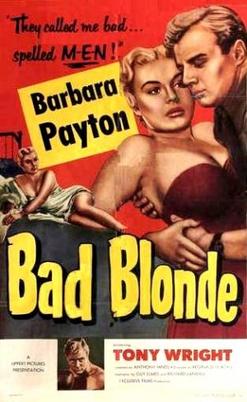
The Golden Age Of The B-Film Noir- Barbara Payton’s “Bad Blonde” (1953)


DVD Review

By Film Critic Emeritus Sam Lowell


Bad Blonde (released in England unbelievably as The Flanagan Boy), starring tragedy-filled blonde bombshell Barbara Payton, Tony Wright, Belinda Lee, Hammer Productions, 1953


I am done, finished, ended, kaput, vaya con dios, adios, out of here or whatever expression you like to indicate that before I blow my top I will go no further with this series of B-noirs (noirs not to die for unlike the lead-ins expression on each DVD intro). Part, the lesser part now, of that reason is based on getting tired, very tired, of the razing I have been receiving from my fellows here on this site after an irate reader called me out as essentially a “penny a word” buffoon “padding” my reviews with extra stuff that she believed didn’t need to be included in order to get the gist of what each film was about. The greater reason now is rather more simple one of B-noir exhaustion after struggling through trying to find any reason for watching the latest film in the series Bad Blonde which had many ways to go, had many possibilities to reach high B-noir almost A-level but sank into its own funk and never rose from the mud again.

To give one very germane example of what I should have expected since I have already reviewed a half dozen or so in the series is that in England the film was released under the totally boorish title The Flanagan Boy making me think of the old-time Boys’ Town out in Nebraska I think run by Father Flanagan from which every Christmas I would get some kind of Christmas stamps was supposed to send dough for the wayward boys as a result. Being wise to the world a little even then I never sent nothing since I had nothing to send although that did not stop me from using the stamps as cheap Christmas wrapping for presents. Yeah, times were that hard for us, for my family back then. But this Flanagan is nothing but an up and coming prize fighter, you know a boxer who spends his eye time eying like any good-looking young guy blondes, good or bad, or any other color around should. To name the film after him when this bad blonde dish comes hither and yon his way seemed like such a travesty along with the dialogue that I, like a used up prize fighter threw in the towel, or will after this excursion is over.                       


Here’s the beauty of a last review though. I don’t have to give, as we used to say in the old neighborhood, a rat’s ass about that irate reader who tagged me with that “penny a word” designation that will probably hang around my neck until they put me under the ground if my dear colleagues, led by Sandy Salmon, Alden Riley, and Pete Markin have anything to say about it. So I will “pad” this baby with whatever comes into my head.

This is what I started with in my last review as a lead in for this dog’s tail, a review of has-been (hell he did three of these Hammer films not to his subsequent film career advantage I don’t believe) Dane Clark’s Blackout (released in England under the quizzical title Murder by Proxy so this latest title travesty was hardly the first):   


“Wouldn’t you want a long-time film reviewer like me, or my colleagues in this space who are the regular reviewers, Sandy Salmon and Alden Riley, to draw a map for you, let you know what is what about any particular film in relationship to others in the genre. As the headline to this review notes (and has on other occasions in this ten film series) I am reviewing a series of B-film noirs from the 1950s produced by the Robert Lippert Hollywood-based organization in conjunction with Hammer Productions in England. The idea, at least this is what I have been able to gather from various readings and speculations after now having reviewed scads of these efforts, by Lippert was to grab some faded Hollywood star who either needed the dough or was looking for some film, any film, to satisfy whatever stardust lust drove him or her to the studio lots in the first place and back him or her up with an English cast, do the production in England and get away with costs on the cheap. If you knew that and then somebody, me, came along and told you that these efforts didn’t compare, didn’t compare at all with classic noirs, you know Out Of The Past, The Big Sleep, The Maltese Falcon, The Last Man Standing and others that you almost know all the lines from by heart since you have seen the films so many times, wouldn’t you appreciate that knowledge   

“You would think so but you would at least in one case, actually more, but the reader I am thinking of as I write this has become something of a thorn in my side, my efforts to draw comparisons have given me nothing but grief, and had hung on me the title of “penny a word” writer as a joke by my colleagues. 

“I noted in my last review in this series, The House Across The Lake, another has-been title that in my long career in the film reviewing racket, a profession if you will which is overall pretty subjective when you think about it, I have run up against all kind of readerships and readers but my recent escapade with one reader takes the cake as they used to say in the old days. That is the person I am thinking of right now as I write yet another screed against the injustice done to me by that person. To cut to the chase a B-grade film noir is one that is rather thin on plotline and maybe film quality usually made on the cheap although some of the classics with B-film noir queen Gloria Grahame have withstood the test of time despite that quality. I have contrasted those with the classics like The Maltese Falcon, Out Of The Past, The Big Sleep, and The Last Man Standing to give the knowledgeable reader an idea of the different.

“I have as already noted done a bunch of these (excluding a couple which I refused to review since they were so thin I couldn’t justify the time and effort to even give the “skinny” on them) using a kind of standard format discussing the difference between the classics and Bs in some detail and then as has been my wont throughout my career giving a short summary of the film’s storyline and maybe a couple of off-hand comments so that the readership has something to hang its hat on when choosing to see, or not see, the film. All well and good until about my fifth review when a reader wrote in complaining about my use of that standard form to introduce each film. Moreover and this is the heart of the issue she mentioned that perhaps I was getting paid per word, a “penny a word” in her own words and so was padding my reviews with plenty that didn’t directly relate to the specific film I was reviewing.

“Of course other than to cut me to the quick “penny a word” went out with the dime store novel and I had a chuckle over that expression since I have had various types of contracts for work over the years but not that one since nobody does that anymore. The long and short of it was that the next review was a stripped down version of the previous reviews which I assumed would satisfy her complaint. Not so. Using the name Nora Charles, the well-known distaff side of the Dashiell Hammett-inspired film series The Thin Man from the 1930s and early 1940s starring William Powell and Myrna Loy, she still taunted me with that odious expression of hers. (I also mentioned there as an aside that one of the pitfalls of citizen journalism, citizen commentary on-line is that one can use whatever moniker one wants to say the most unsavory things and not flame any blow-back). Now Sandy, Alden, Pete Markin, the administrator of this space and a few others have started to call me that as well-‘hey, penny a word.” That has made my blood boil on more than one occasion but I have calmly put up with it rather than blow-up and threaten murder and mayhem to them-and to Nora…..”      

As I pointed out in that review enough of this or Nora will really have case about me “padding” my reviews. Here is the “skinny” on the film under review Bad Blonde in any case as is my wont and let dear sweet Nora suffer through another review-if she dares. A lot could have been done with this plotline, no question, and no matter dear Nora now that I have flamed out I will explain a little by comparison why this damn film is a B and not a classic. Hey this one has the eternal dilemma at its heart. A young, bored, beautiful, 1950s standard beautiful blonde, which meant very blonde and very well aware of that hard fact to the sorrows of all the brunettes, red-heads and raven-haired beauties who took back benches to goddess blonde starting with Marilyn and working down to the bad blonde in this one, Barbara Payton, playing Lorna, the unhappy young trophy wife, of an older man, a wealthy man who seemingly made his dough in some kind of rackets, but who nevertheless seems to believe that everybody in the world was his friend. And maybe they were-except that young, bored, very blonde wife who nevertheless knew that she had tagged into the next best thing-grabbing a fistful of gold in her cheapjack tank dancer life. She was not about to give up the gravy train but she was also fed up with the old man’s pawing and grabbing. And she was savvy enough once her change came to have that action stop-stopped cold.   

Enter as if manna from heaven a young prize-fighter, a young handsome Johnny, played rather woodenly and distractedly by Tony Wright, with plenty of muscle and a fatal attraction to everything that wore a skirt. Enter her life through his manager’s connection with her husband whom he knew previously and who could provide the backing necessary to get this Johnny boy, this, huh, Flanagan boy to the top of the fight racket. Once the husband sees handsome bulging Johnny, but more importantly once Lorna see him in action in the ring, her lips pursed, teeth bared, sexually aroused by the sight of him she gets her act into high gear. That husband is headed for an early grave and that is that. Of course Lorna played her Johnny like a yo-yo ignoring him at first and making little of his manhood and then letting him steam up. Easy work. So easy that when she springs the deal, the real deal, although he isn’t bright enough to see her devilish play, he is all ears. Figures that he will sweep her and the dough up. Needless to say while the murder was rather tiresome, supposedly by drowning hubby, drowning him good and dead Johnny was put on the spot, would be the fall guy, would face the big step-off for his misdeeds.

That is all in a day’s work as far as this film goes. A hard day’s work since while Lorna (Barbara Payton) played her role pretty well as the, well, bad blonde, this muscle-bound Johnny, this Tony Wright is an airhead. Now for comparisons. Look the theme of the bored younger wife, although not always a blonde, trying to get rid of an older husband for dough, for another man, hell, just to have him stop mauling her no matter what the money situation is as old as Adam and Eve, maybe older. In film think about Lana Turner leading John Garfield right up to the big step-off after putting her old curmudgeon cheapie diner chef husband to the big sleep and he still smiling at the thought of her right before the lord high executioner is ready to do his work in The Postman Always Rings Twice.  Think about Fred MacMurry once he sees that ankle bracelet walking down the stairs and even before he sees Barbara Standwycks’ face he is a goner-and so is her older cheapskate engineer stay-at home husband in Double Indemnity. Think, oh forget it, those classics should not even be mentioned in the same paragraph as they interplay between Johnny and Lorna here. Do you see now why I no longer give a rat’s ass about this Hammer Production material.             

Unlike a few other films in this series this film never took turns like a real thriller but the lifeless dialogue and the wooden acting by the Brits (and by faded Barbara in spots too too) made this thing a holy goof. As I have mentioned before in other reviews where things actually looked promising at the beginning here despite the come hither title (in America anyway) and the titillating advertisement poster (see above) for the film this one faded away on its own dead weight. B-noir but seriously B not heading to classics-no way. I am done.                       


The Golden Age Of The B-Film Noir- Barbara Payton’s “Bad Blonde” (1953)


DVD Review

By Film Critic Emeritus Sam Lowell


Bad Blonde (released in England unbelievably as The Flanagan Boy), starring tragedy-filled blonde bombshell Barbara Payton, Tony Wright, Belinda Lee, Hammer Productions, 1953


I am done, finished, ended, kaput, vaya con dios, adios, out of here or whatever expression you like to indicate that before I blow my top I will go no further with this series of B-noirs (noirs not to die for unlike the lead-ins expression on each DVD intro). Part, the lesser part now, of that reason is based on getting tired, very tired, of the razing I have been receiving from my fellows here on this site after an irate reader called me out as essentially a “penny a word” buffoon “padding” my reviews with extra stuff that she believed didn’t need to be included in order to get the gist of what each film was about. The greater reason now is rather more simple one of B-noir exhaustion after struggling through trying to find any reason for watching the latest film in the series Bad Blonde which had many ways to go, had many possibilities to reach high B-noir almost A-level but sank into its own funk and never rose from the mud again.

To give one very germane example of what I should have expected since I have already reviewed a half dozen or so in the series is that in England the film was released under the totally boorish title The Flanagan Boy making me think of the old-time Boys’ Town out in Nebraska I think run by Father Flanagan from which every Christmas I would get some kind of Christmas stamps was supposed to send dough for the wayward boys as a result. Being wise to the world a little even then I never sent nothing since I had nothing to send although that did not stop me from using the stamps as cheap Christmas wrapping for presents. Yeah, times were that hard for us, for my family back then. But this Flanagan is nothing but an up and coming prize fighter, you know a boxer who spends his eye time eying like any good-looking young guy blondes, good or bad, or any other color around should. To name the film after him when this bad blonde dish comes hither and yon his way seemed like such a travesty along with the dialogue that I, like a used up prize fighter threw in the towel, or will after this excursion is over.                       


Here’s the beauty of a last review though. I don’t have to give, as we used to say in the old neighborhood, a rat’s ass about that irate reader who tagged me with that “penny a word” designation that will probably hang around my neck until they put me under the ground if my dear colleagues, led by Sandy Salmon, Alden Riley, and Pete Markin have anything to say about it. So I will “pad” this baby with whatever comes into my head.

This is what I started with in my last review as a lead in for this dog’s tail, a review of has-been (hell he did three of these Hammer films not to his subsequent film career advantage I don’t believe) Dane Clark’s Blackout (released in England under the quizzical title Murder by Proxy so this latest title travesty was hardly the first):   


“Wouldn’t you want a long-time film reviewer like me, or my colleagues in this space who are the regular reviewers, Sandy Salmon and Alden Riley, to draw a map for you, let you know what is what about any particular film in relationship to others in the genre. As the headline to this review notes (and has on other occasions in this ten film series) I am reviewing a series of B-film noirs from the 1950s produced by the Robert Lippert Hollywood-based organization in conjunction with Hammer Productions in England. The idea, at least this is what I have been able to gather from various readings and speculations after now having reviewed scads of these efforts, by Lippert was to grab some faded Hollywood star who either needed the dough or was looking for some film, any film, to satisfy whatever stardust lust drove him or her to the studio lots in the first place and back him or her up with an English cast, do the production in England and get away with costs on the cheap. If you knew that and then somebody, me, came along and told you that these efforts didn’t compare, didn’t compare at all with classic noirs, you know Out Of The Past, The Big Sleep, The Maltese Falcon, The Last Man Standing and others that you almost know all the lines from by heart since you have seen the films so many times, wouldn’t you appreciate that knowledge   

“You would think so but you would at least in one case, actually more, but the reader I am thinking of as I write this has become something of a thorn in my side, my efforts to draw comparisons have given me nothing but grief, and had hung on me the title of “penny a word” writer as a joke by my colleagues. 

“I noted in my last review in this series, The House Across The Lake, another has-been title that in my long career in the film reviewing racket, a profession if you will which is overall pretty subjective when you think about it, I have run up against all kind of readerships and readers but my recent escapade with one reader takes the cake as they used to say in the old days. That is the person I am thinking of right now as I write yet another screed against the injustice done to me by that person. To cut to the chase a B-grade film noir is one that is rather thin on plotline and maybe film quality usually made on the cheap although some of the classics with B-film noir queen Gloria Grahame have withstood the test of time despite that quality. I have contrasted those with the classics like The Maltese Falcon, Out Of The Past, The Big Sleep, and The Last Man Standing to give the knowledgeable reader an idea of the different.

“I have as already noted done a bunch of these (excluding a couple which I refused to review since they were so thin I couldn’t justify the time and effort to even give the “skinny” on them) using a kind of standard format discussing the difference between the classics and Bs in some detail and then as has been my wont throughout my career giving a short summary of the film’s storyline and maybe a couple of off-hand comments so that the readership has something to hang its hat on when choosing to see, or not see, the film. All well and good until about my fifth review when a reader wrote in complaining about my use of that standard form to introduce each film. Moreover and this is the heart of the issue she mentioned that perhaps I was getting paid per word, a “penny a word” in her own words and so was padding my reviews with plenty that didn’t directly relate to the specific film I was reviewing.

“Of course other than to cut me to the quick “penny a word” went out with the dime store novel and I had a chuckle over that expression since I have had various types of contracts for work over the years but not that one since nobody does that anymore. The long and short of it was that the next review was a stripped down version of the previous reviews which I assumed would satisfy her complaint. Not so. Using the name Nora Charles, the well-known distaff side of the Dashiell Hammett-inspired film series The Thin Man from the 1930s and early 1940s starring William Powell and Myrna Loy, she still taunted me with that odious expression of hers. (I also mentioned there as an aside that one of the pitfalls of citizen journalism, citizen commentary on-line is that one can use whatever moniker one wants to say the most unsavory things and not flame any blow-back). Now Sandy, Alden, Pete Markin, the administrator of this space and a few others have started to call me that as well-‘hey, penny a word.” That has made my blood boil on more than one occasion but I have calmly put up with it rather than blow-up and threaten murder and mayhem to them-and to Nora…..”      

As I pointed out in that review enough of this or Nora will really have case about me “padding” my reviews. Here is the “skinny” on the film under review Bad Blonde in any case as is my wont and let dear sweet Nora suffer through another review-if she dares. A lot could have been done with this plotline, no question, and no matter dear Nora now that I have flamed out I will explain a little by comparison why this damn film is a B and not a classic. Hey this one has the eternal dilemma at its heart. A young, bored, beautiful, 1950s standard beautiful blonde, which meant very blonde and very well aware of that hard fact to the sorrows of all the brunettes, red-heads and raven-haired beauties who took back benches to goddess blonde starting with Marilyn and working down to the bad blonde in this one, Barbara Payton, playing Lorna, the unhappy young trophy wife, of an older man, a wealthy man who seemingly made his dough in some kind of rackets, but who nevertheless seems to believe that everybody in the world was his friend. And maybe they were-except that young, bored, very blonde wife who nevertheless knew that she had tagged into the next best thing-grabbing a fistful of gold in her cheapjack tank dancer life. She was not about to give up the gravy train but she was also fed up with the old man’s pawing and grabbing. And she was savvy enough once her change came to have that action stop-stopped cold.   

Enter as if manna from heaven a young prize-fighter, a young handsome Johnny, played rather woodenly and distractedly by Tony Wright, with plenty of muscle and a fatal attraction to everything that wore a skirt. Enter her life through his manager’s connection with her husband whom he knew previously and who could provide the backing necessary to get this Johnny boy, this, huh, Flanagan boy to the top of the fight racket. Once the husband sees handsome bulging Johnny, but more importantly once Lorna see him in action in the ring, her lips pursed, teeth bared, sexually aroused by the sight of him she gets her act into high gear. That husband is headed for an early grave and that is that. Of course Lorna played her Johnny like a yo-yo ignoring him at first and making little of his manhood and then letting him steam up. Easy work. So easy that when she springs the deal, the real deal, although he isn’t bright enough to see her devilish play, he is all ears. Figures that he will sweep her and the dough up. Needless to say while the murder was rather tiresome, supposedly by drowning hubby, drowning him good and dead Johnny was put on the spot, would be the fall guy, would face the big step-off for his misdeeds.

That is all in a day’s work as far as this film goes. A hard day’s work since while Lorna (Barbara Payton) played her role pretty well as the, well, bad blonde, this muscle-bound Johnny, this Tony Wright is an airhead. Now for comparisons. Look the theme of the bored younger wife, although not always a blonde, trying to get rid of an older husband for dough, for another man, hell, just to have him stop mauling her no matter what the money situation is as old as Adam and Eve, maybe older. In film think about Lana Turner leading John Garfield right up to the big step-off after putting her old curmudgeon cheapie diner chef husband to the big sleep and he still smiling at the thought of her right before the lord high executioner is ready to do his work in The Postman Always Rings Twice.  Think about Fred MacMurry once he sees that ankle bracelet walking down the stairs and even before he sees Barbara Standwycks’ face he is a goner-and so is her older cheapskate engineer stay-at home husband in Double Indemnity. Think, oh forget it, those classics should not even be mentioned in the same paragraph as they interplay between Johnny and Lorna here. Do you see now why I no longer give a rat’s ass about this Hammer Production material.             

Unlike a few other films in this series this film never took turns like a real thriller but the lifeless dialogue and the wooden acting by the Brits (and by faded Barbara in spots too too) made this thing a holy goof. As I have mentioned before in other reviews where things actually looked promising at the beginning here despite the come hither title (in America anyway) and the titillating advertisement poster (see above) for the film this one faded away on its own dead weight. B-noir but seriously B not heading to classics-no way. I am done.