Saturday, March 2, 2013

In Honor Of The 94th Anniversary Of The Founding Of The Communist International-Take Two –A Child Of The Revolution


From The Pen Of Frank Jackman
He was a child of the revolution, the big old Bolshevik Revolution that had enveloped Russia couple of years back, back in November 1917 (new calendar, new like everything else that was good happening in that formerly benighted land although there was plenty that was still bad, bad as human experience could fathom going on), if anybody was asking. And if while you were asking you wanted a name to attach to that child then Boris Yanoff (or Yanov, if you like), all of sixteen but already with a couple of revolutionary years under his belt. See Boris had lost his father in one of those ill-advised Russian Army advances against the Germans on the eastern front, maybe at Tannenburg, or some place like that and around that time so he would tell everybody that was where his father fell defending the Czar, the bloody bastard Czar.

The upshot of that father death was that Boris had travelled to Moscow from his wretched family farm in Omsk to find work in the textile mills that were in need of help to supply the huge needs of the Russian in advance, or retreat, mostly the latter. Hell, that family farm thing was really a joke it only barely a garden plot, and the crops wouldn’t show up half the time and all that but he was done with that he was a working now, a proud young worker.

Boris, like a lot of fourteen -year old coming to the city, any city but particularly Moscow, was kind of a hayseed, kind of a know-nothing kid when he came to get that factory work. But he was a fast learning, fast learning how to operate the machinery but also to figure out where he stood in the world, his new working class world. So when the Bolsheviks in the textile plant in summer of 1917 started going on and on about the wretched war, about how the Czar and now the bourgeois government, some coalition between socialists and capitalist, wanted to stay in the damn war, wanted to let the big landowners keep their land, wanted to let the factory owners keep their blood-stained profits he was all ears. It was icing on the cake when one Bolshevik rank and filer whom he worked with got him going by saying that if he went with the Bolsheviks that would help avenge his father’s cruel death for no reason out in some forgotten Czarist killing field. So Boris was in, read the newspapers, and, more importantly joined the factory defense committee and learned how to shoot, shoot for real, not that silly goose pop gun stuff back on the farm.

Then the day of reckoning came. November 7, 1917 (again new calendar to herald a new era). He had heard through the factory grapevine that the Bolsheviks had risen in Saint Petersburg and had declared the Provisional Government null and void, the war null and void, and the big landowners and capitalists null and void and in their place the Soviets, the workers, peasants, and soldiers councils, the people’s voice. Right after that his factory committee was put on notice that they would try to take power in Moscow and while Saint Petersburg’s had been relatively bloodless they, he and his comrades, had a hell of fight, a bloody fight where he lost more than a few shop mates, before they could declare the Moscow Soviet.

As he sat at his bench reading a much passed copy ofPravda now in early March 1919 he thought about that bloody fight, about how he had joined the Red Guards after that, had been called up a couple of times to go out on the outskirts of Moscow and defend the city against the White Guard bastards who were trying to take the land and factories back. No way, no way in hell not after what he and his father had been through in Old Russia. Now they, his Bolshevik comrades, were going to hold a conference, and international conference, where the idea was that what he and his comrades had done in Russia would get done all over the world. That idea, that idea of other countries getting their soviet power and then helping poor Russia appealed to him. He was not so sure about Lenin, although he was the head of the government and he had heard him speak in Red Square after the government had moved here to Moscow when things got tough but he read where Trotsky was all for this Communist International and was going to speak at the conference . And if Trotsky and his fighting phantom train mates were for it then it must be okay. He kind of got a lump in his throat when he thought about that, about how, for once, he was among the first to be fighting for that new world that got him motivated in1917. Yes, he was a child of the revolution and he hoped juts that minute that he would see it through to the end…

SPEECHES ON GRAMOPHONE RECORDS

V. I. Lenin

2

The Third, Communist International

Recorded: End of March 1919;
First Published: Published according to the gramophone records; Organization of these speeches was accomplished by Tsentropechat the central agency of the All-Russia Central Executive Committee for the Supply and Distribution of Periodicals between 1919 and 1921. 13 of Lenin’s speeches were recorded.
Source: Lenin’s Collected Works, 4th English Edition, Progress Publishers, Moscow, 1972 Volume 29, pages 240-241
Translated: George Hanna
Transcription/HTML Markup: David Walters & Robert Cymbala
Copyleft: V. I. Lenin Internet Archive (www.marx.org) 2002; Permission is granted to copy and/or distribute this document under the terms of the GNU Free Documentation License.


In March of this year of 1919, an international congress of Communists was held in Moscow. This congress founded the Third, Communist International, an association of the workers of the whole world who are striving to establish Soviet power in all countries.

The First International, founded by Marx, existed from 1864 to 1872. The defeat of the heroic workers of Paris-of the celebrated Paris Commune-marked the end of this International. It is unforgettable, it will remain for ever in the history of the workers' struggle for their emancipation. It laid the foundation of that edifice of the world socialist republic which it is now our good fortune to be building.

The Second International existed from 1889 to 1914, up to the war. This was the period of the most calm and peaceful development of capitalism, a period without great revolutions. During this period the working-class movement gained strength and matured in a number of countries. But the workers' leaders in most of the parties had become accustomed to peaceful conditions and had lost the ability to wage a revolutionary struggle. When, in 1914, there began the war, that drenched the earth with blood for four years, the war between the capitalists over the division of profits, the war for supremacy over small and weak nations, these leaders deserted to the side of their respective governments. They betrayed the workers, they helped to prolong the slaughter, they became enemies of socialism, they went over to the side of the capitalists.

The masses of workers turned their backs on these traitors to socialism. All over the world there was a turn towards the revolutionary struggle. The war proved that capitalism was doomed. A new system is coming to take its place. The old word socialism had been desecrated by the traitors to socialism.
Today, the workers who have remained loyal to the cause of throwing off the yoke of capital call themselves Communists. All over the world the association of Communists is growing. In a number of countries Soviet power has already triumphed. Soon we shall see the victory of communism throughout the world; we shall see the foundation of the World Federative Republic of Soviets.


Friday, March 1, 2013

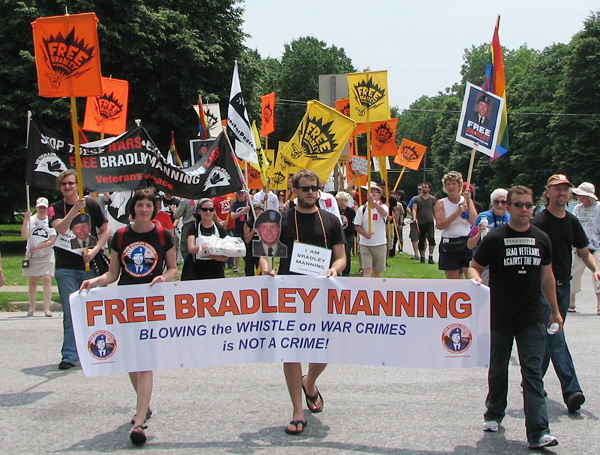
Pardon Private Bradley Manning Stand-Out-Central Square, Cambridge, Wednesdays, 5:00 PM -Update –March 1, 2013


Let’s Redouble Our Efforts To Free Private Bradley Manning-President Obama Pardon Bradley Manning -Make Every Town Square In America (And The World) A Bradley Manning Square From Boston To Berkeley to Berlin-Join Us In Central Square, Cambridge, Ma. For A Stand-Out For Bradley- Wednesdays From 5:00-6:00 PM

***********

Since September 2011, in order to publicize Private Manning’s case locally, there have been weekly stand-outs (as well as other more ad hocand sporadic events) in various locations in the Greater Boston area starting in Somerville across from the Davis Square Redline MBTA stop on Friday afternoons and later on Wednesdays. Lately this stand-out has been held each week on Wednesdays from 5:00 to 6:00 PM at Central Square, Cambridge, Ma. (small park at the corner of Massachusetts Avenue and Prospect Street just outside the Redline MBTA stop, renamed Manning Square for the duration of the stand-out) in order to continue to broaden our outreach. Join us there in calling for Private Manning’s freedom.President Obama Pardon Private Manning Now!

***********

The Private Bradley Manning case is headed toward an early summer trial now scheduled for June 2013. The news on his case over the past several months (since about April 2012) has centered on the many pre-trial motion hearings including recent defense motions to dismiss for lack of speedy trial. Private Manning’s pre-trial confinement is now at over 1000 days and will be over well over 1000 days by the time of trial. That motion has now been ruled on by Military Judge Lind and she had denied the defende motion for dismissal, the last serious chance for Bradley Manning to go free before the scheduled June trial. She ruled furthermore that the various delays were inherent in the nature of this case and that the military authorities except in one short instance had been diligent in it efforts to move the proceedings along. For those of us with military experience this is a classic, if perverse, case of that old army slogan-“Hurry up, and wait.” This is definitely tough news for Private Manning although perhaps a good appeal point in some future civilian review.

******

The defense contends that the charges should be dismissed because the military by its own statutes (to speak nothing of that funny old constitutional right to a speedy trial guarantee that our plebeian forbears fought tooth and nail for against the bloody British and later made damn sure was included in the Amendments when the founding fathers“forgot” to include it in the main document) should have arraigned Private Manning within 120 days after his arrest. They hemmed and hawed for almost 600 days before deciding on the charges and a court martial. Nobody in the convening authority, as required by those same statutes, pushed the prosecution forward in a timely manner. In fact the court-martial convening authority, in the person of oneColonel Coffman, seems to have seen his role as mere “yes man” to each of the government’s eight requests for delays without explanation (and without informing the defense in order to take their objection). Apparently the Colonel saw his role as a mere clearing agent for whatever excuse the government gave, mainly endless addition time for clearing various classified documents a process that need not have held up the proceedings. The defense made timely objection to each governmental request to no avail.

Testimony from military authorities at pre-trial hearings in November 2012 about the reasons for the lack of action ranged from the lame to the absurd (mainly negative responses to knowledge about why some additional delays were necessary. One “reason” sticks out as a reason for excusable delay -some officer needed to get his son to a swimming meet and was thus “unavailable” for a couple of days. I didn’t make this up. I don’t have that sense of the absurd. Jesus, a man was rotting in Obama’s jails and they let him rot because of some damn swim meet). The prosecution, obviously, has argued that the government has moved might and main to move the case along and had merely waited until all leaked materials had been determined before proceeding. We shall see.

The defense has also recently pursued a motion for a dismissal of the major charges (espionage/ indirect material aid to terrorists) on the basis of the minimal effect of any leaks on national security issues as against Private Manning’s claim that such knowledge was important to the public square (freedom of information issues important for us as well in order to know about what the hell the government is doing either in front of us, or behind our backs). Last summer witnesses from an alphabet soup list of government agencies (CIA, FBI, NSA, Military Intelligence, etc., etc.) testified that while the information leaked shouldn’t have been leaked that the effect on national security was de minimus. The Secretary of Defense at the time, Leon Panetta, also made a public statement to that effect. The prosecution argued, successfully at the time, that the mere fact of the leak of classified information caused irreparable harm to national security issues and Private Manning’s intent, even if noble, was not at issue.

The recent thrust of the motion to dismiss has centered on the defense’s contention been that Private Manning consciously and carefully screened any material in his possession to avoid any conflict with national security and that most of the released material had been over-classified (received higher security level than necessary).(Much of the materials leaked, as per those parts published widely in the aftermath of the disclosures by the New York Times and other major outlets, concerned reports of atrocities in Iraq and Afghanistan and diplomatic interchanges that reflected poorly on that profession.) The Obama government has argued again that the mere fact of leaking was all that mattered. That motion has also not been fully ruled on and is now the subject of prosecution counter- motions and a cause for further trial delay.

A defense motion for dismissal based on serious allegations of torturous behavior by the military authorities extending far up the chain of command (a three-star Army general, not the normal concern of someone so far up the chain in the matter of discipline for enlisted personal) while Private Manning was first detained in Kuwait and later at the Quantico Marine brig for about a year ending in April 2011 has now been ruled on. In late November and early December Private Manning himself, as well as others including senior military mental health workers, took the stand to detail those abuses over several days. Most important to the defense was the testimony by qualified military mental health professionals citing the constant willful failure of those who held Private Manning in close confinement to listen to, or act, on their recommendations during those periods

Judge Lind, the military judge who has heard all the pre-trial arguments in the case thus far, has essentially ruled unfavorably on that motion to dismiss given the potential life sentence Private Manning faces. As she announced at an early January pre-trial hearing the military acted illegally in some of its actions. While every Bradley Manning supporter should be heartened by the fact that the military judge ruled that he was subject to illegal behavior by the military during his pre-trial confinement her remedy, a 112 days reduction in any future sentence, is a mere slap on the wrist to the military authorities. No dismissal or, alternatively, no appropriate reduction (the asked for ten to one ratio for all his first year or so of illegal close confinement which would take years off any potential sentence) given the seriousness of the illegal behavior as the defense tirelessly argued for. And the result is a heavy-handed deterrent to any future military whistleblowers, who already are under enormous pressures to remain silent as a matter of course while in uniform, and others who seek to put the hard facts of future American military atrocities before the public.

Some other important recent news, this from the November 2012 pre-trail sessions, is the offer by the defense to plead guilty to lesser charges (wrongful, unauthorized use of the Internet, etc.) in order to clear the deck and have the major espionage /aiding the enemy issue (with a possibility of a life sentence) solely before the court-martial judge, Judge Lind (the one who has been hearing the pre-trial motions, not some senior officer, senior NCO lifer-stacked panel. A wise move, a very wise move.). Also there has been increased media attention by mainstream outlets around the case (including the previously knowingly oblivious New York Times), as well as an important statement by three Nobel Peace Laureates (including Bishop Tutu from South Africa) calling on their fellow laureate, United States President Barack Obama, to free Private Manning from his jails.

************

Check the Bradley Manning Support Network -http://www.bradleymanning.org/ for details and future updates.

*Contribute to the Bradley Manning Defense Fund- as the trial date approaches funds are urgently needed! The government has unlimited financial and personnel resources to prosecute Bradley. And the Obama government is fully using them. We have a fine defense civilian lawyer, David Coombs, many supporters throughout America and the world working hard for Bradley’s freedom, and the truth on our side. Still the hard reality of the American legal system, civilian or military, is that an adequate defense cost serious money. So help out with whatever you can spare. For link go to http://www.bradleymanning.org/ for

*Sign the online petition at the Bradley Manning Support Network (for link go to http://www.bradleymanning.org/ )to the Secretary of the Army to free Bradley Manning-1000 plus days is enough! The Secretary of the Army stands in the direct chain of command up to the President and can release Private Manning from pre-trial confinement and drop the charges against him at his discretion. For basically any reason that he wishes to-let us say 1000 days is enough. Join the over 25,000 supporters in the United States and throughout the world clamoring for Bradley’s well-deserved freedom.

*Call (Comments”202-456-1111, write9 The White House, 1600 Pennsylvana Avenue NW, Washington, DC 20500, e-mail-(http://www.whitehouse.gov’contact/submitquestions-and comments) the White House to demand President Obama pardon Bradley Manning- The presidential powers to pardon is granted under Article II, Section 2 of the Constitution:

“The President…shall have power to grant reprieves and pardons for offenses against the United States, except in case of impeachment .”

In federal cases, and military cases are federal cases, the President of the United States can, under authority granted by the U.S. Constitution as stated above, pardon the guilty and the innocent, the convicted and those awaiting trial- former President Nixon and former Secretary of Defense Caspar Weinberger, for example among others, received such pardons of their heinous crimes- Free Bradley Manning ! Free the whistleblower!

Rally for Bradley Manning. Join us at Fort Meade on June 1, 2013.

Join us at Fort Meade in support of Bradley Manning. By the time his court martial begins in June, he will have spent more then 3 years in prison. All for having done the right thing, for having exposed war crimes!
Join us at Fort Meade in support of Bradley Manning. By the time his court martial begins in June, he will have spent more then 3 years in prison. All for having done the right thing, for having exposed war crimes! Saturday, June 1, 2013 RALLY FOR BRADLEY AT FORT MEADE
By the Bradley Manning Support Network, February 25, 2013.
• 1pm Gather (Reece Road and US 175, Fort Meade, Maryland)
• 2pm March
• 3pm Rally and Speak Out

Sponsored by the Bradley Manning Support Network and the national Veterans for Peace organization, with the help of Courage to Resist, and many other groups.
After more than three years of imprisonment, including nine months of torture, Nobel Peace
Prize nominee Bradley Manning’s trial is finally scheduled to begin June 3, 2013, at Fort Meade,
Maryland. The outcome of this trial will determine whether a conscience-driven 25-year-
old WikiLeaks whistle-blower spends the rest of his life in prison. Bradley believed that the
American people have a right to know the truth about what our government does around the
world in our name. We the People must send a message to the military prosecuting authority,
and President Obama, that Bradley Manning is a patriot and heroic truth-teller.
June 1st is the International Day of Action to Support Bradley Manning. Join us at Fort Meade on
the eve of Bradley’s court martial. Solidarity actions are welcome at bases, recruiting centers and US
embassies worldwide. We ask that Veterans for Peace join us in cosponsoring these historic events.
——————————-
Monday, June 3, 2013
ATTEND THE BEGINNING OF US v. BRADLEY MANNING
8:30 am, enter Fort Meade at Reece Road and US 175, Fort Meade, Maryland
9:00 am scheduled daily start of hearings at Magistrate Court
4432 Llewellyn Avenue, Fort Meade, MD. It is 2 miles from the Main Gate.
The court martial is expected to last 6-12 weeks. Supporters are encouraged to attend as many days of
this trial as they are able.
——————————-
Parking for Saturday, June 1, 2013. We hope to come to an understanding with local
authorities regarding the best place for supporters to park for the Saturday rally. Parking is
available about one mile south near Blue Water Blvd (Weis Market) and US 175. We’ll try to
help shuttle folks as needed.
Portable toilets are expected to be available.
Join us in the courtroom for the trial beginning June 3, 2013. Drive (or taxi) to the Fort Meade Visitor
Control Center at the Fort Meade Main Gate (all the other gates are for military ID holders only), Reece
Road and US 175, Fort Meade, Maryland. We suggest arriving when the visitor center opens at 7:30am,
and certainly before 8:15am. The proceedings are scheduled to begin at 9am daily. The multiple layers
of security take time to navigate, and procedures often change from day to day. Each person will need
a valid state or federal photo ID such as a driver’s license, state photo ID card, or passport. Foreign
passports are accepted. Anyone driving on to Fort Meade will be required to submit their driver’s
license, vehicle registration, and printed (not digital) proof of insurance. Your vehicle will be subject
to search, and you may be required to cover over political bumper stickers on your vehicle. Consider
walking on base if there are any questions at all regarding your vehicle and paperwork.
The proceedings will be held at the Magistrate Court, 4432 Llewellyn Ave, Fort Meade, MD
20755 (this is one mile from the Visitor Center). Electronic devices, including cell phones,
computers, cameras, are not allowed in the courtroom, and should be left in your vehicle.
There are no pre-registration requirements for the public to attend the proceedings. However,
those wishing to attend as credentialed media should contact the US Army Military District of
Washington Public Affairs Office at 202-685-4645.
GETTING THERE
The Fort Meade Main Gate is less than 10 miles south of the Baltimore-Washington DC
International (BWI) airport. It is located between Washington DC and Baltimore MD.
Driving:
From Washington, DC, take MD-295 N towards BALTIMORE to US 175 EAST, then follow
175 EAST until you come to Reece Road. From Baltimore, MD, take MD-295 S towards
WASHINGTON to US 175 EAST, then take 175 EAST until you come to Reece Road.
Buses:
We hope to charter buses for supporters from both downtown Washington DC and Baltimore,
Maryland.
There is regional bus service from BWI Airport to the Arundel Mills Shopping Center (Bus 017).
Then take the CTC K to the Main Gate. For a Google Maps public transit view of this option:
http://alturl.com/3ehis
Train:
Note that the nearby Odenton MARC train station serves commuter trains only and does not
run on the weekend. Amtrak does not stop at this station.
WHERE TO STAY
There are many hotels serving this area just south of the BWI Airport. The closest of these are
5-6 miles from the Ft. Meade Main Gate. One option is Aloft Arundel Mills, 7520 Teague Rd,
Hanover, MD, 21076 (866-539-0036), $80-$100 night. A hotels.com search of the area turns up
rooms nearby starting at $60 a night. The only lodging really close to the Ft. Meade Main Gate
is the White Gables Motel; however, for a number of reasons, we strongly suggest avoiding it.


Bradley Manning’s speedy trial motion denied, despite nearly three years without trial

In a pretrial hearing at Fort Meade, MD, Judge Denise Lind denied the defense’s motion to dismiss charges for lack of a speedy trial. She listened to arguments over government evidence, a written statement from Bradley, and an updated plea offer. Bradley will get a chance to explain his releases to WikiLeaks in a public discussion with the judge on Thursday.
By Nathan Fuller, Bradley Manning Support Network. February 26, 2013.
c1e92bec9dd9401f92d78c305f5b218c
Defense lawyer David Coombs and PFC Bradley Manning, sketched by Clark Stoeckley of the Bradley Manning Support Network.
On PFC Bradley Manning’s 1,005th day in prison without trial, military judge Denise Lind ruled that the government has not deprived him of his due process right to a speedy trial. Rules for court martial require the military to arraign defendants within 120 days, and more than 600 passed before prosecutors arraigned Bradley. Judge Lind denied the defense motion to dismiss charges, ruling that the delays excluded by the Convening Authority were justifiably removed from the speedy trial clock.
Judge Lind repeatedly referenced the “complexity” of the case and the “voluminous” set of documents at issue. She did say that prosecutors mishandled discovery documents and were not justified in delaying 6 days from the speedy trial clock shortly following the Article 32 pretrial hearing in December 2011. However, those caveats didn’t outweigh her decision that the government was otherwise largely diligent.
The ruling, a verbose litany of dates, delays, and correspondence, took more than two hours to read and was virtually impossible to transcribe in full. Judge Lind refuses to make her rulings, or any filings or transcripts for that matter, publicly available, so reporters are left to scramble and summarize.
Defense, Judge Lind question government’s prejudicial evidence
Judge Lind then questioned the prejudicial nature of the government’s request to submit evidence allegedly retrieved at Osama bin Laden’s raided compound in Abbottabad, Pakistan. Prosecutors said they want to prove that the United States’ enemy “received” documents that Bradley’s accused of releasing. But defense lawyer David Coombs said that the government could show evidence from anyone to prove that the documents were in fact published on the Internet, and that this move is intended to incur prejudice against Bradley, either from a potential jury or in the court of public opinion. Prosecutors have chosen bin Laden, Coombs implied, to impugn Bradley’s character in connecting him to America’s enemies.
Furthermore, Coombs said that this request contradicts the government’s previous contention that events after the fact – such as the lack of damage done to national security – are irrelevant to whether Bradley committed the offense. The defense is not allowed to show that WikiLeaks’ releases brought no harm to the U.S. on the grounds that later harm isn’t relevant.
Bradley Manning to make his case on Thursday
Finally, the defense has submitted a written statement explaining Bradley’s offer to plead guilty to several lesser-included offenses and not guilty to some of the major specifications. Bradley is expected to proffer to plead guilty to lesser offenses, such as “unauthorized possession” of documents instead of “exceeds authorized access,” that would carry a maximum of 20 years in jail. The plea offer triggers an in-session colloquy between Bradley and Judge Lind, currently scheduled for Thursday, in which she’ll ask him a series of questions to ensure he understands to what he’s pleading. Bradley submitted the supplemental statement, which is at least 25 pages long, to educate Judge Lind ahead of the discussion.
The government objected to the statement, claiming many of the personal and political factors Bradley wishes to discuss are irrelevant to the charged offenses. By way of these objections, we learned that included in the statement are some of Bradley’s explanations and feelings about WikiLeaks’ releases. For instance, he wrote to Judge Lind that he’d hoped the release of the Iraq War Logs would ‘spark a domestic debate on the role of our military and foreign policy in general.’
The statement also alludes to the seminal incident in the Army in which Bradley objected to Iraqi Federal Police detaining political dissidents for distributing literature. As he told Adrian Lamo in chat logs published by Wired, Bradley reported the repressive arrests to his superiors but was told to keep quiet and continue helping Iraqi police. This stonewalling, it was implied, led Bradley to look for alternative outlets to expose this abuse.
Poet’s Corner- Claude McKay-If We Must Die-In Honor Of The 94thAnniversary Of The Communist International


…they had heard that a group of White Guards, a first detachment on horse, maybe from the dreaded mercenary Czech Legion that were running amok form Siberia to the Urals or worst maybe the dreaded Cossacks who took no prisoners, none, were heading their way, heading right for their line of defense in the city ready to take back Kazan for the asking, so those Whites thought. Kazan fallen then the road to Moscow lay wide open and perhaps the end of the Soviet experiment in that dragged on second year of hellish civil war. But Commissar Vladimir and his band of comrade brothers, five in all, (and one sister, one stray Red Emma, they called her who learned of revolution and sex, young love smitten sex even in war-torn Kazan with young Zanoff, in that exact order while in their company and proved as fierce a fighter both ways, according to that same Zanoff, as any man) swore, swore a blood oath on their tattered red flag, the previous day that they would retreat no further, that here was their stand, their last stand if necessary but no more moves away from Moscow.

It had not always been that way with them, not by a long shot. They had all farmed, like their fathers eons before them, the same fruitless task (for them) land for Orlov, the richest landowner in Omsk, and never lifted their heads when the Social Revolutionaries had come with glad tidings (and before them other city radicals had spoken to their fathers and grandfathers). They just shoveled the dirt and kept their heads down. Then the war came, the bloody world war, and the Czar’s police came and “drafted” them into some vast ill-fed, ill-clad, ill-armed peasant force which proved no match for the methodical Germans as they were slaughtered by the millions in those foul trenches. And still they kept their heads bent. Kept them bent until the February revolution and in the fall of 1917 they had just followed their fellow out of the trenches and went home. Went home to farm Orlov’s land. Even when the Bolsheviks took power in November and decreed the land of Orlov’s theirs they kept their heads bent. It was not until Orlov and his agents and his White Guard friends came back and took the land, their now precious land, that they roared back. And joined one of Trotsky’s red brigades passing through.
Just then a messenger came to their line, a messenger from the river in front of Kazan. The message said that Trotsky himself had decided to fight and die before Kazan if necessary to save the revolution, to save their precious land. Vladimir and his comrades, including Red Emma, reaffirmed their blood oath. If they must die they would die in defense of Kazan, and maybe just maybe somebody would hear of their story, the story of five peasant boys and a pretty peasant girl as brave as they, and lift their heads and roar back too….
******

If We Must Die

If we must die, let it not be like hogs
Hunted and penned in an inglorious spot,
While round us bark the mad and hungry dogs,
Making their mock at our accursèd lot.
If we must die, O let us nobly die,
So that our precious blood may not be shed
In vain; then even the monsters we defy
Shall be constrained to honor us though dead!
O kinsmen! we must meet the common foe!
Though far outnumbered let us show us brave,
And for their thousand blows deal one death-blow!
What though before us lies the open grave?
Like men we'll face the murderous, cowardly pack,
Pressed to the wall, dying, but fighting back!


Workers Vanguard No. 1018
22 February 2013

Black History Month

Class, Race and the Black Struggle in the U.S.

Claude McKay, 1922

Claude McKay, a Jamaican-born poet active on the left in the U.S. and Britain, traveled to Soviet Russia for the Fourth Congress of the Communist International in November 1922. In his presentation at the Congress (reprinted in “Blacks and Bolsheviks,” Black History and the Class Struggle No. 5, February 1988), McKay stressed the centrality of black oppression to American capitalism and criticized American Communists for not adequately addressing this issue. It took the intervention of the Comintern to get the American Communists to begin to actively fight for black rights.

At the time of the Congress, he drafted notes about the situation of black people in the United States, the Caribbean and Africa. The notes are unsigned, but McKay referred to them in other correspondence. We print below excerpts from the sections on the black struggle in the U.S., which we obtained from Tamiment Library at New York University. The original is in the Russian State Archive of Socio-Political History (RGASPI) in Moscow. In his notes, McKay refers to the African Blood Brotherhood, a Harlem-based organization, mainly comprising Caribbean immigrants, whose leadership had recently joined the American Communist Party.

*   *   *

During the World War the economic status of the Negro Race in the New World underwent a swift transition for the better. Especially was this the case in the United States where, on account of the giant war industries and the shutting down of immigration, the services of Negro workers were greatly in demand in the northern industrial zone. During this period it is estimated that over 500,000 Negro workers left the South for jobs in the less hostile atmosphere of the North.

Along with the improvement in their economic status came a great wave of emotional racialism, aroused in part by the wrongs suffered by the race and the sacrifices it was called upon to make for “World Democracy,” as well as by the fine democratic phrases with which the Entente statesmen were gassing the credulous liberals of their own countries and misleading the peoples of the colonies. This racialism among the Negro workers at first took the form of a proletariat movement but has been to a great extent perverted by subsequent activities of opportunists and charlatans with their cowardly compromises and surrenders and their grafting of all sorts of stock schemes upon the mass movement....

The prey of unscrupulous leaders who glibly promised everything but accomplished nothing save the periodical emptying of the pockets of their credulous followers, the Negro masses are discouraged and suspicious, yet there are organizational possibilities on a wide scale for any organization that can, first, win their confidence and, second, push energetically the campaign of organizing and, third, keep up interest in the organization.

The Negro masses are leavened by an increasingly large body of race radicals and class radicals. The former are Negroes who, while roused to thought and action by the wrongs of the race, have not yet recognized the essential class nature of the struggle, nor the exact cause and source of their oppression, which they blame indiscriminately upon the entire white race. They are, however, generally inclined to side with and follow the leadership of the class radicals who, fully cognizant of the value of race radicalism for rousing the masses and as a natural and necessary step toward class radicalism, have not been slow in utilizing it and even in helping in its development.

Comparatively few Negro workers are in the unions for the reason that, until recently, they were almost universally barred from the ranks of Organized Labor. However, several thousand are now unionized. Some in the regular unions, but many in segregated unions which are generally affiliated with the national bodies.

Most of the class radicals are to be found in the ranks of the “African Blood Brotherhood” and the “Friends of Negro Freedom”—the latter an organization backed by the Socialist Party of America; the former said to have Communist tendencies.

A large group of race radicals are also in the African Blood Brotherhood (which makes a race as well as a class appeal); and a larger group in the so-called “Garvey Movement” of “Universal Negro Improvement Association and African Communities League.” The true race radical should not be confused, however, with the motley crowd of fanatics, emotionalists, title and tinsel worshippers who make up the huge mass of the Garvey organization....

The petit-bourgeoisie, with whom the race is honeycombed, find expression chiefly in the “National Association for the Advancement of Colored People,” in which a group of bourgeois gentlemen (colored and white) and gentlemen who, while lacking the bourgeois gold, carry around the bourgeois psychology, dominate a large but not compactly organized or effectively functioning body of workers and professionals. The domination of the bourgeoisie is here more open and complete than in the Garvey Movement which, while cursed with petit-bourgeoisie for leaders, has a rank and file wholly made up of workers, and the bourgeoisie in the latter movement have been accordingly forced to resort to camouflage tactics. The compact organization of the Garvey Movement, together with the mighty enthusiasm and blind fanaticism of most of its membership have made it in the past more of an obstacle to the proper prosecution of the Negro Liberation Struggle than has been the National Association for the Advancement of Colored People....

As is well-known, the Negro workers are the most viciously oppressed and poorly paid of any group of workers in the United States. No matter what a Negro’s ability and fitness there are positions which he may not fill and trades whose doors are closed to him. As a rule, only the most menial jobs are open to him during normal times. Made to believe that the antagonistic attitude of Organized Labor is wholly responsible for his exclusion from the better-paid industries, he becomes a willing—and often a joyous—tool of the Interests, and a scab in times of crisis for Organized Labor. He knows that in numerous instances White Labor opposes his employment. He knows, too, of frequent and widely heralded “philanthropies” to his race—by way of subsidies to Negro colleges, etc.—on the part of the White Bourgeoisie and being at least as backward as White Labor, which by its silly prejudices splits the ranks of Labor, he is not able to see the facts as they really are.... His doubts are further increased when he is shown that the white bourgeoisie controls the press, the schools, the churches, the theatres, etc., in which race prejudice is engendered and promoted....

And this leads naturally to a consideration of the present aspirations of the Negro Race. The vast masses of the race in America have only the very simplest aspirations, viz: to be permitted to live and eke out a mean and miserable existence in peace. Of the various groups that rise above this low level, the aspirations of some are confined to safety of life and property and the protection of their women from insult and rape at the hands of white men. Other groups would have political equality in addition; while the most progressive groups demand nothing less than full equality: political, economic, racial; and the abolition of human exploitation.
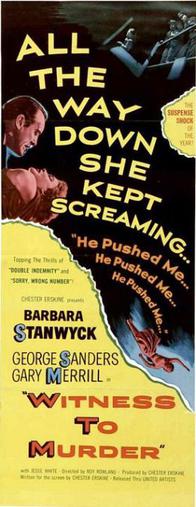
Out In The Film Noir Night- Barbara Stanwyck’s Witness To Murder

DVD Review

Witness to Murder, Barbara Stanwyck, Gary Merrill, George Sanders, United Artists, 1954
The last time the name Barbara Stanwyck appeared in this space she and Fred MacMurry were plotting, plotting big time, to murder her husband for his life insurance policy (and other considerations left unsaid ) in the film adaptation of James M. Cain’s Double Indemnity. Times have changed for Ms. Stanwyck though as here in Witness To Murder she off-handedly witnesses what she believes is a murder of a woman by a man in the apartment building across from her one night. And, unlike in Double Indemnity where everybody and their brother (and sister) KNOWS she and Fred did the deed here she cannot get anyone to believe her. Especially when the mad man who actually did the deed was a Svengali –like mastermind, an alleged ex-Nazi (although that de-nazification program stuff after World War II didn’t seem to take in his case), played by George Sanders.

Now the problem with accusing someone of murder, murder most foul , who actually did the deed is that unless and you have a body you are in trouble trying to pin the rap on him. Moreover, yelling bloody murder about the guy is going to, well, put him off-balance especially when he is lined up to marry into some serious California dough. So you might as well say Ms. Stanwyck’s life just got very complicated, very complicated in deed when she takes a small stand for some rough justice in this wicked old world. Worst this murderer is so smooth that the cops, the guys who are supposed to live to solve dastardly crimes are practically taking up a collection for the poor guy and are ready putting her in the loony bin, for good. Really. Of course one cop, the love interest cop played by Gary Merrill is not going to let a smart, sassy, good-looking woman go under without a fight. So you know in the end that this case will get solved and old Mr. Smoothie will get his just desserts. But doesn’t Ms. Stanwyck have a case for dereliction of duty or something against those nay-saying cops.


In Honor Of The 94th Anniversary Of The Founding Of The Communist International-In The Time Of His Time


From The Pen Of Frank Jackman

Billy Casey woke up in a sweat that early March 1919 night, woke up in a once again sweat that he had earned from his experiences as a doughboy, an American doughboy in France now furloughed home to New York City, awaiting medical discharge from that mustard gas explosion that harried his breathe ever since. Yes, he had had it rough overseas, had seen some stuff and done some stuff he didn’t want to repeat to anybody, stuff that frankly no man should be forced to do, and which he believed, or he came to believe, no man would do even to an animal. He had put some of that behind him but still a little corner would flare up on nights when he was excited and he was excited this night and had been for the past few nights about big doings in Moscow coming up in a few days (or since he wasn’t sure of the dates of the conference, except early March, maybe had already occurred), about creating a new organization to right the wrongs of this wicked old world.  

See, Bill Casey had gotten “religion,”  no not catholicprotestantjewishmuslim religion but the good word-the socialist word , the word that all workingmen, and Bill Casey was nothing if not a working man, were brothers and that the robbers of the world were the only ones who had benefited from the damn war “to end all wars” over in Europe.  And Bill had the destroyed lungs to prove it was not him who had benefited. This new language had been taught to him by a fellow soldier, a fellow doughboy, who had belonged to the American Socialist Party before the war, before he passed away from failed lungs in that French convalescent home Bill was assigned before coming back to America. So when Bill got back to New York the first thing, well maybe not the first, the first being to roll the pillows with his long-suffering girlfriend, Rosie, also nothing if not a daughter of the working class, he marched down to the American Socialist Party office in Greenwich Village (that is where his deceased comrade told him to go since that is where he had been a member) and joined right up.    

Now Bill Casey had never been much for the books, and the materials that he received from the local secretary when he paid his dues and received his membership card seemed a lot more convoluted that the way his hospital pal explained it, but he plugged at it for a while, and that along with the weekly lectures helped him along. And he was going to be in full need of that knowledge because he had landed on his socialist arse (his expression) right at a time when the whole socialist movement was in turmoil. And the big event was the Russian Revolution of 1917 and the fall-out from that event. See Bill’s pal had only known the American Socialist Party before that revolution, and since most of the party had been anti-war before his pal joined up to fight he didn’t know the stuff that was going on between the different factions-basically to stick with the Socialist International or go with the new one, the one that said that the old one was done for and a new Communist International had to be formed to fight for revolutions everywhere. Heady stuff. Stuff to make Bill sweat in anticipation.

And that is where the martyred James Connolly, Bill’s hero from the Easter 1916 uprising in Dublin and a man who had been executed by the bloody British for his part in it, came into it. Or kind of came into it. See the fight over who were the real revolutionaries, the Europeans or the Russians, basically was hard to figure. That is when he met a guy, an Irish guy, a comrade, from one of the factions, Jim Cannon, who put him straight, who told him that if he wanted to get back for that dirty deal he received in France by his own government he had to go with the Russian Bolsheviks and the new international they were trying to form. And Bill Casey respected Jim Cannon, respected the big heavy-drinking Irishman from out in the sticks of Kansas and so he cast his fate with Jim and his communist brethren. And you know what else Jim said to him- he, Bill Casey,  should say at meetings and out on the Union Square and Village soapboxes to one and all what he saw and did in France so people would know, know better the next time the government tried to stuff a war down their throats. Bill Casey didn’t know if he could so that, could avoid some tough night sweats thinking about doing it, but he thought if it stopped some young guy from joining up maybe he would at that…                      
*******

V. I. Lenin

Founding Of The Communist International

Speech At A Joint Meeting Of The All-Russia Central Executive Committee, The Moscow Soviet, The Moscow Committee Of The Russian Communist Party (Bolsheviks), The All-Russia Central Council Of Trade Unions, Moscow Trade Unions And Factory Committees To Mark The Founding Of The Communist International

March 6, 1919


Delivered: 6 March, 1919
First Published: Brief report published in Pravda No. 52, March 7, 1919; Published in full in May 1919 Published according to the verbatim report
Source: Lenin’s Collected Works, 4th English Edition, Progress Publishers, Moscow, 1972 Volume 28, pages 480-484
Translated: Jim Riordan
Transcription/HTML Markup: David Walters & Robert Cymbala
Copyleft: V. I. Lenin Internet Archive (www.marx.org) 2002. Permission is granted to copy and/or distribute this document under the terms of the GNU Free Documentation License

(Stormy ovation.) Comrades, at the First Congress of the Communist International we did not succeed in getting representatives from all countries where this organisation has most faithful friends and where there are workers whose sympathies are entirely with us. Allow me, therefore, to begin with a short quotation which will show you that in reality we have more friends than we can see, than we know and than we were able to assemble here, in Moscow, despite all persecution, despite the entire, seemingly omnipotent, union of the bourgeoisie of the whole world. This persecution has gone to such lengths as to attempt to surround us with a sort of Great Wall of China, and to deport Bolsheviks in dozens from the freest republics of the world. They seem to be scared stiff that ten or a dozen Bolsheviks will infect the whole world. But we, of course, know that this fear is ridiculous—because they have already infected the whole world, because the Russian workers’ struggle has already convinced working people everywhere that the destiny of the world revolution is being decided here,. in Russia.

Comrades, I have here a copy of L’Humanité, a French newspaper whose policy corresponds more to that of our Mensheviks or Right Socialist-Revolutionaries. During the war, this paper was utterly ruthless in its attacks on those who supported our viewpoint. Today it is defending those who during the war went along with their own bourgeoisie. This very newspaper reports in its issue of January 13, 1919, that a mammoth meeting (as the newspaper itself admits) took place in Paris of active party and trade union members of the Seine Federation, i.e., the district nearest to Paris, the centre of the proletarian movement, the centre of all political life in France. The first speaker was Bracke, a socialist who throughout the war took the same line as our Mensheviks and Right-wing defence advocates. He was meek and mild now. Not a word about a single burning issue! He ended by saying that he was against his government’s interference in the struggle of the proletariat of other countries. His words were drowned in applause. The next speaker was a supporter of his, a certain Pierre Laval. He spoke of demobilisation, the burning issue in France today—a country which has probably borne greater sacrifices than any other country in this criminal war. And this country now sees that demobilisation is being dragged out, held up, that there is no desire to carry it through, that preparations are being made for a new war that will obviously demand new sacrifices from the French workers for the sake of settling how much more of the spoils the French or British capitalists will get. The newspaper goes on to say that the crowd listened to the speaker, Pierre Laval, but when he started running down Bolshevism, the protests and excitement stopped the meeting. After that, citizen Pierre Renaudel was refused a hearing, and the meeting ended with a brief statement by citizen Pdricat. He is one of the few people in the French labour movement who in the main is in agreement with us. And so, the newspaper has to admit that the speaker who began to attack the Bolsheviks was immediately pulled up.

Comrades, we have not been able to get even one delegate here directly from France, and only one Frenchman, Comrade Guilbeaux, arrived here, and he with great difficulty. (Stormy applause.) He will speak here today. He spent months in the prisons of that free republic, Switzerland, being accused of having contact with Lenin and preparing a revolution in Switzerland. He was escorted through Germany by gendarmes and officers, for fear, evidently, that he might drop a match that would set Germany on fire. But Germany is ablaze without this match. In France, too, as we can see, there are sympathisers with the Bolshevik movement. The French people are probably among the most experienced, most politically conscious, most active and responsive. They will not allow a speaker at a public meeting to strike a false note: he is stopped. Considering the French temperament, he was lucky not to have been dragged down from the rostrum! Therefore, when a newspaper hostile to us admits what took place at this big meeting we can safely say the French proletariat is on our side.

I am going to read another short quotation, from an Italian newspaper. The attempts to isolate us from the rest of the world are so great that we very rarely receive socialist newspapers from abroad. It is a rare thing to receive a copy of the Italian newspaper Avanti!, the organ of the Italian Socialist Party, a party which participated in Zimmerwald, fought against the war and has now resolved not to attend the yellow congress in Berne, the congress of the old International, which was to be attended by people who had helped their governments to prolong this criminal war. To this day, Avanti! is under strict censorship. But in this issue, which arrived here by chance, I read an item on party life in a small locality called Cavriago (probably a remote spot because it cannot be located on the map). It appears that the workers there adopted a resolution supporting their newspaper for its uncompromising stand and declared their approval of the German Spartacists. Then follow the words “Sovietisti russi” which, even though they are in Italian, can be understood all over the world. They sent greetings to the Russian “Sovietisti” and expressed the wish that the programme of the Russian and German revolutionaries should be adopted throughout the world and serve to carry the fight against the bourgeoisie and military domination to a conclusion. When you read a resolution like that, adopted in some Italian Poshekhonye,’82 you have every right to say to yourself that the Italian people are on our side, the Italian people understand what the Russian “Sovietisti” are, what the programme of the Russian “Sovietisti” and the German Spartacists is. Yet at that time we had no such programme! We had no common programme with the German Spartacists, but the Italian workers rejected all they had seen in their bourgeois press, which, bribed as it is by the millionaires and multimillionaires, spreads slander about us in millions of copies. It failed to deceive the Italian workers, who grasped what the Spartacists and the “Sovietisti” were and declared that they sympathised with their programme, at a time when this programme did not exist. That is why we found our task so easy at this Congress. All we had to do was to record as a programme what had already been implanted in the minds and hearts of the workers, even those cast away in some remote spot and cut off from us by police and military cordons. That is why we have been able to reach concerted decisions on all the main issues with such ease and complete unanimity. And we are fully convinced that these decisions will meet with a powerful response among workers elsewhere.

The Soviet movement, comrades, is the form which has been won in Russia, which is now spreading throughout the world and the very name of which gives the workers a complete programme. I hope that we, having had the good fortune to develop the Soviet form to victory, will not become swelled-headed about it.

We know very well that the reason we were the first to take part in a Soviet proletarian revolution was not because we were as well or better prepared than other workers, but because we were worse prepared. This is why we were faced with the most savage and decrepit enemy, and it is this that accounted for the outward scale of the revolution. But we also know that the Soviets exist here to this day, that they are grappling with gigantic difficulties which originate from an inadequate cultural level and from the burden that has weighed down on us for more than a year, on us who stand alone at our posts, at a time when we are surrounded on all sides by enemies, and when, as you know perfectly well, harrowing ordeals, the hardships of famine and terrible suffering have befallen us.


Those who directly or indirectly side with the bourgeoisie often try to appeal to the workers and provoke indignation among them by pointing to the severe sufferings of the workers today. And we tell them: yes, these sufferings are evere and we do not conceal them from you. We tell the workers that, and they know it well from their own experience. You can see we are fighting not only to win socialism for ourselves, not only to ensure that our children shall only recollect capitalists and landowners as prehistoric monsters; we are fighting to ensure that the workers of the whole world triumph together with us.

And this First Congress of the Communist International, which has made the point that throughout the world the Soviets are winning the sympathy of the workers, shows us that the victory of the world communist revolution is assured. (Applause.) The bourgeoisie will continue to vent their fury in a number of countries; the bourgeoisie there are just beginning to prepare the destruction of the best people, the best representatives of socialism, as is evident from the brutal murder of Rosa Luxemburg and Karl Liebknecht by the whiteguards. These sacrifices are inevitable. We seek no agreement with the bourgeoisie, we are marching to the final and decisive battle against them. But we know that after the ordeal, agony and distress of the war, when the people throughout the world are fighting for demobilisation, when they feel they have been betrayed and appreciate how incredibly heavy the burden of taxation is that has been placed upon them by the capitalists who killed tens of millions of people to decide who would receive more of the profits—we know that these brigands’ rule is at an end!

Now that the meaning of the word “Soviet” is understood by everybody, the victory of the communist revolution is assured. The comrades present in this hall saw the founding of the first Soviet republic; now they see the founding of the Third, Communist International (applause), and they will all see the founding of the World Federative Republic of Soviets. (Applause.)
 
Brief report published; in Pravda No. 52, March 7, 1919; Published in full in May 1919 Published according to the verbatim report