Sunday, March 3, 2013

In Honor Of The 94th Anniversary Of The Founding Of The Communist International-Take Four-For Rosa Luxemburg And Karl Liebknecht


The cops, the hated Federals, and their allies the Freikorps, were hunting down every Red, hell every leftist or trade union militant that would not bow his head, they could find in all of stinking Bavaria after they crushed the Commune. It was awful, savage, something out of what Otto Schmidt thought it must have been like when Thiers and his hatchet men pulled the hammer down on the Paris Commune. He had read plenty, plenty as a schoolboy, as a proud member of the Socialist Youth, about those heroic events back in 1871 so he knew that if they, they the working people did not win, then the blood would flow in the streets. And it had after some bloody street fighting. Worse they had grabbed their leader, Eugene Levine, and who knows what had happened to him. Hell, Otto had just barely gotten out of Munich himself and now hiding in a small apartment of a sympathizer in the outer suburbs of Munich he had a chance to think about the events of the past several months since the damn Kaiser had abdicated, the war had come to a crashing halt, and working people like him, honest socialists trying to figure out a way to change this rotten old world, had unbowed their heads for once and taken some action.
Otto knew, although he was not theoretician, not even really a leader, not a big leader anyway, although he was respected among the youth for his militancy and his willingness to stick his neck out, that they, the revolutionaries, the real revolutionaries had made mistakes, made bad mistakes about what to do, and with whom. Sure they were young, mostly, hot-headed, mad and hell had never before, unlike the Russians they were trying to emulate, ever had a part in a revolution before. Their leaders, their Social-Democratic leaders mostly, had told them organize, organize, organize and vote, vote, vote, and when they had done enough of both then they would just ease into the socialist republic of their dreams, his dreams.

Then when the chance actually came those leaders, those august bootblack leaders, just filled the governmental seats and left everybody else standing high and dry. Worse those bastards had done the bosses’work for them; they had suppressed everything, every armed attempt to get some worker justice. Those damn leaders were just as bad as Thiers and his French companions in suppressing the Commune. Otto burned with an inner rage when he thought about what they, Ebert, that fat pig, and Noske, that goddam hangman, had done, done with glee from what he had heard, to Rosa, Rosa Luxemburg, the rose of the revolution, and courageous Karl Liebknecht, bright shining Karl who had in the flames of war stood up and called down every kind of damnation on the German war aims (and the other side too but he was aimed at his own fellow Germans first). And had paid the price. Poor Levine, poor beautiful Levine with the soul of a poet probably was slated for that same fate, a martyr’s fate.
Yes, Otto could see where the big mistakes lie, trusting those parlor socialists gotten fat and lazy off of hard-earned workingmen’ dues once they took over the bourgeois government. Somebody, he forgot who it was and some of the details but a comrade who had been to Russia or had talked to a Russian Bolshevik while he was in Germany, one night in Munich when it looked like they would win, had said when the revolution was at its hottest then the struggle against the reform socialists (in Russia the Mensheviks and Social Revolutionaries and here the Social-Democrats) has to most merciless. They had forgotten that, forgotten that to their regret. He had heard that same night that in Moscow earlier in the spring the Bolsheviks and their international allies had formed a new International, a Communist International to fight against the Social –Democrats tooth and nail for the allegiance of the working masses. He had had not had time to investigate that more since all hell had broken out a week or so after that, to sign up or anything but he knew this, knew it deep in his young bones, that he wished the effort well. He also wished that they, and he, could find some way, some righteous way to avenge those deaths of Luxemburg and Liebknecht. And now probably Levine too.
*******

V. I. Lenin

The Third International and
Its Place in History


Written: 15 April, 1919
First Published: Published in May 1919; Published according to the manuscript.
Source: Lenin’s Collected Works, 4th English Edition, Progress Publishers, Moscow, 1972 Volume 29, pages 305-313
Translated: George Hanna
Transcription/HTML Markup: David Walters & Robert Cymbala
Copyleft: V. I. Lenin Internet Archive (www.marx.org) 2002; Permission is granted to copy and/or distribute this document under the terms of the GNU Free Documentation License.

The imperialists of the Entente countries are blockading Russia in an effort to cut off the Soviet Republic, as a seat of infection, from the capitalist world. These people, who boast about their “democratic” institutions, are so blinded by their hatred of the Soviet Republic that they do not see how ridiculous they are making themselves. Just think of it, the advanced, most civilised and “democratic” countries, armed to the teeth and enjoying undivided military sway over the whole world, are mortally afraid of the ideological infection coming from a ruined, starving, backward, and even, they assert, semi-savage country!

This contradiction alone is opening the eyes of the working masses in all countries and helping to expose the hypocrisy of the imperialists Clemanceau, Lloyd George, Wilson and their governments.
We are being helped, however, not only by the capitalists’ blind hatred of the Soviets, but also by their bickering among themselves, which induces them to put spokes in each other’s wheels. They have entered into a veritable conspiracy of silence, for they are desperately afraid of the spread of true information about the Soviet Republic in general, and of its official documents in particular. Yet, Le Temps, the principal organ of the French bourgeoisie, has published a report on the foundation in Moscow of the Third, Communist International.

For this we express our most respectful thanks to the principal organ of the French bourgeoisie, to this leader of French chauvinism and imperialism. We are prepared to send an illuminated address to Le Temps in token of our appreciation of the effective and able assistance it is giving us.
The manner in which Le Temps compiled its report on the basis of our wireless messages clearly and fully reveals the motive that prompted this organ of the money-bags. It wanted to have a dig at Wilson, as if to say, “Look at the people with whom you negotiate!” The wiseacres who write to the order of the money-bags do not see that their attempt to frighten Wilson with the Bolshevik bogey is becoming, in the eyes of the working people, an advertisement for the Bolsheviks. Once more, our most respectful thanks to the organ of the French millionaires!

The Third International has been founded in a world situation that does not allow prohibitions, petty and miserable devices of the Entente imperialists or of capitalist lackeys like the Scheidemanns in Germany and the Renners in Austria to prevent news of this International and sympathy for it spreading among the working class of the world. This situation has been brought about by the growth of the proletarian revolution, which is manifestly developing everywhere by leaps and bounds. It has been brought about by the Soviet movement among the working people, which has already achieved such strength as to become really international.

The First International (1864-72) laid the foundation of an international organisation of the workers for the preparation of their revolutionary attack on capital. The Second International (1889-1914) was an international organisation of the proletarian movement whose growth proceeded in breadth, at the cost of a temporary drop in the revolutionary level, a temporary strengthening of opportunism, which in the end led to the disgraceful collapse of this International.

The Third International actually emerged in 1918, when the long years of struggle against opportunism and social-chauvinism, especially during the war, led to the formation of Communist Parties in a number of countries. Officially, the Third International was founded at its First Congress, in March 1919, in Moscow. And the most characteristic feature of this International, its mission of fulfilling, of implementing the precepts of Marxism, and of achieving the age-old ideals of socialism and the working-class movement—this most characteristic feature of the Third International has manifested itself immediately in the fact that the new, third, “International Working Men’s Association” has already begun to develop, to a certain extent, into a union of Soviet Socialist Republics.

The First International laid the foundation of the proletarian, international struggle for socialism.
The Second International marked a period in which the soil was prepared for the broad, mass spread of the movement in a number of countries.

The Third International has gathered the fruits of the work of the Second International, discarded its opportunist, social-chauvinist, bourgeois and petty-bourgeois dross, and has begun to implement the dictatorship of the proletariat.

The international alliance of the parties which are leading the most revolutionary movement in the world, the movement of the proletariat for the overthrow of the yoke of capital, now rests on an unprecedentedly firm base, in the shape of several Soviet republics, which are implementing the dictatorship of the proletariat and are the embodiment of victory over capitalism on an international scale.

The epoch-making significance of the Third, Communist International lies in its having begun to give effect to Marx’s cardinal slogan, the slogan which sums up the centuries-old development of socialism and the working-class movement, the slogan which is expressed in the concept of the dictatorship of the proletariat.

This prevision and this theory—the prevision and theory of a genius—are becoming a reality.
The Latin words have now been translated into the languages of all the peoples of contemporary Europe—more, into all the languages of the world.

A new era in world history has begun.

Mankind is throwing off the last form of slavery: capitalist, or wage, slavery.

By emancipating himself from slavery, man is for the first time advancing to real freedom.
How is it that one of the most backward countries of Europe was the first country to establish the dictatorship of the proletariat, and to organise a Soviet republic? We shall hardly be wrong if we say that it is this contradiction between the backwardness of Russia and the “leap” she has made over bourgeois democracy to the highest form of democracy, to Soviet, or proletarian, democracy—it is this contradiction that has been one of the reasons (apart from the dead weight of opportunist habits and philistine prejudices that burdened the majority of the socialist leaders) why people in the West have had particular difficulty or have been slow in understanding the role of the Soviets.

The working people all over the world have instinctively grasped the significance of the Soviets as an instrument in the proletarian struggle and as a form of the proletarian state. But the “leaders”, corrupted by opportunism, still continue to worship bourgeois democracy, which they call “democracy” in general.

Is it surprising that the establishment of the dictatorship of the proletariat has brought out primarily the “contradiction” between the backwardness of Russia and her “leap” over bourgeois democracy? It would have been surprising had history granted us the establishment of a new form of democracy without a number of contradictions.

If any Marxist, or any person, indeed, who has a general knowledge of modern science, were asked whether it is likely that the transition of the different capitalist countries to the dictatorship of the proletariat will take place in an identical or harmoniously proportionate way, his answer would undoubtedly be in the negative. There never has been and never could be even, harmonious, or proportionate development in the capitalist world. Each country has developed more strongly first one, then another aspect or feature or group of features of capitalism and of the working-class movement. The process of development has been uneven.

When France was carrying out her great bourgeois revolution and rousing the whole European continent to a historically new life, Britain proved to be at the head of the counter-revolutionary coalition, although at the same time she was much more developed capitalistically than France. The British working-class movement of that period, however, brilliantly anticipated much that was contained in the future Marxism.

When Britain gave the world Chartism, the first broad, truly mass and politically organised proletarian revolutionary movement, bourgeois revolutions, most of them weak, were taking place on the European continent, and the first great civil war between the proletariat and the bourgeoisie had broken out in France. The bourgeoisie defeated the various national contingents of the proletariat one by one, in different ways in different countries.

Britain was the model of a country in which, as Engels put it, the bourgeoisie had produced, alongside a bourgeois aristocracy, a very bourgeois upper stratum of the proletariat.[1] For several decades this advanced capitalist country lagged behind in the revolutionary struggle of the proletariat. France seemed to have exhausted the strength of the proletariat in two heroic working-class revolts of 1848 and 1871 against the bourgeoisie that made very considerable contributions to world-historical development. Leadership in the International of the working-class movement then passed to Germany; that was in the seventies of the nineteenth century, when she lagged economically behind Britain and France. But when Germany had out stripped these two countries economically, i.e., by the second decade of the twentieth century, the Marxist workers’ party of Germany, that model for the whole world, found itself headed by a handful of utter scoundrels, the most filthy blackguards—from Scheidemann and Noske to David and Legien—loathsome hangmen drawn from the workers’ ranks who had sold themselves to the capitalists, who were in the service of the monarchy and the counter-revolutionary bourgeoisie.

World history is leading unswervingly towards the dictatorship of the proletariat, but is doing so by paths that are anything but smooth, simple and straight.

When Karl Kautsky was still a Marxist and not the renegade from Marxism he became when he began to champion unity with the Scheidemanns and to support bourgeois democracy against Soviet, or proletarian, democracy, he wrote an article—this was at the turn of the century—entitled “The Slavs and Revolution”. In this article he traced the historical conditions that pointed to the possibility of leadership in the world revolutionary movement passing to the Slavs.

And so it has. Leadership in the revolutionary proletarian International has passed for a time—for a short time, it goes without saying—to the Russians, just as at various periods of the nineteenth century it was in the hands of the British, then of the French, then of the Germans.
I have had occasion more than once to say that it was easier for the Russians than for the advanced countries to begin the great proletarian revolution, but that it will be more difficult for them to continue it and carry it to final victory, in the sense of the complete organisation of a socialist society.

It was easier for us to begin, firstly, because the unusual—for twentieth-century Europe—political backwardness of the tsarist monarchy gave unusual strength to the revolutionary onslaught of the masses. Secondly, Russia’s backwardness merged in a peculiar way the proletarian revolution against the bourgeoisie with the peasant revolution against the landowners. That is what we started from in October 1917, and we would not have achieved victory so easily then if we had not. As long ago as 1856, Marx spoke, in reference to Prussia; of the possibility of a peculiar combination of proletarian revolution and peasant war.[2] From the beginning of 1905 the Bolsheviks advocated the idea of a revolutionary-democratic dictatorship of the proletariat and the peasantry. Thirdly, the 1905 revolution contributed enormously to the political education of the worker and peasant masses, because it familiarised their vanguard with “the last word” of socialism in the West and also because of the revolutionary action of the masses. Without such a “dress rehearsal” as we had in 1905, the revolutions of 1917—both the bourgeois, February revolution, and the proletarian, October revolution—would have been impossible. Fourthly, Russia’s geographical conditions permitted her to hold out longer than other countries could have done against the superior military strength of the capitalist, advanced countries. Fifthly, the specific attitude of the proletariat towards the peasantry facilitated the transition from the bourgeois revolution to the socialist revolution, made it easier for the urban proletarians to influence the semi-proletarian, poorer sections of the rural working people.

Sixthly, long schooling in strike action and the experience of the European mass working-class movement facilitated the emergence—in a profound and rapidly intensifying revolutionary situation—of such a unique form of proletarian revolutionary organisation as the Soviets.
This list, of course, is incomplete; but it will suffice for the time being.

Soviet, or proletarian, democracy was born in Russia. Following the Paris Commune a second epoch-making step was taken. The proletarian and peasant Soviet Republic has proved to be the first stable socialist republic in the world. As a new type of state it cannot die. It no longer stands alone.

For the continuance and completion of the work of building socialism, much, very much is still required. Soviet republics in more developed countries, where the proletariat has greater weight and influence, have every chance of surpassing Russia once they take the path of the dictatorship of the proletariat.

The bankrupt Second International is now dying and rotting alive. Actually, it is playing the role of lackey to the world bourgeoisie. It is a truly yellow International. Its foremost ideological leaders, such as Kautsky, laud bourgeois democracy and call it “democracy” in general, or—what is still more stupid and still more crude—“pure democracy”.

Bourgeois democracy has outlived its day, just as the Second International has, though the International performed historically necessary and useful work when the task of the moment was to train the working-class masses within the framework of this bourgeois democracy.
No bourgeois republic, however democratic, ever was or could have been anything but a machine for the suppression of the working people by capital, an instrument of the dictatorship of the bourgeoisie, the political rule of capital. The democratic bourgeois republic promised and proclaimed majority rule, but it could never put this into effect as long as private ownership of the land and other means of production existed.

“Freedom” in the bourgeois-democratic republic was actually freedom for the rich. The proletarians and working peasants could and should have utilised it for the purpose of preparing their forces to overthrow capital, to overcome bourgeois democracy, but in fact the working masses were, as a general rule, unable to enjoy democracy under capitalism.

Soviet? or proletarian, democracy has for the first time in the world created democracy for the masses, for the working people, for the factory workers and small peasants.
Never yet has the world seen political power wielded by the majority of the population, power actually wielded by this majority, as it is in the case of Soviet rule.
It suppresses the “freedom” of the exploiters and their accomplices; it deprives them of “freedom” to exploit, “freedom” to batten on starvation, “freedom” to fight for the restoration of the rule of capital, “freedom” to compact with the foreign bourgeoisie against the workers and peasants of their own country.

Let the Kautskys champion such freedom. Only a renegade from Marxism, a renegade from socialism can do so.

In nothing is the bankruptcy of the ideological leaders of the Second International, people like Hilferding and Kautsky, so strikingly expressed as in their utter inability to understand the significance of Soviet, or proletarian, democracy, its relation to the Paris Commune, its place in history, its necessity as a form of the dictatorship of the proletariat.

The newspaper Die Freiheit, organ of the “Independent” (alias middle-class, philistine, petty-bourgeois) German Social-Democratic Party, in its issue No. 74 of February 11, 1919, published a manifesto “To the Revolutionary Proletariat of Germany”.

This manifesto is signed by the Party executive and by all its members in the National Assembly, the German variety of our Constituent Assembly.

This manifesto accuses the Scheidemanns of wanting to abolish the Workers’ Councils, and proposes—don’t laugh!—that the Councils be combined with the Assembly, that the Councils be granted certain political rights, a certain place in the Constitution.

To reconcile, to unite the dictatorship of the bourgeoisie and the dictatorship of the proletariat! How simple! What a brilliantly philistine idea!

The only pity is that it was tried in Russia, under Kerensky, by the united Mensheviks and Socialist-Revolutionaries, those petty-bourgeois democrats who imagine themselves socialists.
Anyone who has read Marx and failed to understand that in capitalist society, at every acute moment, in every serious class conflict, the alternative is either the dictatorship of the bourgeoisie or the dictatorship of the proletariat, has understood nothing of either the economic or the political doctrines of Marx.

But the brilliantly philistine idea of Hilferding, Kautsky and Co. of peacefully combining the dictatorship of the bourgeoisie and the dictatorship of the proletariat requires special examination, if exhaustive treatment is to be given to the economic and political absurdities with which this most remarkable and comical manifesto of February 11 is packed. That will have to be put off for another article.[3]

Moscow, April 15, 1919

Endnotes

[1] Marx and Engels, Selected Correspondence, Moscow, 1965, p. 110.
[2] Marx and Engels, Selected Correspondence, Moscow, 1965, p. 92.
[3] See pp. 392-401 of this volume.
In Honor Of The 94th Anniversary Of The Founding Of The Communist International-Take ThreeA Daughter of The Communards?     

 
Claudette Longuet idolized her grandfather, her maternal grandfather, Louis Paret, called the Lyonese Jaures by his comrades in the Socialist Party and by others as well not attuned to his political perspectives by respectful of the power of his words nevertheless, an honorific well-deserved for his emulation of the internationally famous French socialist orator, Jean Jaures, who had been villainously assassinated just before the war. Claudette had reason to idolize Papa Paret for his was a gentle man toward his several grandchildren and so had a built-in fan club of sorts before he even left the comfortable confines of his townhouse on the edges of downtown Lyon.
More importantly Claudette had idolized him for his political past, his proud working class and socialist political past. As a mere boy he had fought on the barricades during the Paris Commune, a touchstone for all those who survived the bloody massacre reprisals of the Theirs government carried out by the sadistic General Gallifit. He just barely missed being transported. Fortunately no “snitch” could place him on the barricades, although the Theirs government was not always so choosey about such things when they had their killing habits on. He had defended the poor Jewish soldier Dreyfus when Emile Zola screamed for his release. He had opposed Alexander Millerand, an avowed socialist, in joining the murderous bourgeois government when he took that step. He tirelessly campaigned against war, signed all the national and international petitions to prevent that occurrence, and attended all the conferences too. Although he himself was no Marxist, his socialism ran to more mystical and philosophical trends, he welcomed the Russian revolution of 1905 with open arms. So, yes, Claudette, as she grew to young womanhood and began her own search for social and political meaning, understandable took her cues from her Papa. Moreover before the war she spent many hours in his company at the local socialist club doing the “this and that” to spread the socialist faith around and about Lyons.

Then the war came, that dreaded awful August 1914 when the guns of war howled into the night and her grandfather changed, almost chameleon-like. From a fervent anti-warrior he turned overnight into a paragon of defense of  French culture, French bourgeois culture, as he would have previously said against, against, the Hun, the Boche, the, the, whatever foul word he could use to denigrate the Germans, all of them. He stood in the central square in Lyon and preached, preached the duty of every eligible young Frenchman to defend the republic to the death, no questions asked. And since he had that Jaures-like quality those young boys listened and sadly went off to war, many to never return. For a while he also had Claudette with him, for the first couple of years when he, they uttered not one anti-war word, not one. But after about two years, after some awful battles fought on French soil, some awful battles that were just stacking up the corpses without let-up, she started to listen to that younger Papa voice, the voice that thrilled her young girl-hood, and silently began to oppose the war, to oppose her grandfather who had not changed his opinion one iota throughout the carnage.
Claudette kept his silence until the February revolution in Russia in 1917 when it seemed like peace might be at hand. He grandfather cursed the Russians whenever there was talk that they might withdraw from the war but she saw that their withdrawal might stop the war on all fronts. Mainly she was tired of seeing the weekly casualty lists and all the women, young and old, in black, always black. Then in November or maybe December 1917 she heard, heard from her new beau (a beau a little younger than her, almost just a boy, since the men her age were either at the fronts or down in the ground) who had been agitating for an end to the war (and getting hell for it from the local government, and her grandfather) that the Russians under the Bolsheviks had withdrawn from the war. Things were sketchy, very sketchy with the wartime censorship on but that is what she heard from him. She talked to, or tried to talk to her grandfather about it, but he would not hear of the damn Bolshevik rabble.

Papa Paret moreover said when peace came, and it would come, with or without the damn Russians, since the entry of the American would take the final stuffing out of the Germans, then everybody could go back to arguing against war and French and German workers could unite again under the banner of the Socialist International and maybe really end war for good. And the war did end, and the various socialists who had just supported the massive blood-letting in Europe and elsewhere started talking of brotherhood once again and of putting that old peacetime International back together. Claudette though, now more under the spell of that feisty boyfriend, was not sure that grandfather had it right. And in the summer of 1919 when she heard (via that same boyfriend who had already joined the French Communist Party, or really the embryo of that party) that the Bolsheviks had convened a conference to form a new International, a Third International, to really fight against war and fight for socialism she was more conflicted. See she really did idolize Papa and so she would wait and see…     

Leon Trotsky

Great Times

(1919)


Written: 1919
First Published: The Communist International [Petrograd], Vol.I, No.1, 1919.
Translated: Unknown.
Transcription/HTML Markup: Sally Ryan.
Copyleft: Leon Trotsky Internet Archive (www.marxists.org) August 2002. Permission is granted to copy and/or distribute this document under the terms of the GNU Free Documentation License.

The Tsars and the priests – the former lords of the Moscow Kremlin – never foresaw, we may imagine, that within its hoary walls would one day gather the representatives of the most revolutionary part of contemporary humanity. Nevertheless, this has happened. In one of the halls of the Palace of Justice, where still are wandering the wan ghosts of the criminal paragraphs of the Imperial code, at this moment the delegates of the Third International are in session. Verily, the mole of history has dug his tunnel well beneath the Kremlin walls.

These material surroundings of the Communist Congress are merely the outward expression; the visible embodiment, of the gigantic changes which have taken place in the world during the last ten or twelve years.

In the days of the First, and again in those of the Second Internationals, Tsarist Russia was the chief stronghold of world reaction. At the International Socialist Congresses, the Russian revolution was represented by emigrants, towards whom the majority of the opportunist leaders of European Socialism adopted an attitude of ironical condescension. The bureaucrats of Parliamentarism and Trade Unionism were filled with an unshakeable certainty that the miseries of a revolution were to be the lot only of semi-Asiatic Russia, while Europe was assured of a gradual, painless, peaceful development from Capitalism to Socialism.

But in August, 1914, the accumulated antagonisms of Imperialism tore to pieces the “peaceful” cloak of capitalism, with its Parliamenterism, its established “liberties,” and its legalised prostitution, political and otherwise. From the heights of civilization mankind found itself hurled into an abyss of terrifying barbarism and bloodstained savagery.

Notwithstanding that Marxist theory had foreseen and foretold the bloody catastrophe, the social-reformist parties were taken completely by surprise. The perspectives of peaceful development became smoke and dust. The opportunist leaders could find no work left for them but to call upon the toiling masses to defend the capitalist national State. On August 4, 1914, the Second International perished with dishonour.

From that moment, all true revolutionary heirs of the Marxian spirit placed before themselves the task of creating a new International – an International of unquenchable revolutionary struggle against capitalist society. The war let loose by Imperialism upset the balance if the whole of the capitalist world. All questions revealed themselves as revolutionary questions. The old revolutionary cobblers applied all their arts in order to preserve the balance of the old hopes, the old lies, the old organisations. All was of no avail. The war – not for the first time in history – showed itself the mother of the revolution. An imperialist war brought forth a proletarian revolution.

The honour of having taken the first step belongs to the Russian working class and its veteran, battle-scarred Communist Party. By its November revolution the Russian proletariat not only opened the gates of the Kremlin to the representatives of the international proletariat, but also laid the foundation stone for the building of the Third International.

The revolutions in Germany, Austria and Hungary; the stormy tide of the Soviet movement and of civil war that has poured over Europe, crested by the martyrdom of Karl Liebknecht, Rosa Luxemburg and many thousands of nameless heroes; these have shown that the paths of Europe are not other than those of Russia. The unity of method in the struggle for Socialism, revealed by practice, has laid the ideal foundations for the creation of a Communist International, while, at the same time, it has rendered impossible the postponement of a Communist Congress.

At this moment, that Congress is sitting within the walls of the Kremlin. We are witnesses of and participants in one of the greatest events in the history of the world.

The working class of the whole world has wrested the most impregnable fortress of all – that of former Imperial Russia – from its enemies. On it as its base, it is uniting its forces for the last decisive battle.

What happiness – to live, and fight at such a time!
 
L. TROTSKY
           

Saturday, March 2, 2013


Poet’s Corner- Claude McKay-If We Must Die-In Honor Of The 94th Anniversary Of The Communist International


…they had heard that a group of White Guards, a first detachment on horse, maybe from the dreaded mercenary Czech Legion that were running amok from Siberia to the Urals, paid for by who knows, some said the English some said the French, or worst maybe the dreaded Cossacks, who needed no outside pay but only their  Ataman’s word to bend contemptible peasant heads to size, and who took no prisoners, none, were heading their way, heading right for their line of defense in the city ready to take back Kazan for the asking, so those Whites thought. Kazan fallen then the road to Moscow lay wide open and perhaps the end of the Soviet experiment in that dragged on second year of hellish civil war. But Commissar Vladimir ( assigned that title because he, a little more literate, a little cooler under pressure, than the vast bulk of  lumpish peasants who had signed up to fight and to die for the land, their land from what they had heard, was listened to by that mass unlike the city boy reds) and his band of comrade brothers, five in all, (and one sister, one stray Red Emma, they called her who learned of revolution and sex, young love smitten sex even in war-torn Kazan  with young Zanoff, in that exact order while in their company and proved as fierce a fighter both ways, according to that same Zanoff, as any man), the last remnant from the old Orlov estate who survived the bloody endless Czar war  swore, swore a blood oath on their tattered red flag, the previous day that they would retreat no further, that here was their stand, their last stand if necessary, but no more moves away from Moscow.     

It had not always been that way with them, not even with Vladimir, not by a long shot. They had all farmed, like their fathers going back eons before them, the same fruitless task (for them) land for Orlov, the richest landowner in Omsk, and never lifted their heads when the Social Revolutionaries had come before the war and during that last revolution, the one back in 1905, with glad tidings (and before them other city radicals, narodniks or something like that, had spoken to their fathers and grandfathers). They just shoveled the dirt, kept shoveling, and kept their heads down.

Then the war came, the bloody world war as it turned out, and the Czar’s police (Orlov’s really but in the name of the Czar so the same thing) came and “drafted” them into some vast ill-fed, ill-clad, ill-armed peasant force which proved no match for the methodical Germans as they were slaughtered by the millions in and around those foul trenches. And still they kept their heads bent. Kept them bent until the February revolution stirred things up although they held to the front since no one told them not to leave and in the fall of 1917 they had just followed their fellows out of the trenches and went home. Not the first ones out, nor the last but just out. Went home to farm Orlov’s land again they figured with bent heads again.  Even when the Bolsheviks took power in November and decreed the land of Orlov’s theirs they kept their heads bent. It was not until Orlov, his agents and his White Guard friends came back and took the land, their now precious land, theirs, that they roared back. And joined one of Trotsky’s red brigades passing through on a recruiting drive. They had moved here and there as the lines of battle shifted but mainly back, mainly retreats or break-ups since then and hence the blood oath, and no more retreats. The peasant slows in them had been busted, busted good.  

Just then a messenger came to their line, a messenger from the river in front of Kazan. The message said that Trotsky himself had decided to fight and die before Kazan if necessary to save the revolution, to save their precious land. Vladimir and his comrades, including Red Emma, Red Emma who if the truth be told despite her tender years of sweet sixteen was the best soldier of the lot, and should have been the commissar except those lumpish peasants would not have listened to her, reaffirmed their blood oath. If they must die they would die in defense of Kazan, and maybe just maybe somebody would hear of their story, the story of five peasant boys and a pretty red-hearted city girl as brave as they, and lift their heads and roar back too….    

If We Must Die

If we must die, let it not be like hogs
Hunted and penned in an inglorious spot,
While round us bark the mad and hungry dogs,
Making their mock at our accursèd lot.
If we must die, O let us nobly die,
So that our precious blood may not be shed
In vain; then even the monsters we defy
Shall be constrained to honor us though dead!
O kinsmen! we must meet the common foe!
Though far outnumbered let us show us brave,
And for their thousand blows deal one death-blow!
What though before us lies the open grave?
Like men we'll face the murderous, cowardly pack,
Pressed to the wall, dying, but fighting back!


From The Boston Bradley Manning Support Committee Archives (September   2012)


Let’s Redouble Our Efforts To Save Private Bradley Manning-Make Every Town Square In America (And The World) A Bradley Manning Square From Boston To Berkeley to Berlin-Join Us At Ashmont Station, Dorchester –Tuesday August 7, 2012 From 4:00-5:00 PM  

The Private Bradley Manning case is headed toward a late fall/early winter trial. Those of us who support his cause should redouble our efforts to secure his freedom. For the past several months there has been a weekly stand-out in Greater Boston across from the Davis Square Redline MBTA stop (renamed Bradley Manning Square for the vigil’s duration) in Somerville on Friday afternoons but we  have now changed the time from 4:00-5:00 PM on Wednesdays. This stand-out has, to say the least, been very sparsely attended. We need to build it up with more supporters present. Please join us when you can. Or better yet if you can’t join us start a Support Bradley Manning weekly vigil in some location in your town whether it is in the Boston area, Berkeley or Berlin. And please sign the petition for his release. I have placed links to the Manning Network and Manning Square website below.    


News has reached us that some of the folks at the Dorchester People for Peace (DPP) have started a stand-out for Private Manning to be held weekly beginning on Tuesday July 24, 2012 at 4:00 PM.   The next stand-out is on August 7, 2012 at Ashmont Station  in Dorchester. Ashmont Station is an easily reachable stop via the MBTA Redline.The next stand-out is August Please join them.  
********
Bradley Manning Support Network
http://www.bradleymanning.org/ 

Somerville Manning Square website
http://freemanz.com/2012/01/20/somerville_paper_photo-bradmanningsquare/bradleymanningsquare-2011_01_13/

The following are remarks that we have been focusing on of late to build support for Bradley Manning’s cause.

Veterans for Peace proudly stands in solidarity with, and defense of, Private Bradley Manning.

We of the anti-war movement were not able to do much to affect the Bush- Obama Iraq War timetable but we can save the one hero of that war, Bradley Manning. 

I stand in solidarity with the alleged actions of Private Bradley Manning in bringing to light, just a little light, some of the nefarious war-related doings of this government, under Bush and Obama. If he did such acts they are no crime. No crime at all in my eyes or in the eyes of the vast majority of people who know of the case and of its importance as an individual act of resistance to the unjust and barbaric American-led wars in Iraq and Afghanistan. I sleep just a shade bit easier these days knowing that Private Manning may have exposed what we all knew, or should have known- the Iraq war and the Afghan war justifications rested on a house of cards. American imperialism’s gun-toting house of cards, but cards nevertheless.

I am standing in solidarity with Private Bradley Manning because I am outraged by the treatment meted out to Private Manning, presumably an innocent man, by a government who alleges itself to be some “beacon” of the civilized world. Bradley Manning had been held in solidarity at Quantico and other locales for over two years, and has been held without trial for longer, as the government and its military try to glue a case together. The military, and its henchmen in the Justice Department, have gotten more devious although not smarter since I was a soldier in their crosshairs over forty years ago.

These are more than sufficient reasons to stand in solidarity with Private Manning and will be until the day he is freed by his jailers. And I will continue to stand in proud solidarity with Private Manning until that great day.

Immediate Unconditional Withdrawal of All U.S./Allied Troops And Mercenaries From Afghanistan! Hands Off Iran! Free Private Manning Now! 


Pardon Private Bradley Manning Stand-Out-Central Square, Cambridge, Wednesdays, 5:00 PM -Update –March 1, 2013


Let’s Redouble Our Efforts To Free Private Bradley Manning-President Obama Pardon Bradley Manning -Make Every Town Square In America (And The World) A Bradley Manning Square From Boston To Berkeley to Berlin-Join Us In Central Square, Cambridge, Ma. For A Stand-Out For Bradley- Wednesdays From 5:00-6:00 PM
********
Beginning in September 2011, in order to publicize Private Manning’s case locally, there have been weekly stand-outs (as well as other more ad hoc and sporadic events) in various locations in the Greater Boston area starting in Somerville across from the Davis Square Redline MBTA stop on Friday afternoons and later on Wednesdays. Lately this stand-out has been held each week on Wednesdays from 5:00 to 6:00 PM at Central Square, Cambridge, Ma. (small park at the corner of Massachusetts Avenue and Prospect Street just outside the Redline MBTA stop, renamed Manning Square for the duration of the stand-out) in order to continue to broaden our outreach. Join us there in calling for Private Manning’s freedom. President Obama Pardon Private Manning Now!  
********
The Private Bradley Manning case is headed toward an early summer trial now scheduled for June 2013. The news on his case over the past several months (since about April 2012) has centered on the many pre-trial motion hearings including recent defense motions to dismiss for lack of speedy trial. Private Manning’s pre-trial confinement is now at over 1000 days and will be over well over 1000 days by the time of trial. That motion has now been ruled on by Military Judge Lind. On February 26, 2013 she denied the defense’s motion for dismissal, the last serious chance for Bradley Manning to go free before the scheduled June trial. She ruled furthermore that the various delays by the government were inherent in the nature of this case and that the military authorities, except in one short instance, had been diligent in their efforts to move the proceedings along. For those of us with military experience this is a classic, if perverse, case of that old army slogan-“Hurry up, and wait.” This is definitely tough news for Private Manning although perhaps a good appeal point in some future civilian review.  

The defense had contended that the charges should be dismissed because the military by its own statutes (to speak nothing of that funny old constitutional right to a speedy trial guarantee that our plebeian forbears fought tooth and nail for against the bloody British and later made damn sure was included in the Amendments when the founding fathers “forgot” to include it in the main document) should have arraigned Private Manning within 120 days after his arrest. They hemmed and hawed for almost 600 days before deciding on the charges and a court martial. Nobody in the convening authority, as required by those same statutes, pushed the prosecution forward in a timely manner. In fact the court-martial convening authority, in the person of one Colonel Coffman, seemed to have seen his role as mere “yes man” to each of the government’s eight requests for delays without explanation (and without informing the defense in order to take their objection). Apparently the Colonel saw his role as a mere clearing agent for whatever excuse the government gave, mainly endless addition time for clearing various classified documents a process that need not have held up the proceedings. The defense made timely objection to each governmental request to no avail.

Testimony from military authorities at pre-trial hearings in November 2012 about the reasons for the lack of action ranged from the lame to the absurd (mainly negative responses to knowledge about why some additional delays were necessary. One “reason” sticks out as a reason for excusable delay -some officer needed to get his son to a swimming meet and was thus “unavailable” for a couple of days. I didn’t make this up. I don’t have that sense of the absurd. Jesus, a man was rotting in Obama’s jails and they let him rot because of some damn swim meet). The prosecution, obviously, argued that the government has moved might and main to move the case along and had merely waited until all leaked materials had been determined before proceeding. The judge saw it the government’s way and ruled according as noted above.  
*******
Those who have followed the Manning case over the past year or so, maybe since about April 2012 when the pre-trial hearing began in earnest know that last November the defendant offered to plead guilty to a few lesser included charges in his indictment, basically taking legal and political responsibility for the leaks to WikiLeaks that had been the subject of some of the government’s allegations against him. Without getting into the arcane legal maneuvering on this issue the idea was to cut across the government’s  pretty solid case against him being the leaker of information and to have the now scheduled for June trial be on the substantial question of whether his actions constituted  “material aid to terrorism” which could subject Private Manning to life in prison. On February 28, 2013 in open court as part of the continuing pre-trial hearings down at Fort Meade in Maryland Private Manning pled guilty to those lesser charges (unauthorized use of Internet,  disclosing secret information, etc.) before Judge Lind and has left himself open for up to twenty years of imprisonment. Right now the June trial issue will be on the major charges only. We need to stay with Bradley on this and make sure people know that what he admitted to was that he disclosed that information about American military atrocities in Iraq and Afghanistan and other diplomatic high crime and misdemeanors. He is in trouble, big trouble, and needs our support more than ever.      
********
The defense has also recently pursued a motion for a dismissal of the major charges (espionage/ indirect material aid to terrorists) on the basis of the minimal effect of any leaks on national security issues as against Private Manning’s claim that such knowledge was important to the public square (freedom of information issues important for us as well in order to know about what the hell the government is doing either in front of us, or behind our backs). Last summer witnesses from an alphabet soup list of government agencies (CIA, FBI, NSA, Military Intelligence, etc., etc.) testified that while the information leaked shouldn’t have been leaked that the effect on national security was de minimus. The Secretary of Defense at the time, Leon Panetta, also made a public statement to that effect. The prosecution argued, successfully at the time, that the mere fact of the leak of classified information caused irreparable harm to national security issues and Private Manning’s intent, even if noble, was not at issue.

The recent thrust of the motion to dismiss has centered on the defense’s contention that Private Manning consciously and carefully screened any material in his possession to avoid any conflict with national security and that most of the released material had been over-classified (received higher security level than necessary).Much of the materials leaked, as per those parts published widely in the aftermath of the disclosures by the New York Times and other major outlets, concerned reports of atrocities in Iraq and Afghanistan and diplomatic interchanges that reflected poorly on that profession. The Obama government has argued again that the mere fact of leaking was all that mattered. That motion has also not been fully ruled on and is now the subject of prosecution counter- motions and a cause for further trial delay.
********
A defense motion for dismissal based on serious allegations of torturous behavior by the military authorities extending far up the chain of command (a three-star Army general, not the normal concern of someone so far up the chain in the matter of discipline for enlisted personal) while Private Manning was first detained in Kuwait and later at the Quantico Marine brig for about a year ending in April 2011 has now been ruled on. In late November and early December Private Manning himself, as well as others including senior military mental health workers, took the stand to detail those abuses over several days. Most important to the defense was the testimony by qualified military mental health professionals citing the constant willful failure of those who held Private Manning in close confinement to listen to, or act, on their recommendations during those periods

Judge Lind, the military judge who has heard all the pre-trial arguments in the case thus far, has essentially ruled unfavorably on that motion to dismiss given the potential life sentence Private Manning faces. As she announced at an early January pre-trial hearing the military acted illegally in some of its actions. While every Bradley Manning supporter should be heartened by the fact that the military judge ruled that he was subject to illegal behavior by the military during his pre-trial confinement her remedy, a 112 days reduction in any future sentence, is a mere slap on the wrist to the military authorities. No dismissal or, alternatively, no appropriate reduction (the asked for ten to one ratio for all his first year or so of illegal close confinement which would take years off any potential sentence) given the seriousness of the illegal behavior as the defense tirelessly argued for. And the result is a heavy-handed deterrent to any future military whistleblowers, who already are under enormous pressures to remain silent as a matter of course while in uniform, and others who seek to put the hard facts of future American military atrocities before the public.

Some other important recent news, this from the November 2012 pre-trail sessions, is the offer by the defense to plead guilty to lesser charges (wrongful, unauthorized use of the Internet, etc.) in order to clear the deck and have the major espionage /aiding the enemy issue (with a possibility of a life sentence) solely before the court-martial judge, Judge Lind (the one who has been hearing the pre-trial motions, not some senior officer, senior NCO lifer-stacked panel. A wise move, a very wise move.). Also there has been increased media attention by mainstream outlets around the case (including the previously knowingly oblivious New York Times), as well as an important statement by three Nobel Peace Laureates (including Bishop Tutu from South Africa) calling on their fellow laureate, United States President Barack Obama, to free Private Manning from his jails.
************
On February 23, 2013, the 1000th day of Private Bradley Manning’s pre-trial confinement, an international day of solidarity was observed with over seventy stand-outs and other demonstration held in America and internationally. Bradley Manning and his courageous stand have not been forgotten. Go to the Bradley Manning Support Network for more details about the events of that day. Another international day of solidarity is scheduled for June 1, 2013 at Fort Meade, Maryland and elsewhere just before the scheduled start of his trial. Check the support network for updates on that event as well.    
*******
Check the Bradley Manning Support Network -http://www.bradleymanning.org/ for details and future updates.

*Contribute to the Bradley Manning Defense Fund- as the trial date approaches funds are urgently needed! The government has unlimited financial and personnel resources to prosecute Bradley. And the Obama government is fully using them. We have a fine defense civilian lawyer, David Coombs, many supporters throughout America and the world working hard for Bradley’s freedom, and the truth on our side. Still the hard reality of the American legal system, civilian or military, is that an adequate defense cost serious money. So help out with whatever you can spare. For link go to http://www.bradleymanning.org/ for

*Sign the online petition at the Bradley Manning Support Network (for link go to http://www.bradleymanning.org/ ) to the Secretary of the Army to free Bradley Manning-1000 plus days is enough! The Secretary of the Army stands in the direct chain of command up to the President and can release Private Manning from pre-trial confinement and drop the charges against him at his discretion. For basically any reason that he wishes to-let us say 1000 days is enough. Join the over 25,000 supporters in the United States and throughout the world clamoring for Bradley’s well-deserved freedom.

*Call (Comments”202-456-1111, write9 The White House, 1600 Pennsylvania Avenue NW, Washington, DC 20500, e-mail-(http://www.whitehouse.gov’contact/submitquestions-and comments) the White House to demand President Obama pardon Bradley Manning- The presidential powers to pardon is granted under Article II, Section 2 of the Constitution:

“The President…shall have power to grant reprieves and pardons for offenses against the United States, except in case of impeachment.”

In federal cases, and military cases are federal cases, the President of the United States can, under authority granted by the U.S. Constitution as stated above, pardon the guilty and the innocent, the convicted and those awaiting trial- former President Nixon and former Secretary of Defense Caspar Weinberger, for example among others, received such pardons of their heinous crimes- Now that Bradley Manning has plead guilty to some lesser charges and is subject to further prison time this pardon campaign is more necessary than ever. Free Bradley Manning! Free the whistleblower!


Government tries to block Bradley Manning’s defense from interviewing classified witness

Pretrial hearing ends with a closed session. The government wants to call a witness that the defense says is both irrelevant and prejudicial. But the government doesn’t believe the defense should be allowed to interview him before he testifies.
By Nathan Fuller, Bradley Manning Support Network. March 1, 2013.
Bradley Manning reading his plea statement in court, sketched by Clark Stoeckley of the Bradley Manning Support Network.
This week’s pretrial hearing for PFC Bradley Manning has ended, at least for the press and public. The court moved to another closed session after about an hour of open-court litigation over elements of the “aiding the enemy” charge.
Prosecutors want to introduce evidence from the May 1, 2011, raid on Osama bin Laden’s compound in Pakistan to prove its charge that Bradley “aided the enemy.” They say bin Laden requested national defense information found on WikiLeaks’ website and that an Al Qaeda member responded with cables he found. They argue this is proof that America’s enemies “received” the unauthorized transmission from Bradley Manning, through WikiLeaks.
The defense opposes the move, because ‘receipt’ is not a required element of the charge (UCMJ Article 104). Rather, defense lawyer David Coombs said, the offense is committed as soon as the communication issues from the accused.
Though this may appear an effort to lower the burden of proof for the government, because it removes an element that prosecutors would have to prove, the defense opposed the evidence because it’s irrelevant and prejudicial. Coombs says that prosecutors are using bin Laden’s name in a politically charged effort to implicitly malign Bradley’s character. As he observes, the government charged Bradley with “aiding the enemy” on March 1, 2011 — two full months before the Abbottabad raid even occurred.
If the judge rules against the defense, the government wants to call a classified witness referred to as ‘John Doe.’ Prosecutors say ‘John Doe’ retrieved digital media from bin Laden’s compound, and many speculate that he’s a member Navy Seal Team 6.
The Secretary of Defense has invoked a privilege on ‘John Doe,’ which means that his identity and other elements of his prospective testimony are classified or are to remain concealed. The prosecution contends this privilege means that the defense shouldn’t be allowed to interview the witness before he testifies.
But invoking a privilege doesn’t negate Bradley’s 6th Amendment right to talk to a witness, Coombs says.
The defense could learn plenty of relevant information without eliciting classified information – for example, whether ‘John Doe’ has had memory issues, or has relevant biases, or has made inconsistent statements that would undercut his credibility.
Coombs also said the defense should be allowed to ask about the digital media allegedly found at the raid: where were they located, how were they found, what their condition was, whether he was the only person who collected them, and whether he decided to collect some and not other information. Hypothetically, Coombs said, “John Doe” could’ve found the media at the bottom of a trashcan. These are the types of things he could determine in an interview before testimony. Coombs agreed to speak to the witness telephonically if he was allowed to testify, to protect his identity.
The government says there are still classified facts regarding the raid – in response, Coombs observed that books have been written and a movie has been made about the raid. The prosecution’s exasperated Ashden Fein said the books and movie were made by private citizens, not the government.
Once again this week, litigation became too difficult to proceed in open court, as the government wanted to make arguments that required discussing, if not divulging, classified information. Judge Denise Lind moved to a closed session and adjourned the court to the press and public until Bradley’s next hearing, April 10-12.

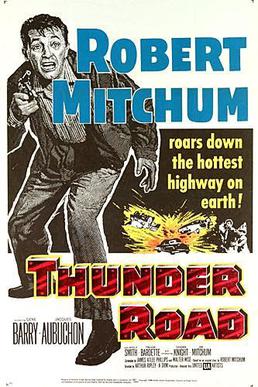
Out In The Film Noir Night-Out In The Hills And Hollows-Robert Mitchum’s Thunder Road

 
DVD Review

Thunder Road, Robert Mitchum, Keely Smith, Gene Barry, United Artists, 1958

…he came out of the hills and hollows (I know, I know, hollas but let’s leave it at and get to the good stuff and not get stuck on that cultural gradient business), came out in any fast-back 1950s sedan (Fords and Chevys favorites, all tooled up, all geared up to rip out the best the cops, the fed cops, the whiskey tax boys, could run against him and any other civilian hound-doggers who wanted to try, and they did and got more, much more than they bargained for) converted to dark night whiskey runs that he could put together and hold together on those back woods thunder roads. Proud of it or not proud of it, that is what he, Luke Doolin, did, ran whiskey, corn whiskey, white lightening, and if anybody didn’t like it, well, they could eat his dust, and they usually did. Ran it all around the Appalachian valleys just like his daddy and his daddy before him going back to mist of America times, pioneer times when people tired out of eastern seaboard clutter and picked up and moved west, eternally moved west, except his people lost the wanderlust early and stayed put on the worked out land, and then got wise to the name of the game.

Yes, Luke Doolin was a piece of work, something out of the olden times, old world times, old Irish times, when a man counted himself a man because he was a man and acted the part, maybe not a hero, no, definitely not a hero, but not a man to be pushed around, not with that couple of centuries pedigree out in those stark mountains, mountains where he fit in or didn’t fit in depending on his mood but where he was doomed to end his days, whenever and however that fate was dealt.

And of course Luke had that jut-jawed look, that take a punch and still stand look, that primitive man look but with some sensitive feelings, feelings that he learned to express a little when he was in the “real world,” the cities and the war fight that rounded out his education that drew women to him like a magnet. Made those women toss and turn all night, some nights anyway, thinking, thinking hard about what exactly they were going to have to do, what seductions they were going to have to perform to draw Luke’s attentions. Needless to say, mountain man that he was, only one woman, one hard-headed woman, would win the brass ring but others would surely try, try or of have more restless mountain wind nights.

Women were the least of it though, although he had had his share, maybe more that the share due him in his line of work. Trouble was brewing, always trouble when cheap jack liquor and dough combined, and maybe throw in some tough-nosed federals looking to bust the untaxed trade. See some guy, some city guy usually, because mountain people usually didn’t run to big adventure ideas-just brew the corn-run it to the cities – collect the dough and make some more, easy and done- yes, some city guy wanted corner the market, run the whole show himself. Even the thought of the idea should have sent that city guy packing, packing the first time he proposed to Luke and to the other backyard distillers the deal he had for them, the deal, or else. But once a guy gets that corner the market lust in his blood he begins to make odd-ball decisions and so there you have it. In the end it was Luke’s way too, or no way.

And as fate would have it, a fate Luke had signaled one night to one of his lady friends- “he was born of the hills and hollows just like other men were born of the sea, it was in his blood, no, more it was a way of thinking about things, about how you wanted to be treated, about what you would, or would not, take, maybe, not like other men who would give a little here, give a little there and then before you knew it they were hollow men, men working for some clock, or something like that. All he knew was that at night, in the middle of the night, with the moon blasting away, the driver window down, maybe on the passenger side too, a cigarette hanging from his sullen lip, taking the turns all sweet and gentle one minute all tense and taut the next he felt alive, felt part of something, felt like the mountain wind’s own brother.” Let leave it at this, he said , it was hard to explain, hard to explain to a woman, a woman with her home-seeking ways, but if that didn’t explain it then just this- “he was a transporter, and that was what he did, and so he would play his hand that way –there was no other way out.”

Hell, they still talk about old Luke and how he got it, got it just like he lived it that night he ran that last run out of the hills and hollows of thunder road and how he did it his way, his way alone, and about how they didn’t make them like Luke any more…

And hence this film