Friday, May 2, 2014

***Out In The Be-Bop Be-Bop 1960s Night- Save The Last Dance For Me


A YouTube film clip of The Drifters performing their classic Save The Last Dance For Me

 
Back in the 1960s, probably now too, one of the great coming-of-age events, if you could stand the gaff, was figuring out how you stood in the high school pecking order (hell junior high too it started that far back). One of the determining factors was your ability, male or female, to garner a date for one of the myriad school dances that took part at various intervals during the year. Topping off that conquest was the last dance, the last dance of the evening, a slow one to allow the heat of sixty-seven rock and roll fast dances to die down and get you ready for the “real” night (if you were lucky) down at the old beach (or wherever the locale was if you were not ocean-worthy) and its subsequent finish at some all-night diner. But you had to get some vibe going on that last dance or else you were going to be home early watching the late shows on television. That last dance thought and what would, or would not happen, came into my mind recently when I saw a YouTube film clip of the Drifters singing their classic last dance song, well, Save The Last Dance For Me with a bunch of kids dancing in front. Some who looked like they were going to make the beach, others ready to reach for that television knob.

Recently I told all who would listen a little heart-rendering story about a girl I knew back at North Adamsville High, a girl who went on to gain some fame as a torch singer fronting for jazz bands (and an occasional rock group as well), Diana Nelson. Needless to say I had a “crush” on her in ninth grade and she in turn would not give me the time of day (or so I thought since I was so girl-shy that I did not pick any signals and just daydreamed watching his ass). I mentioned, in detailing some of the events surrounding the North Adamsville Class of 1962-sponsored version of the traditional late September Falling Leaves Dance in that sketch was that one of the perks that year was getting to hear the vocals of local singer and classmate that Diana Nelson, backed up by local rock band favorite, The Rockin’ Ramrods.

I also mentioned that her selection to front for the group at the dance had been the result of a singing competition held by the town fathers and that I would relate some of the details of that competition at a later date. At the time of the above-mentioned dance she was “going steady” with some college joe, and had not given me the time of day, flirting or encouraging-wise, since about tenth grade, although we always talked about stuff, music and political stuff, two of my passions, and hers too. Here’s the “skinny.”

******

No question that about 1960, maybe into 1961, girl vocalists were the cat’s meow. (Okay, young women, but we didn’t call them that then, no way.) Also no way as well is what we called them, called them among we corner boys at Salducci’s Pizza Parlor, especially when we got “no action.” I don’t have to draw you a diagram on what that meant, right? You can, if you were around then, reel off the names just as well as I can, Connie Francis, Carla Thomas, Patsy Cline, and the sparkplug Brenda Lee. I won’t even mention wanna-bes like Connie Stevens and Sandra Dee, Christ. See, serious classic rock by guys like Elvis, Bo Diddley, Chuck Berry and Jerry Lee Lewis was, well, passé, in that musical counter-revolution night. But music, like lots of other things abhors a vacuum and while guys were still singing, I guess, the girl singers (read young women, okay, and we will leave it at that) “spoke” to us more. Especially to record- buying girls who wanted to hear about teen romance, teen alienation, lost love, unstoppable hurts, betrayal (usually by the girl’s best friend and the sobbing girl’s boyfriend) stuff that teenagers, boys and girls equally, have been mulling over, well, since they invented teenagers a long time ago.

So it was natural for the musically-talented girls around North Adamsville, and maybe around the country for all I know, to test themselves against the big name talents and see what they had. See if they could make teen heaven- a record contract with all that entailed. In North Adamsville that was actually made easier by the town fathers if you can believe that (and they were all men, mostly old men in those days so fathers is right). Why? Because for a couple of years in the early 1960s, maybe longer, they had been sponsoring a singing contest, a female vocalist, singing contest. I heard later, and maybe it was true, that what drove them was that, unlike those mid-1950s evil male rockers mentioned above, the women vocalist models had a “calming effect” on the hard-bitten be-bop teen night. And calm was what the town fathers cared about most of all. That, and making sure that everything was in preparedness for any Soviet missile strike, complete with periodic air raid drills, Christ again.

In 1962 this contest, as it was in previous years, was held in the spring in the town hall auditorium. And among the contestants, obviously, was that already "spoken for" Diana Nelson who was by even the casual music listener the odds-on favorite. She had prepped a few of us with her unique rendition of Brenda Lee’s I’m Sorry so I knew she was a shoo-in. And she was. What was interesting about the competition was not her victory as much as the assorted talents, so-called, that entered this thing. If I recall there were perhaps fifteen vocalists in all. The way the thing got resolved was a kind of sing-off. A process of elimination sing-off.

Half a dozen, naturally, were some variation of off-key and dismissible out of hand. These girls fought the worst when they got the hook. Especially one girl, Elena G., if anyone remembers her who did one of the worst versions of Connie Francis’ Who’s Sorry Now I had (and have) ever heard. The more talented girls took their lost with more grace, probably realizing as Diana got into high gear that they were doomed. But here is the funny part. One of the final four girls was not a girl at all. Jimmy C. from right down the end of my street dressed himself up as girl (and not badly either although none of us knew much about “drag queen” culture then) and sang a great version of Mary Wells’ Two Lovers. Like I said we knew from nothing about different sexual preferences and thought he just did it as a goof. (I heard a couple of years later that he had finally settled in Provincetown and that fact alone “hipped” me to what he was about, sexually.)

I probably told you before that one part of winning was a one thousand dollar scholarship. That was important, but Diana, when she talked to me about it a couple of days later just before class, said she really wanted to win so she could be featured at the Falling Leaves Dance. Now, like I said, I had a big crush on her, no question, so I was amazed that she also said that she wanted me to be sure to be at the dance that next late September. Well, if you have been paying attention at all then you know I was there. I went alone, because just then I didn’t have a girlfriend, a girlfriend strong enough for me to want to go to the dance with anyway. But I was having a pretty good time. I even danced with Chrissie McNamara, a genuine fox, who every guy had the “hots” for since she, just the night before, had busted up with Johnny Callahan, the football player. And Diana sang great, especially on Brenda Lee’s I Want To Be Wanted. She reached somewhere deep for that one.

Toward the end of the evening, while the Rockin’ Ramrods were doing some heavy rock covers, Chuck Berry’s Sweet Little Sixteen I think, and she was taking a break, Diana came over to me and said, I swear she said it exactly like this- “save the last dance for me.” I asked her to repeat herself. She said Bobby (her college joe) was not there that evening for some reason I do not remember and that she wanted to dance the last dance with someone she liked. Well, what’s a guy to do when someone like Diana gives her imperial command? I checked my dance card and said “sure.” Now this last dance thing has been going on ever since they have had dances and ever since they have had teenagers at such events so no big deal, really. Oh, except this, as we were dancing that last dance to the Ramrod’s cover of The Dubs Could This Be Magic Diana, out of the blue, said this. “You know if you had done more than just stared at my ass in class (and in the corridors too, she added) in ninth grade maybe I wouldn’t have latched onto Bobby when he came around in tenth grade.” No, a thousand times no, no, no, no…

Thursday, May 1, 2014

From the Marxist Archives -ALL OUT TO MADISON SQUARE ON MAY DAY (1934)


James P. Cannon The Militant April 28, 1934

ALL OUT TO MADISON SQUARE ON MAY DAY


Written: 1934
Source: The Militant. Original bound volumes of The Militant and microfilm provided by the Holt Labor Library, San Francisco, California.
Transcription\HTML Markup:Andrew Pollack

On May Day this year New York will witness the most imposing demonstration of the workers and the most tangible advances toward their united struggle against the common enemy that has been seen for many years. The participating workers’ organizations will march together in a single parade and hold a common demonstration at Madison Square. The Communist League (International Communists) will march in the parade under its own banner and will be represented by its own speakers at the demonstration.
The idea that the political and economic organizations of the workers, regardless of their differences of principle, must form a united front of action against the class enemy—this idea, which was rejected with such fatal consequences in Germany, has brought a host of organizations together and governs their practice in carrying out all the arrangements of the united front May Day parade and demonstration. The no less important condition—that each organization shall preserve its own identity and march under its own banner—is likewise respected and observed by the participants.
The features of the demonstration signify a victory for the idea of a workers’ united front and the beginning of its realization in action. For these reasons alone, the Communist League, which insistently fights for the united front of the workers’ organizations, would be duty bound to take part in the work and actions of the May Day Labor Conference which culminate in the parade and demonstrations on May Day. But there are other reasons of no less weight and importance which make the course we have taken mandatory upon us as communists.
The Stalinist party (CP) and the organizations under its control are conducting a separate parade and demonstration at the same hour. Thus, although the preponderant weight of forces is with the Labor Day Conference; a serious element of division remains in the workers’ ranks. Such a division is not of our making. We stand for the united front of all the workers’ organizations and will continue to fight for it in the future. Nevertheless, the division, and the holding of the demonstrations at the same hour, compel each organization and each individual militant to make a choice.
We have made our choice in this matter with full deliberation, and our decision is not an isolated one, applicable only to a single occasion. It corresponds, rather, to the trend of developments in the labor movement. And this, in turn, determines the tactical course of the revolutionary Marxist.
The Stalinists, who reject the united front with all organizations not under their direct control, demand that the workers demonstrate on May Day only under Stalinist auspices. This ultimatum is repeated by their camp followers of various kinds in varying stages of confusion and demoralization.
The ultimatums of the Stalinists have no interest for us. We reject the “leadership” of these political hooligans and condemn them as a menace to the labor movement. But to the conscientious left-wing workers who may have the mistaken impression that the May Day demonstrations present a choice between communism and reformism, we owe a frank explanation of the course we have taken. Our remarks on the question are addressed especially to them.
It is argued by the Stalinists and their camp followers that the parade and demonstration at Madison Square, organized by the Labor Conference, will be composed predominantly of the Socialist political organizations and reformist trade unions, while the Union Square demonstration represents the revolutionary workers. The workers who want a united front of action and defense are called upon to choose between the Socialist Party and the Communist Party. This ultimatum contains three propositions which have to be dealt with separately.
It is quite true that the Madison Square demonstration will be predominantly Socialist and trade unionist and that these organizations have by far the main weight in the conference. But that is not a reason for communists to stay away from the demonstration. On the contrary, it is the duty of the communists to march with the Socialist workers and the trade unionists and to raise the banner of communism in their midst. As long as the communists are permitted to march with their own banner and to be represented by their own speakers at the demonstration—and these rights have been expressly provided for all the participating organizations by the joint arrangements committee—they have no need and no right to present any other demands as a condition for a united action. March separately, strike together—this is the fundamental basis for the united front of the workers.
We do not demand that the Socialist workers leave their own organizations as a condition for common action with us. We do not demand that they cease to be Socialists in order to make the united front with communists. We do not demand that our leadership be recognized beforehand, and we do not repeat the insane gibberish about the “united front from below.” It is such ultimatums, which the Stalinist bureaucrats are in the habit of laying down to the workers, which negate the very idea of the united front and make it impossible. We hope to convince the workers, in the course of common action, of the inadequacy of reformism and the necessity for revolutionary policy and leadership. But we do not demand that they be convinced of this in advance. Therein lies the fundamental difference between the Stalinist and the revolutionary communist conception of the united front.
The second false assumption in the ultimatum of the Stalinists and their ideological captives is the argument that the Union Square demonstration is a demonstration of the “revolutionary workers,” that the Stalinist leaders are the representatives of communism. This contention, false to the core, is especially repugnant today in the face of the cynical united front of Stalinism with world reaction in hounding the organizer of the Russian revolution.
Many workers with the impulse to be revolutionists will undoubtedly participate in the Stalinist demonstration. But Stalinism as a political current contributes nothing to the labor movement but ideological disorientation, demoralization, and defeat. The Stalinist hooligans corrupt every principle of communism and defile its very name. They always subordinate the interests of the working class to the special interests of a bureaucratic apparatus. The Stalinists disrupt and sabotage every attempt of the workers to unite their forces for a common fight against the class enemy. Stalinism is a poison in the veins of the labor movement, and its harmful influence derives precisely from the assumption by many workers that it represents communism.
It is necessary to attack this illusion in deed as well as in word and to put the question as it really stands: Stalinism is a reactionary force in the labor movement of the whole world.
The Madison Square demonstration will be predominantly reformist, in composition and leadership. That is true. But revolutionary internationalism will be represented there this May Day, and only there. Not the banner of Stalinism, splotched with crimes and treacheries, but the banner of the International Communists—this is the banner of communism. Every revolutionary worker ought to march behind it and no other.
The third fallacy in the ultimatum of the Stalinists and their apologists consists in the posing of the question of a united front on May Day as a rivalry and conflict between the Socialist Party and the Communist Party, and the demand that the workers choose between the two parties. “March with the Communist Party, not with the Socialist Party” is the formula of this ultimatum. For our part, if it is a question of party preference, we choose neither the CP nor the SP and follow neither. If the May Day meetings are to be construed simply as meetings of different parties then the revolutionary workers supporting the Communist League would have no choice but to abstain from both demonstrations and to organize their own, however small it might be.
But this is not how the question presents itself to us. Quite the contrary. General political meetings of the parties can be conducted apart from the demonstrations under the auspices of the respective parties—the Communist League, for example, will hold its own meeting in the evening. But the demonstration and purpose on May Day ought to represent a united front of all the parties and workers’ organizations in a single demonstration against war and fascism and for the immediate needs of the workers.
It is precisely the inability of the Stalinists even to comprehend the question in this sense, their shopkeeper’s conception of the special interest of their own party apparatus and their fear of “competition,” that impelled them to organize the Union Square demonstration as a demonstration for the Communist Party. Their stubborn refusal to merge their party interest for a single occasion, on May Day of all days, with the general class interest, condemns the demonstration to isolation as an affair of the CP and its auxiliaries, despite all the crooked ballyhoo about “unity” and the “united front. ”
And by the same token this policy of the Stalinists and the whole line of conduct flowing from it, not forgetting the Madison Square Garden affair—this policy and conduct make it easy for the Socialist leaders, who are no more in favor of an all-inclusive fighting united front than the Stalinists, to counteract the pressure of their own members for a single, united demonstration.
The fact that the Socialist leaders felt obliged to agree to joint action with every other group and organization except the Stalinists, to give up their original demand that the May Day Labor Conference be labeled as “Socialist and Labor,” their agreement that all the participating organizations be represented with their banners at the head of the parade as well as on the arrangements committee and on the speakers’ platform—all this is powerful testimony to the deep-rooted sentiments of the Socialist workers for a genuine united front.
The Communist League fought in the conference and arrangements committee for an invitation to the Stalinists, but without success. We also sent delegates to the Stalinist conference to propose that a direct approach be made to the May Day Labor Conference for a single demonstration. Our proposal was rejected with the usual barrage of epithets and slander. Nevertheless, it can be asserted, so pressing is the need for unity and so powerful the sentiment of the rank-and-file workers for it, that if our proposal had been adopted and carried out honestly and consistently, it would have been extremely difficult, if not impossible, for the Socialist leaders to refuse.
We shall continue to fight for this policy as we have fought consistently for it in the past. For years, as a faction working for the reform of the CP, we continuously advocated the adoption by the party of the policy of the united front in the same sense that we present it today. The victory of fascism in Germany is directly due to the rejection by the Stalinist leadership of the united front with the Social Democracy and the reformist trade unions, which the Left Opposition insistently demanded. The weakness and disorganization of the working-class movement in this country, after four and one-half years of the unprecedented crisis, is in large part also the result of the same fatal mistakes, systematically repeated.
Breaking with the Comintern because of its obvious and irremediable bankruptcy, and taking the path toward new parties and the Fourth International, the International Communists (formerly the Left Opposition) in no way alter or modify the principles, strategy, and tactics with regard to the broad labor movement which they formerly proposed for the adoption of the official Communist parties. The only difference is that we carry out in practice now, as a completely independent organization, the tactics which we previously recommended to the CP. This is the meaning of our decision to participate in the Madison Square demonstration and parade with the Socialist Party, the trade unions, and other political groups and tendencies.
The parade and demonstration organized by the May Day Labor Conference, lacking the inclusion of the Stalinist organizations, is obviously not a complete united front and should not be represented as such. But this is not a reason to abstain from participation. After all the divisions and demoralization, it is utopian to expect that the idea of the united front will take hold everywhere with the same force and that it can be realized organizationally overnight.
The building of the united front of the workers is a process. This process involves agitation for the idea, experiments in cooperation, and tests in action. Including all the tendencies of the more or less progressive section of the labor movement, with the single exception of the Stalinists and their satellites, the May Day Labor Conference represents a tremendous step forward. From this point of view it must be hailed and supported by the revolutionary workers. At the same time efforts must be made to broaden out its composition and extend it to other fields of activity in the class struggle.
Needless to say, our participation at Madison Square does not imply in any way the slightest reconciliation with the Socialist Party. The united front of action on concrete questions does not signify political collaboration. No blurring of principled issues. No mixing of banners.
Our principled differences with social reformism remain. We shall fight them out to the end. Not by lies and slanders, not by hooligan violence, but through argument and example, we shall endeavor to convince the Socialist workers of the necessity of a revolutionary policy and leadership. In intransigent principled struggle against social reformism we shall work for the new party and the new International.
Meantime, now as always, we shall stand for the united front in concrete struggles of the day: with the Socialist workers through the medium of their chosen organization.
maydayfeature

May Day: Lessons from Yesterday and Today

Published On April 24, 2014 | By Katie Quarles | History, Labor Movement

Beginning with May Day this year, the fight for a $15 an hour minimum wage can spread like wildfire. This can become a catalyst to rebuild the labor movement and traditions of mass struggle. As we fight for a $15 an hour minimum wage, we need to learn the lessons of past victories to win our struggles today.
Workers have always had to fight for everything we have, from the weekend to the eight-hour day to less dangerous working conditions. Not to mention every wage increase we have received.
Every year on May 1, workers in many countries get the day off and unions organize large demonstrations and celebrations for International Workers Day. May 1 commemorates events that occurred during the struggle for the eight-hour day in the U.S. in 1886.
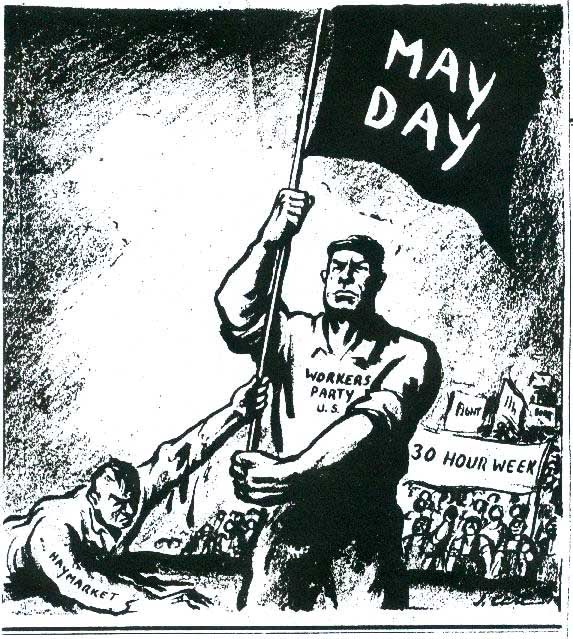
MayDayCartoon lgAt that time, workers across the United States were commonly working 10-16 hours a day, six days a week. A general strike was organized across many parts of the country on May 1. Much like the demand for a $15/hr minimum wage today, many businesses claimed a 40-hour workweek was unreasonable and would be too expensive for them. The strike went on for several days. A number of workers were shot by police and the National Guard in cities like Chicago and Milwaukee. Then, on May 4, a bomb exploded during a rally at Haymarket Square in Chicago. Labor activists were blamed, with seven of them sentenced to death. Nevertheless, the strike was a victory, with many workers getting their workdays shortened to eight or 10 hours a day without loss of pay.
The demand for an eight-hour day helped to mobilize fighting unions, radicalizing youth and activists in political parties organizing against capitalist domination. The fight for a $15 an hour minimum wage can do the same today, bringing together labor activists, former Occupiers, and campaigners against racism and sexism. After the momentum of a victory for the eight-hour day, many felt the need to commemorate the struggle and take the movement forward. In 1889, the “Second International” of working-class organizations endorsed May 1 as a worldwide day of demonstrations.
May Day Today
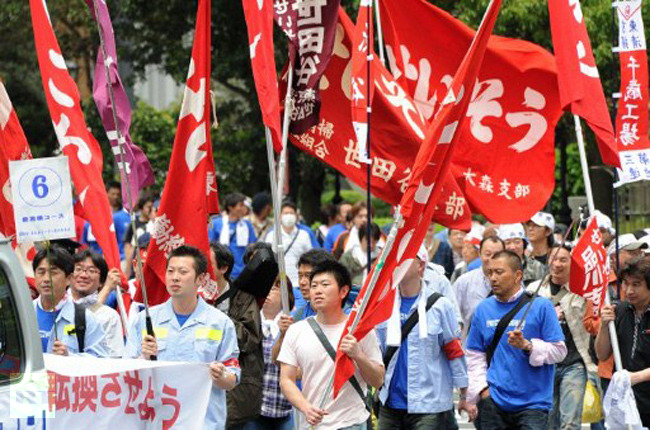
AFP Photo / Sabah Arar
To this day, International Workers Day is a legal holiday in more than 80 countries and unofficially celebrated in many more, where workers mark the day by going to mass demonstrations.
With 400 Americans owning more wealth than half of all Americans combined now, more than ever, working people in the United States need to reclaim May 1 and its original spirit of struggle. In recent years, the tradition has been reclaimed in the U.S. by the immigrant rights movement. Then, Occupy groups in 2012 also helped organize big rallies. This year, the fight for a $15 an hour minimum wage will be a key demand of many demonstrations.
Immigrants also played a big role in the struggle for the eight-hour day. In today’s struggle to raise the minimum wage, immigrants also have a key role to play. That’s why the struggle to raise the minimum wage needs to go hand in hand with the struggle for immigrant rights. Organizing and fighting is easier when workers don’t have to live in fear of being deported for standing up. This will make victory easier to help all low-wage workers, native-born and immigrants. May 1 can be an important day to help build the struggle for immigrant rights, linking it to the fight for a $15 minimum wage.
When We Fight. . .We Win!
thumb.phpThe concessions made to workers in 1886 were not given easily. It took the organized struggle of tens of thousands of workers, risking their lives, breaking laws in a coordinated manner, and defying police and the National Guard to win these improvements.
The very fact that workers were able to shut down large sections of the economy to win improvements in their standard of living shows the potential power of the organized working class. Despite the decreasing union density in the U.S., the potential for this power remains fundamentally the same. The power to organize to bring the economy to its knees is the power that changed manufacturing jobs from the low-skill, low-wage, unorganized jobs they were to being considered “good union jobs” now. We need to fight to make the same transformation in the low-wage service sector jobs of today.
However, every victory won under capitalism is only temporary in nature. As soon as the workers and our unions appear weaker, the bosses will try and claw back previously won gains. The profit motive as the driving factor in the economy dictates that bosses will always try to decrease the workers’ share of the profits in order to increase their own.
Workers do all the work in this society. We can run the economy and society democratically ourselves by taking the top 500 corporations into public ownership. A society run on this basis rather than the profit motive could immediately give everyone a socially necessary job, eliminate unnecessary branches of the economy and, instead, make a massive investment in infrastructure, improving and expanding free education for all, including universities; free universal health care with a strong focus on preventive care; and food production in the interests of public health rather than profit. And spreading the socially necessary work out among the entire potential workforce would decrease the number of hours everyone would have to work. No one who works would have to live in poverty, as the obscene wealth hoarded by the 1% would be made available for all.
Genuine democratic socialism would be a fundamentally different society in which the economy is democratically run through committees in workplaces and neighborhoods, which would elect people to regional and worldwide committees who would be recallable at any time and would not earn any more than the average of the people they represent.
To achieve such a fundamental transformation of society – a key goal of many of the original organizers of International Workers Day – we need to build and strengthen the labor movement and fight to get unions to break from the two parties of big business and enter the political arena with a party of our own.

Like this Article? Share it!

*From The Archives-ON MAY DAY-OUR FLAG IS STILL RED-HONOR THE HAYMARKET MARTYRS


Commentary

THIS YEAR MARKS THE 128TH ANNIVERSARY OF THE MAY DAY HAYMARKET FRAMEUPS. HONOR THE MEMORY OF AUGUST SPIES, ALBERT PARSONS, ADOLPH FISCHER, GEORGE ENGEL, LOUIS LINGG, MICHAEL SCHWAB, SAMUEL FIELDEN, OSCAR NEEBE- CLASS WAR VICTIMS OF AN EARLIER TIME. ALSO REMEMBER LUCY PARSONS WHO CARRIED ON THE STRUGGLE FOR VINDICATION AFTER HER HUSBAND’S EXECUTION. LET US REDOUBLE OUR EFFORTS TO FREE TODAY’S CLASS WAR PRISONERS.

FORGET DONKEYS, ELEPHANTS AND GREENS- BUILD A WORKERS PARTY


Politically, the writer of these lines is far distance from those of the Haymarket Martyrs. Their flag was the black flag of anarchism, the writer’s is the red flag of socialism. Notwithstanding those political differences, militants must stand under the old labor slogan that should underscore all labor defense work now as then- ‘An injury to one is an injury to all’. Unfortunately that principle has been honored far more in the breech than in the observance by working class organizations.

Additionally, in the case of the Haymarket Martyrs today’s militants must stand in solidarity and learn about the way those militants bravely conducted themselves before bourgeois society in the face of the witch hunt against them and their frame-up in the courts of so-called bourgeois ‘justice’. Not for the first time, and most probably not for the last, militants were railroaded by the capitalist state for holding unpopular and or/dangerous (to the capitalists) views. Moreover, it is no accident that most of the Haymarket Martyrs were foreigners (mainly Germans) not fully appreciative of the niceties of 19th century American ‘justice’. This same ‘justice’ system framed the heroic anarchist immigrant militants Sacco and Vanzetti in the early 20th century and countless other militants since then. As we struggle in the fight for full citizenship rights for immigrants today we should keep this in mind. Although, as we also know, this American system of ‘justice’ will not forget the occasional uppity ‘native’ political dissenter either.

Most importantly, we must not forget that the Haymarket Martyrs at the time of their arrest were fighting for the establishment of a standardized eight hour work day. It is ironic that 120 years later this simple, rational, reasonable demand should, in effect, still be necessary to fight for by working people. All proportions taken into account since the 1880’s, a very high percentage of the working class still does not have this luxury- given the necessity of two wage-earner families, two job wage-earners, dramatic increases in commute time in order to gain employment, unpaid but mandatory work time (note especially the Walmart-ization of labor time) and a high rate of partially or fully unemployed able-bodied workers. To do justice to the memory of the Haymarket Martyrs this generation of militants should dust off another old labor slogan that used to be part of the transitional demands of the socialist movement- 30 hours work for 40 hours pay. TODAY THIS IS A REASONABLE DEMAND.

Obviously such a demand cannot be implemented in isolation. To even propose such a demand means we need to build a workers party to fight for it. Moreover, and let us not have illusions about this; this capitalist state does not want to and will not grant such a demand. Therefore, we must fight for a workers government. That would be a true monument to the memory of the Haymarket Martyrs.
***Out In The Be-Bop, Be-Bop 1960s Night- The World Turned Upside Down-The Great Teenage Triangle


A YouTube film clip of Dale Ward performing his classic 1960s teen angst Letter From Sherry, with lyrics provide below, in order to give a flavor of the times to this piece

From The Pen Of Frank Jackman

Yeah, no question I had trouble, big trouble, holding on to girls when I was a kid in high school. Or maybe I better be more honest and say that I was tongue-tied around them, didn’t understand them, and got all sweaty-palmed around them and therefor did not need to worry about holding out to them because they vanished in the night like some fog rolled in. Of course now the other problem was that I seemed to always be behind the curve in the teenage “intelligence” department. You know finding out via the ubiquitous teenage grapevine which held forth first thing Monday morning before school in the boys’ “lav” who was “spoken” for and such. I was forever picking girls who were “going steady” or had large boyfriends or stuff like that. Now that kind of thing is done with, no more worries. Except recently I was looking at a 1960s record compilation, you know one of those “greatest hits” things that record companies are hustling to the AARP-worthy generation when I spied a telling song, Dale Ward performing his classic 1960s teen angst Letter From Sherry. Just seeing that song listed had me fully engaged in a sweaty-handed re-run of my teen angst and alienated youth. I have provided lyrics provide below in order to give a flavor of the times to this piece. The story below will tell you why.

*********

Nobody said being a teenager was going to be easy now, in 1860 or whenever they invented teenagers, 1960 the time period of this piece, or, hell, 2360. Teen angst, short term or long, comes with the territory. However sometimes something, in this case a song, will sum up just exactly how hard teen life really is. I admit this one had me a little weepy for a while over the fate, a common fate, of one of the characters. That is until I realized, wait a minute this is teen stuff, next week the configuration will have totally changed, or the boys (or girl) in this teen triangle will have sworn off girls (or boys, for the girl). Yah, right.

Rather than leave the reader in any more suspense let me give the details of the heart-rending dilemma. It seems that Robert, well let’s call him Robert because Roberts always seem to be the kind of guys who draw the short end of the stick in teen life, was head over heels in love with Sherry, and had been ever since they met a couple of summers back down at the far end, the teen far end, of Olde Saco Beach up in cold climate Maine so it must have been July, no later. Needless to say they were both “enjoying” the rite of passage teen bored-to-death vacation with their ever-loving families when the family dogs they were walking met, and presto Robert and Sherry met. (By the way dogs are optional in this kind of story, although included here since they met while walking the respective family dogs) Things went fine for a while, as such summer romances go, and they wrote during the winter with all kinds of expectations of another high school teen romance summer, with maybe a little more than just kissing this time.

As luck would have it though Robert, studious, shoulder to the wheel if smitten Robert, had an opportunity to work at Ben’s Market in Olde Saco that next summer in order to help with his soon to be impeding college tuition. Naturally he had to “jump” at the opportunity (with a very big “friendly” push from his parents). And that is when things started to fall apart.

Nature, and teen nature is a pure scientific example of that law, abhors a vacuum. Especially a foxy Sherry on the beach alone, no Robert alone, (and no dog along for introductions this time) when Eddie, let’s call him Eddie, not Edward, not, Ed, not Eduardo, just Eddie because it is always Eddies who scoop up the foxes in teen life came swaggering up the beach, sat right beside Sherry and started, well, started in his version of fast Eddie love talk. Just like that. And Sherry, well, Sherry was just in the mood to hear such talk, if not from "shoulder the wheel" Robert then Eddie, kind of hunky Eddie, would do just fine. After all a girl has to look out for herself in this wicked old world.

The long and short of it was that Sherry made a date with Eddie, a happy date when she found out that Eddie had a “boss” ’57 Chevy for that date. Robert’s was working at his silly old market job anyway so he would be none the wiser. That night, it might have been the stars, it might have been the moon, it might have been Sherry mad at Robert, or it just might have been the time of her time, but Sherry let Eddie have his way with her down at the far, far, far end of Olde Saco beach. The place where only teenagers with something on their minds other than throwing pebbles in the surf go, no one else goes there not even the cops.

So far still nothing remarkable, right. A million teens lost in the moon-beam night learning about the ways of the world, the adult sex world that they keep hush-hush about but which every teen since Socrates, maybe before, gets hip to, one way or another. But here is where it gets dicey. See Eddie already had a foxy girlfriend back home, Laura, who outfoxes Sherry six ways to Sunday. And is rather possessive of her man. Switchblade-like possessive if it came to it. And Eddie, frankly, while he enjoyed Sherry was in it for kicks, for just doing it when the opportunity arose, and moving on. So that is exactly what he did. Sherry though, after the short summer tryst was over, started writing Eddie asking when he was coming back and all that kind of stuff, girl crush stuff.

Still not that remarkable though. What was though was that Eddie and Robert attended the same regional high school together, Arundel High over the other side of Sanford (although they do not live in the same town) and were both on the football team. (Robert the steady plebeian pulling guard, Fast Eddie, well, the fleet-footed halfback, naturally) So one afternoon Eddie, Eddie acting like a peacock, showed Robert, in the presence of his best friend, Josh Breslin, and so that is how this situation became public knowledge, well school knowledge anyway, since Josh is a friend of mine as well one of Sherry’s letters.

Eddie went on a little about what he and Sherry did and what a cluck she was for writing a breeze guy like Eddie such stuff. And Eddie said right then and there that he bet Robert five dollars, five serious dollars, that he could write a couple of lines to Sherry about not having enough dough for postage stamps to write her before, or something, as his reason for not writing and he could be right back down there at the far, far, far end of Olde Saco Beach with Sherry anytime he wanted. Well, maybe not anytime because on hearing that Robert reared back and gave Eddie a punch that dropped him to the ground in nothing flat. So floor-fast Eddie and his jaw were on the bench for a while if Sherry wanted to know his whereabouts just then.

***********

Letter From Sherry lyrics-Dale War

A letter from Sherry

Oh boy, what a girl

But to the boy who really loves her

Its the end of the world.

A letter from Sherry

Brings teardrops to my eyes

A letter from Sherry

Oh why, Sherry, why?

My best friend named Eddie

Came by just yesterday

With a letter from Sherry

Heres what she had to say

Dear Eddie Dear Eddie, I love you I love you

With all my heart with all my heart

Vacation last summer

Was grand

And though you

You never write

I pray I pray

Each day and night

For Im yours

And yours alone

And dear Sherry, shes comin home

A letter from Sherry

Oh boy, what a girl

But to the boy who really loves her

***Out In The Be-Bop 1960s Night- When "Stewball" Stu Stewart ’57 Chevy Ruled The “Chicken” Roads


A YouTube film clip of Chuck Berry performing his classic School Days to give a flavor of the times to this piece

From The Pen Joshua Lawrence Breslin


Back in the day, back in the 1960s be-bop night I was enamored of, dug, the guys who could wheel around in cars like nothing. Guys who were handy with a wrench in more ways than one, guys who could steer on a dime, guys who thought nothing of going 100 miles an hour on some after midnight “chicken run” to prove, to prove what, to prove they were the king of the hill in the burned-out Olde Saco Beach night. Guys totally different from clumsy, non-mechanical, nerdy me who could barely work the shifts on a car. Yeah, guys like “Stewball” Stu Stewart who lived down at the end of my street and who I was thinking about recently. The reason for that thought after so many years was that I had just then seen for about the twelfth time James Dean’s Rebel Without A Cause where cool car guys and chicken runs to prove manhood came into play (and teen angst and alienation too but I had that part down already, down  big time). I was also at that time looking at an old record cover from those days when everybody was glad to put a big old “golden age of the automobile” young guy with a souped-up car on the album as a lure to the guys. Come on, to the girls, silly. So there it was artfully done a guy in full James Dean-imitation pout, one good-looking, DA-quaffed, white muscle-shirted young man, an alienated young man, no question, leaning, leaning gently, very gently, arms folded, on the hood of his 1950’s classic automobile, clearly not his father’s car, but also clearly for our purposes let us call it his “baby.”

And that car, that extension of his young manhood, his young alienated manhood, is Friday night, Saturday night, or maybe a weekday night if it is summer, parked directly in front of the local teenage "hot spot." (Priority parked, meaning nobody with some Nash Rambler, nobody with some foreign Volkswagen, no biker even, in short, nobody except somebody who is tougher, a lot tougher, than our alienated young man better breathe on the spot while he is within fifty miles of the place.) And in 1950s’ America, a teenage America with some disposal income (allowance, okay), that hot spot is likely to be, as in that picture, the all-night Mel’s (or Joe’s, Adventure Car-Hop, whatever) drive-in restaurant opened to cater to the hot dog, hamburger, French fries, barbecued chicken cravings of exhausted youth. Youth exhausted after a hard night of, well, let’s just call it a hard night and leave the rest to your knowing imagination, or their parents’ evil imaginations.

And in front of the restaurant, in front of that leaned-on “boss” automobile stands one teenage girl vision. One blondish, pony-tailed, midnight sun-glassed, must be a California great American West night teeny-bopper girl holding an ice cream soda after her night’s work. The work that we are leaving to fertile (or evil, as the case may be) imaginations. Although from the pout on Johnny’s (of course he has to be a Johnny, with that car) face maybe he “flunked out” but that is a story for somebody else to tell. Here’s mine.

********

Not everybody, not everybody by a long-shot, who had a “boss” ’57 cherry red Chevy was some kind of god’s gift to the earth; good-looking, good clothes, dough in his pocket, money for gas and extras, money for the inevitable end of the night stop at Jimmy John’s Drive-In restaurant for burgers and fries (and Coke, with ice, of course) before taking the date home after a hard night of tumbling and stumbling (mainly stumbling). At least that is what one Joshua Breslin, Josh, me, freshly minted fifteen- year old roadside philosopher thought as for the umpteenth time “Stewball” Stu left me by the side of Albemarle Road and rode off into the Olde Saco night with his latest “hot” honey, fifteen year old teen queen Sally Sullivan.

Yah, Stewball Stu was nothing but an old rum-dum, a nineteen year old rum-dum, except he had that “boss” girl-magnet ’57 cherry red Chevy (painted that color by Stu himself) and he had his pick of the litter in the Olde Saco, maybe all of Maine, night. By the way Stu’s official name, was Stuart Stewart, go figure, but don’t call him Stuart and definitely do not call him “Stewball” not if you want to live long enough not to have the word teen as part of your age. The Stewball thing was strictly for local boys, jealous local boys like me, who when around Stu always could detect a whiff of liquor, usually cheap jack Southern Comfort, on his breathe, day or night.

Figure this too. How does a guy who lives out on Tobacco Road in an old run-down trailer, half-trailer really, from about World War II that looked like something out of some old-time Hooverville scene, complete with scrawny dog, and tires and cannibalized car leavings every which way have girls, and nothing but good-looking girls from twelve to twenty (nothing older because as Stu says, anything older was a woman and he wanted nothing to do with women, and their women’s needs, whatever they are). And the rest of us get his leavings, or like tonight left on the side of Route One. And get this, they, the girls from twelve to twenty actually walk over to Tobacco Road from the nice across the other side of the tracks homes like on Atlantic Avenue and Fifth Street, sometimes by themselves and sometime in packs just to smell the grease, booze, burnt rubber, and assorted other odd-ball smells that come for free at Stu’s so-called garage/trailer.

Let me tell you about Stu, Sally, and me tonight and this will definitely clue you in to the Stu-madness of the be-bop Olde Saco girl night. First of all, as usual, it is strictly Stu and me starting out. Usually, like today, I hang around his garage on Saturdays to get away from my own hell-house up the road and I am kind of Stu’s unofficial mascot. Now Stu had been working all day on his dual-exhaust carburetor or something, so his denims are greasy, his white tee-shirt (sic) is nothing but wet with perspiration and oil stains, he hasn’t taken a bath since Tuesday (he told me that himself with some sense of pride) and he was not planning to do so this night, and of course, drinking all day from his silver Southern Comfort flask he reeked of alcohol (but don’t tell him that if you read this and are from Olde Saco because, honestly, I want to live to have twenty–something as my age). About 7:00 PM he bellows out to me, cigarette hanging from his mouth, a Lucky, let’s go cruising.

Well, cruising means nothing but taking that be-bop ’57 cherry red Chevy out on East Grand and do the “look.” Look for girls, look for boys from the sticks with bad-ass cars who want to take a chance on beating Stu at the “chicken run” down at the flats on the far end of Sagamore Beach, look for something to take the edge off the hunger to be somebody number one. At least that last is what I figured after a few of these cruises with Stu. Tonight it looks like girls from the way he put some of that grease (no not car grease, hair-oil stuff) on his curly hair. Yes, I am definitely looking forward to cruising tonight once I have that sign because, usually whatever girl Stu might not want, or maybe there are a couple of extras, or something I get first dibs. Yah, Stu is righteous like that.

So off we go, stopping at my house first so I can get a little cleaned up and put on a new shirt and tell my brother to tell our mother that I will be back later, maybe much later, if she ever gets home herself before I do. The cruising routine in Olde Saco means up and down Route One (okay, okay Main Street), checking out the lesser spots (Darby’s Pizza Palace, Hank’s Ice Cream joint, the Colonial Donut Shoppe where I hang during the week after school and which serves a lot more stuff than donuts and coffee, sandwiches and stuff, and so on). Nothing much this Saturday. So we head right away for the mecca, Jimmy John’s Diner. As we hit Stu’s “saved” parking spot just in front I can see that several stray girls are eyeing the old car, eyeing it like tonight is the night, tonight is the night Stu, kind of, sort of, maybe notices them (and I, my heart starting to race a little in anticipation and glad that I stopped off at my house, got a clean shirt, and put some deodorant on and guzzled some mouthwash, am feeling tonight is the night too).

But tonight is not the night, no way. Not for me, not for those knees-trembling girls. Why? No sooner did we park than Sally Sullivan came strolling (okay I don’t know if she was strolling or doo-wopping but she was swaying in such a sexy way that I knew she meant business, that she was looking for something in the Olde Saco night and that she had “found” it) out to Stu’s Chevy and with no ifs, ands, or buts asked, asked Stu straight if he was doing anything this night.

Let me explain before I tell you what Stu’s answer was that this Sally Sullivan is nothing but a sex kitten, maybe innocent-looking, but definitely has half the boys, hell maybe all the boys at Olde Saco High, including a lot of the guys on the football team drooling over her. I know, because I have had more than one sleepless night over her. See, she is in my English class and because Mr. Murphy lets us sit where we want I usually sit with a good view of her. So Stu says, kind of off-handedly, like having the town teen fox come hinter on him was a daily occurrence, says kind of lewdly, “Well, baby I am if you want to go down Sagamore Rocks right now and look for dolphins?”

See, Sagamore Rocks is nothing but the local lovers’ lane here and “looking for dolphins” is the way everybody, every teenage everybody in town says “going all the way,” having sex for the clueless. And Sally, as you can guess if you have been following my story said, “Yes” just like that. At that is why I was dumped, unceremoniously dumped, at my street while they roared off into the night. I said before not every “boss” car owner is god’s gift to women, not by a long shot. Or maybe they are.
***Out In The Be-Bop Be-Bop 1960s Night-When Diana Nelson “Touched” The North Adamsville Night Away


YouTube film clip of Leslie Gore performing her classic 1960s teen dream theme That’s The Way Boys Are.

From The Pen Of Frank Jackman


Everybody knows, or should know, and if you don’t I will tell you now, that I had it bad for Diana Nelson. Yes, that Diana Nelson, the gal who has sung more note-worthy torch songs, brought more tears to sullen eyes, in front of more jazz combos, good ones too, than I have time to list here.  We went to school together back in the 1960s (North Adamsville Class of 1964, sorry Diana if you are fudging on your age these days) and even then I knew she would be good, would make it. We had had our possible moment one time but I always seemed to be about one or two steps behind in those days, behind in the girl figuring out department.

Recently I was rummaging through a chest up in the attic where I store lots of old stuff, including old vinyl records that I remember laughingly telling my wife would “make a comeback someday” and so should be kept for potential value. And nostalgia. One of the albums, a compilation, had a photograph of Leslie Gore on the cover, and that got me to thinking about Diana again. The Leslie Gore song on the compilation was the classic teen dream theme (girl division) song, That’s The Way Boys Are. That song was our “song” for that brief period when we were flirting around each other. More importantly that was one of the songs in demand that Diana covered when she got gigs to sing at various dances. All of which reminded me of how good she was but also how driven she was to make good. The following is how I remember that drive of hers from what she mentioned in our talks together.       

******

I, Diana Nelson, am going to be a big singing star just watch out, watch out and don’t blink because then you will miss it. Hey, it is written in the stars, my stars. Proof? I have just this spring won the 1962 edition of the annual Adamsville Female Vocalist Contest. Hands down! There was no way that any of those other girls could match (and one guy who dressed up as a girl, weird right, although he did a good job on Mary Wells’ Two Lovers and I was a little worried until they found out he was a guy and gave him the boot). Even Emma Johns and her smoky version of old hat Peggy Lee’s Fever got left behind when I went deep, deep down almost to my soul on Brenda Lee’s I’m Sorry. See that is what the judges were looking for, not smoldering sexy stuff but act of contrition stuff. And the girls who filled up the audience seats and gave their thumbs up and down only wanted to hear stuff that they could listen to when they cry on their pillows after their Johnny doesn’t call, when he goes cheap on some corny date, or when he cheats on them, cheats on them with their best friend, usually. I’ve got it all figured out.

Sure, like I was telling my good friend, Frank Jackman, the other day during class I was glad to get the one thousand dollar scholarship money that was one of the prizes offered. I can use it if I decide to go to college after we graduate next year. But the big thing for me is to get to sing, sing featured, along with the guys from the Rockin’ Ramrods to back me up, at the Falling Leaves Dance which is held late in September. That dance is always sponsored by the senior class and it will give me a thrill to go out to please that crowd of fellow seniors, especially Frank, who shares my love of music (although he is not a very good singer, sorry if you see this Frank) and likes to talk about politics and stuff like I do. The big, big thing though, and I haven’t even told Frank about this is that a recording agent, Jerry Rice, yes, Jerry Rice, from Ducca Records, the one that signed Connie what’s-her name, has promised to be there and if he likes what he hears, well, like I say it in my stars. Don’t blink, okay.

By the way don’t get thrown off by that good friend Frank thing, especially if you know my own true love boyfriend Bobby Swann. There’s nothing to it, noting to it (sorry again, Frank). Bobby couldn’t be at the contest because he was studying for his finals at State University. He is finishing up his freshman year and so he had to study hard. Frank and I met in ninth grade and we have been good friends ever since. Oh, I suppose I can tell you now, now that I have my handsome blue-eyed Bobby, that if he wasn't such a “stup” Frank could have had his chances with me but all he ever did was stare at my ass in class, and in the corridors. If you don’t believe me ask Emma Johns, she’s the one that noticed him doing it first, although I had an idea. Better yet, ask Frank he’ll tell you, maybe. The thing was that I couldn’t wait forever for him to get up the nerve to ask me out and then Bobby came along and swooped me up in tenth grade and then I didn’t care for younger guys anymore, except as good friends.

I guess I should tell you since I am telling you everything else that I had a dream when I was very young, maybe seven or eight, that I was going to be a singing star. Maybe it was my mother always playing women singers on the family record like that Peggy Lee when she was young and sprightly with Benny Goodman, Teresa Brewer, and Billie Holiday that got me going because I would sing along all day with the radio on. Later Ma had me take singing lessons and I have been going strong ever since. Frank said he went crazy when he first heard me do Brenda’s I Want To Be Wanted and Patsy Cline’s Crazy, although she, Patsy, seemed a little to ah, shucks, countrified when I first heard her. She has gotten less so since she has started turning to more a more popular style. I sure wish I could hit her high notes but Miss French, my vocals teacher, says I will get there soon enough and then I will have to, get this word, “husband” my valuable resource. See, I am a cinch.

Did I tell you that I told, no ordered Frank (and I can do that to him, and he jumps like a puppy dog, sorry again Frank) to be at the Falling Leaves Dance solo, so we can talk between sets. It looks like Bobby won’t be coming. According to him no big time State University sophomore would be caught dead at a high school dance and also his cross-country team is having a big meet in New York City that weekend. You know, and I hope you won’t tell Bobby, if you know him, because I do love him so, every once in a while I wish Frank would have done more than just look at my ass in ninth grade.