Thursday, November 13, 2014

***Growing Up Absurd In The 1950s- Be-Bop The Adventure Car Hop
 
 
A YouTube film clip of Johnny Ace performing his classic Pledging My Love.
From The Pen Of Frank Jackman
No question if you were alive in the 1950s in America, and maybe in other countries too for all I know but I think that this is truly an American phenomenon, the golden age of the   automobile  met the golden age of  al fresco dining, okay, okay low end pre-Big Mac dining. Sorry, I got carried away. Golden Age eating outdoors, well, not really outdoors but in your Golden Age automobile at the local drive-in restaurant (not drive through but that may have been true too). See the idea was that a young guy, maybe a guy who was a wiz at fixing up cars and who had retro-fitted, dual carb-fitted, low-slung wheels-fitted, amp-fitted some broken down wreak and made it a “boss” car, like a ‘57 Chevy or Dodge or some nerdy young guy who had two left hands and had borrowed his father’s blah-blah family car for the night would bring his date to the drive-in restaurant and did not give a damn about the cuisine or the ambience against sitting in that car all private and all to munch on burgers and fries. And be seen in that “boss” car or in the case of the father borrowed car just to be seen with his date. Be seen by the million and one young guys, maybe guys who were also wizzes at fixing up cars and who had also retro-fitted, dual carb-fitted, low-slung wheels-fitted, amp-fitted some broken down wreak and made it a “boss” car, like a ‘57 Chevy or ‘59 Dodge or some nerdy young guys who had two left hands and had borrowed their father’s blah-blah family car for the night would bring their dates to the drive-in restaurant and did not give a damn about the cuisine or the ambience against sitting in those cars all private and all to munch on burgers and fries. Also to be seen and to be placed in the high school pecking order accordingly. Or if not in high school to be paid homage for surviving that chore, and for knowing the ropes, knowing the signposts in the drive-in night.     

Once I have put golden age automobile and golden age dining out together all that needs to be added is that Eddie, Eddie Connell, is out, out once again, with his ever lovin’ Ginny, Virginia Stone, in the Clintondale 1950s be-bop night, having a little something to eat at the Adventure Car Hop, that burgers and fries eternal teen night dining combo (did I mention a Coke or Pepsi, if I did not then those were the standard drinks to wash those hard-hearted burgers and those fat-saturated fries down) after a hard night of dancing to the local rockers and afterward a bout down at Adamsville Beach located a couple of towns over and so filled with Clintondale and other young couple seeking some privacy from watchful town eyes, in the “submarine race” watching night. Let’s hone in on what Eddie and Ginny are up to, okay.  

“Two hamburgers, all the trimmings, two fries, two Cokes, Sissy,” rasped half-whispering Eddie Connell to Adventure Car Hop number one primo car hop Sissy Jordan. Eddie and Sissy had known each other forever. Sissy had been Eddie’s girlfriend back in junior high days, back in eight-grade at Clintondale South Junior High when he learned a thing or two about girls, about girl charms and girl bewilderments. And Sissy had been his instructor, although like all such early bracings with the opposite sex there was as much misinformation and confusion as intimacy since nobody, no parent, no teacher, and no preacher was cluing any kids in, except some lame talk about the birds and the bees, kids’ stuff. Things, as happens all the time in teen love, had not worked out between them. Had not worked out as well because by ninth grade blossoming Sissy was to be found sitting in the front seat of senior football halfback Jimmy Jenkin’s two-toned souped-up Hudson and Sissy had no time for mere boys then. Such is life.   

For those who know not of Adventure Car Hop places or car hops here is a quick primer. The Adventure Car Hop, the only such place in town and therefore a magnet for everybody from about twelve to twenty-something was (now long gone and the site of a small office park)  nothing but an old time drive-in restaurant where the car hop took your order from you while you were  sitting in your “boss” car. Hopefully boss car, although the lot the night Eddie and Ginny graced the place had been filled with dads’ borrowed cars, strictly not boss, not boss at all.  Sitting with your “boss” girl (you had better have called her that or the next week she would be somebody else’s “boss” honey) personally. And would return to you after, well, it depended on how busy it was, and just then right this was Adventure Car Hop busy time, with your order on a tray which attached to your door. By the way families, parents alone without children, or anybody else over twenty-something either gave the place a wide berth or only went there during the day when no self-respecting young person, with or without car or date, would be seen dead there, certainly not to eat the food. Jesus no. 

Now Sissy, a little older then than most Clintondale car hops at twenty-two, was is really nothing but a career waitress, a foxy one still, but a waitress which was all a car hop really was. Except most car hops at Adventure Car Hop were "slumming” through senior-hood at Clintondale High or freshman at some local college and were just trying to make some extra money for this and that while being beautiful. Because, and there was no scientific proof for this, but none was needed, at Adventure Car Hop in the year 1959 every car hop had been a fox (that beautiful just mentioned), a double fox on some nights, in their short shorts, tight blouses, and funny-shaped box hats. And Sissy topped the list. Here though is where Sissy made a wrong turn. She had let Jimmy Jenkins have his way with her too many times, too many unprotected times and when she was a senior at Clintondale High a few years back (and Jimmy was up at State U playing football and having sex with a few adoring college girlfriends on the side) she had to drop out of school to have a baby (we called it “gone to Aunt Ella’s” and once a girl was not seen for a while someone would use that term and that was all that was needed). But see Jimmy, caddish Jimmy, left Sissy in the lurch, would not marry her or provide for the child (what the hell he was a student he had no dough even if he had done the honorable thing) and so she never went back to finish up after that visit to Aunt Ella and had latched onto the job at Adventure Car Hop to support her child. And thus all the signs told that  career waitress was to be her fate, maybe not at that place but probably she would wind up at some truck stop diner on the outside of town with a too tight steam-sweated uniform, pencil in her hair, gum in her mouth, still fending off, mostly fending off, lonesome trucker advances.          

But back to the 1959 be-bop night, the be-bop Friday or Saturday night when those car hops, those foxes, were magnets for every guy with a car, a fathers’ car or not but without girls hoping against hope for a moment with one said car hop. And for guys with girls who were looking to show off their girls, foxier even than the car hops if that was possible and it usually wasn’t. Although under any conditions do not let them know that. More importantly, to show off their “boss cars.” And playing, playing loudly for all within one hundred yards to hear, their souped-up car radio complexes, turned nightly in rock heaven’s WJDA, the radio station choice of everyone under the age of thirty.

Right now on Eddie's super-duplex speaker combo The Dell-Vikings are singing their hit, Black Slacks and some walkers are crooning along to the tune. Yes, if you can believe this, some guys and girls, some lame guys and girls, actually walked to the Adventure Car Hop to grab something to eat after the Clintondale Majestic Theater let out. They, of course, ate at the thoughtfully provided picnic tables although their orders were still taken by Sissy’s brigade. Nicely served just like real customers with nighttime social standing, although they were still nothing but lamos in the night social order.

But, getting back to Eddie and Ginny, see Sissy knows something that you and I don’t know just by the way Eddie placed his order as The Falcon’s doo wop serenade, Your So Fine, blared away from his radio in the fading night. Sissy knows because, being a fox she has had plenty of experience (including with Eddie in the days, the junior high days when she and Eddie were nothing but lamo car-less walkers) that Eddie and Ginny (who was nothing but a stick when Eddie and she were an item, a stick being a girl, a twelve or thirteen year old junior high school girl with no shape, unlike say Sissy who did have a shape, although no question, no question even to Sissy Ginny has a shape now, not as good as hers but a shape good enough to keep Eddie snagged) have been "doing it” after  spending the early part of the evening at the Surf, the local rock dance hall for those over twenty-one (and where liquor is served). The tip-off: Eddie’s request for all the trimmings on his hamburgers. All the trimmings in this case being mustard, ketchup, pickles, lettuce, and here is the clincher, onions. Yes, Eddie and Ginny are done with love’s chores for the evening and can now revert to primal culinary needs without rancor, or concern.

Sissy had to laugh at how ritualized (although she would never use such a word herself to describe what was going on) the teen   night life was in Clintondale (and really just slightly older set like the clients of the Surf rock club, Eddie and Ginny, who learned the ropes at Adventure Car Hop way back when). If a couple came early, say eight o’clock, they never ordered onions, no way, the night still held too much promise. The walkers, well, the walkers you couldn’t tell, especially the young walkers like she and Eddie in the old days, but usually they didn’t have enough sense to say “no onions.” And then there were the Eddies and Ginnys floating in around two, or three in the morning, “done” (and you know what done is now), starving, maybe a little drunk and ready to devour Benny’s (the owner of Adventure) cardboard hamburgers, deep-fried, fat-saturated French fries, and diluted soda (known locally as tonic, go figure) as long as those burgers had onions, many onions on them. And as we turn off this scene to the strains of Johnny Ace crooning Pledging My Love on Eddie’s car radio competing just now with a car further over with The Elegants’ Little Star Sissy has just place the tray on Eddie’s side of the car and has brought his order and placed it on the tray, with all the trimmings.

Wednesday, November 12, 2014

***A Thicket Of Deceit-James Cagney’s 13 Rue Madeleine


DVD Review

From The Pen Of Frank Jackman

13 Rue Madeleine, starring James Cagney, Richard Conte, 1947 

Every once in a while it is legitimately possible to think, to “what if” think,  about what would have happened in a military situation if certain information had been available about the enemy’s deployments, strengths, and such. If that that information had been used in a timely manner. In modern times one thinks about Stalin’s head-in-the-sand attitude toward Hitler with the signing of the German-Russian non-aggression pact prior to World War II after he had been informed by master spy Richard Sorge and others of the date on which the German armies would be advancing on Russia in June, 1941. And one can think as well about what would have happened if the Germans, who were desperately working on finding out the information, had known about the place and time where the second front was to be opened up, had known that it was Normandy. Seeking that information had been the subject of several novels and films, especially espionage thrillers, including the early docu-drama under review, 13 Rue Madeleine.          

No question modern espionage is a tough racket, no longer as a rule is one nation able to gather information about another in wartime without some professional direction. Of course we all know of the CIA in America, and some may know of its precursor during World War II, the OSS. With the use of a little cinematic license the storyline of this film is based on one of the wartime files from that latter agency, a story about how one gallant team of spies thwarted yet another German effort to find out about the landing place for the second front in Europe.     

As  I mentioned doing such spy work in modern times takes plenty of certain kind of skills, physical, mental and emotional and so the first part of the film concentrate on weeding out the professionals from the amateurs. And that nuts and bolts work has been entrusted to a well-thought of master spy, Bob Sharkey (played by old time cinematic gangster James Cagney) who is charged with creating teams who will eventually see action in Europe in secret locations in England. The film focuses on the creation of one such team, a team which to add to the intrigue has been infiltrated by a master German spy, Wilhem Kuncel (played by Richard Conte), who has been sent by the High Command to see if he can find out the landing spot.

Of course the Americans are on to Kuncel and to flush him out Sharkey has devised a fake mission for him and his team (while giving the other two team members a different mission, to get the French rocket scientist Dubois out of France and into Allied hands in order to tell them where the rockets the Germans have placed in strategic spots were located). But Kuncel was no fool, had been at the spy business for a while, and so he ditched his team (killing one and setting up the other) and returned to his own side. Kuncel’s escape leaves things in a tight spot since he can turn in every agent he trained with. So naturally somebody has to do in Kuncel and Sharkey despite his knowledge of the time and place of the landing volunteers. He wants revenge for those lost agents as well. Their mission had been aborted but they still needed to get Dubois to give them the locations of the rocket sites.

And by a circuitous route Sharkey does get Dubois out and singing to the Allies with the help of the French Resistance. But he also gets captured by a Kuncel-led manhunt and taken to 13 Rue Madeleine, the Gestapo headquarters in the area. The Gestapo torture him trying to get that damn information about the landing out of him. Sharkey’s bosses back in England know two things; Sharkey is a goner under the torturous Gestapo regime and Kuncel must not get any information about the landing out of 13 Rue Madeleine. So with the traitor Dubois giving the coordinates they sent a bombing mission to level that location to the ground. And it was making Sharkey posthumously a hero. Like I said modern espionage is a tough racket.               

Monday, November 10, 2014

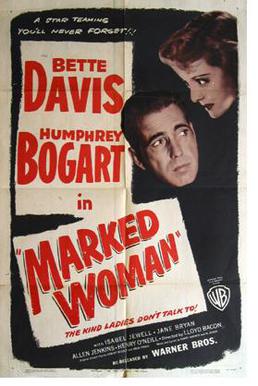
***The Girl With The Bette Davis Eyes-Part II-Marked Woman  


DVD Review

From The Pen Of Frank Jackman

Marked Woman, starring Bette Davis, Humphrey Bogart, 1937

Guys, guys like me from old-time working class neighborhoods whatever their take on the situation learned early on that you did not cross the local tough guys, the corner boys, the nickel and dime hoodlums who inevitably populated such neighborhoods and held them in check. Guys, guys like me, also figured the angles a little, made a decision, one way or the other, to either lean into the criminal life, the life of the drifter, grifter, midnight sifter or break out and try some other way, some other life. So some guys who figured all the angles a little toward those dark midnight stars figured a couple of easy scores, maybe with a little luck thrown, although they really believed that you made your own luck, and they would be on easy street. Or face down in some rain-soaked back alley with a couple of errant slugs in their kissers for having played the angles a little too closely. The other guys, guy like me, dipped our fingers in for a minute, drawn by the lure of easy street (compared to the “from hunger” street staring us in the face) and backed off, although that back off was a close thing for guys, guys like me, with big wanting habits. Apparently, at least going by the story-line in the film under review reputed to be based on the case of the then fallen mobster Lucky Luciano, Marked Woman, some gals from the “wrong side of the tracks” also had some decisions to make, had some dreams to make some fast dough and then step out onto easy street, or die trying.            

Here is how the female version goes. Well a girl, a girl from the “wrong side of the tracks” has got to look out for herself especially if she has no great skills other than dressing and dancing well. And that is what corralled five women who made their way in the world as “hostesses,” you know party girls and I don’t to spell out what was expected of them do I, besides dancing and looking beautiful although the film leaves that part, the sex part, rather vague, in a clip joint recently taken over by one hard-nosed, no holds barred mobster, Johnny Vanning (the Lucky Luciano-based figure) who made his decisions strictly by the signs of the cash nexus and of keeping himself out of jail by any means necessary. Of course all the hostesses had dreams, soft, small dreams, but the ones here knew the score and figured easy street was not coming their way. Except Mary (played by the girl with the Bette Davis eyes). See Mary was smart, not school smart but “street smart,” the kind of smart that matters if you are running your dreams toward easy street. She figured a few more bumps and then easy street, no problem.  

What Mary didn’t figure on was one of her “dates,” a guy who ran afoul of Johnny Vanning, and you do not run afoul of Johnny and live to a ripe old age, was found face down in the river. And what Mary also did not figure on was that she was going to be collared for the crime while her kid sister was in town, was right in the room when the coppers pinched her. See Mary had been supporting that kid sister, had sent her to college, and the sister was clueless about how Mary made her dough. So things begin to fall apart in Mary’s well-ordered know all the angles life.  And the number one thing that broke her up, made her see some light, was that her sister, caught in the middle all confused about her future now that Mary’s house of cards world had tumbled, had attended a party at Johnny’s, had squawked when some guy thought she really was a party girl and wound up very dead in Johnny’s favorite spot, the river.           

So Mary, with the same determination that drove her easy street dreams made Johnny V. a marked man and turned to an up and coming assistant district attorney, Graham (played by Humphrey Bogart) who had been put in charge of that “date” murder case and  now was going to nail Johnny for Mary’s sister’s murder. But it was not so easy because a guy like Johnny Vanning knew a few angles too, had a smart mouthpiece who had kept him out of jail for a long time, and had not become a major crime boss by being nice. Worse, worse for Mary’s case, was that her fellow hostesses initially would not come forward against Johnny. Would not come forward until Johnny tried to kill the hostess who had actually seen what Johnny had done to Mary’s sister at the party. Then Mary rallied the other hostesses and between them and our up and coming assistant district attorney Johnny Vanning was going to do some very hard time. And Mary? Well Mary, like all the Marys, hell, like all the guys and gals from the wrong side of the tracks, guys like me, was going to have to reevaluate the kind of angles that she knew about, and her easy street dreams too.           

Thursday, November 6, 2014


***The Girl With The Bette Davis Eyes-Bette Davis’ Dark Victory


DVD Review

From The Pen Of Frank Jackman

Dark Victory, starring Bette Davis, George Brent, Humphrey Bogart, 1939

Early on, probably before the “talkies ” way back in the silent movie days before the late 1920s Hollywood bet that providing film fare with heart-breaking stories would fill the seats, would have mothers weeping into handkerchiefs, father trying to control that lump forming in their throats, and have children squirming in their seats as well not quite sure what response they should be sending about how that scene affected them. Yes, I am sure Hollywood made that bet early on and needed no test audience, needed no pollster to help them figure that out although when you think about it that drawing tissues and the like would have been harder to do in the silent era since all you would have had were actors emoting like crazy, maybe over-emoting and causing some confusion about whether to laugh or cry from the few that I have seen, and those silly placards cluing you into what you were supposed to feel.

Hollywood is still making them so that that money in the bank heart-breaking story still plays well today, although the storyline has to have a feel good sense that people can relate to. And that notion was true back in the 1930s when the film under review, Dark Victory, was being shown in theaters. The film stars a young Bette Davis, emoting like crazy although we have her words to guide us as to why she was doing so, a solid man of the world George Brent who falls in love with her as he tries to save her, and a young Humphrey Bogart, who had teamed with Ms. Davis before as Duke Mantee , a career criminal and very nasty guy to cross before they finally took him down, to her wanderlust Western wayward girl, Gabby, in The Petrified Forest , and plays an uncharacteristic love-smitten with Bette role as a horse trainer in Bette’s employ and that a part of the film that seemed misplaced as against the main drama) worked up the hankie brigade in overdrive.    

Bette Davis, the girl with the Bette Davis eyes, naturally, those doe-like eyes that command “pretty please” to every passing male, played a young well-to-do Long Island socialite and huntswoman (is that the way to say it), Judy, with time on her hands and worlds to conquer who kept getting severe headaches for unknown reasons. Being young and spirited she tried to shuffle it off as nothing but they persisted. Finally she was forced marched to the doctor, a handsome brain specialist played by George Brent (who was built for these helpful doctor/lawyer/professional roles) who finds that she has a brain tumor which he at first believed could be operated on successfully but in the end provide inoperable. Such things happen in life although when they happen to the young, act against the natural order of things where everybody should get old before there time is up, they are particularly poignant and hence under that sign the drama unfolds here.

Of course we are talking about a spirited young woman (I am being kind) and so she had a problem dealing with the whole thing. The problem was, well two problems, really, no, three problems, first the doctor insisted that Judy not be told that she has a terminal condition (which when she did find out by accident sent her into a drunken rage), second, Judy, grateful Judy, Judy who knew a good catch when she saw one, in fell in love with the doctor (and he her, although we will not get into the ethics of the situation or the natural bond between patient and doctor which can produce such social complications), and third, when she found out that she was going to die (after she got over her rage) she denied reality for a long as she could. Tried to live that socialite-huntswoman (I hope that’s right) to the hilt to defy the gods. But like all things Hollywood our Judy as time got short bucked up at the end, marries her doctor love and for as long as she was able made him a proper wife. And in the end, a bit drawn out cinematically even for a heart-rending story if you ask me, she summoned up the courage to die with dignity… No wonder the handkerchiefs were out in force for this melodrama.             

Sunday, November 2, 2014

***Out In The Be-Bop 1960s Night- The Time Of Frankie’s Carnival Time


From The Pen Of Frank Jackman

An old man walked, walked haltingly down a North Adamsville street, maybe Hancock Street, or maybe a street just off of it, maybe a long street like West Main Street, he has forgotten which exactly in the time between his walking and his telling me his story. A street near the high school anyway, North Adamsville High School, where he had graduated from back in the mist of time, the 1960s mist of time. A time when he was known, far and wide, as the king, the king hell king, if the truth be known, of the schoolboy be-bop night. And headquartered himself, properly headquartered himself as generations of schoolboy king hell kings had done previously, at Salducci’s Pizza Parlor as was his due as the reigning schoolboy king of the night. But that schoolboy corner boy king thing is an old story, an old story strictly for cutting up old torches, according to the old man, Frankie, yes, Francis Xavier Riley, as if back from the dead, and not fit, not fit by a long shot for what he had to tell me about his recent “discovery,” and its meaning.

Apparently as Frankie, let us skip the formalities and just call him Frankie, walked down that nameless, maybe unnamable street he was stricken by sight of a sign on a vagrant telephone pole announcing that Jim Byrd’s Carnival and Traveling Show was coming to town and setting up tent at the Veteran’s Stadium in the first week in June, this past June, for the whole week. And seeing this sign, this vagrant sign on this vagrant telephone pole, set off a stream of memories from when the king hell king of the schoolboy corner boy night was so enthralled with the idea of the “carny” life, of this very Jim Byrd’s Carnival and Traveling Show carnival life, that he had plans, serious plans, to run away, run away with it when it left town.

Under this condition, and of course there was always a condition: if Ma Riley, or Pa Riley if it came to it, although Pa was usually comfortably ensconced in the Dublin Pub over on Sagamore Street and was not a big factor in Frankie’s life when it came time for him to make his mark as king hell king, just bothered him one more time, bothered about what was never specified at least to me. Of course they never did, or Frankie never let on that they did, bother him enough to force the issue, and therefore never forced him on the road. But by then he was into being the corner boy king so that dream must have faded, like a lot of twelve year old dreams.

In any case rather than running away with the carnival Frankie served his high school corner boy term as king hell king, went to college and then to law school, ran a successful mid-sized law practice, raised plenty of kids and political hell and never looked back. And not until he saw that old-time memory sign did he think of regrets for not having done what he said that “he was born for.” And rather than have the reader left with another in the endless line of cautionary tales, or of two roads, one not taken tales, or any of that, Frankie, Frankie in his own words, wants to expand on his carnival vision reincarnation and so we will let him speak :

Who knows when a kid first gets the carnival bug, maybe it was down in cradle times hearing the firecrackers in the heated, muggy Fourth Of July night when in old, old time North Adamsville a group of guys, a group of guys called the “Associates,” mainly Dublin Pub guys, and at one time including my father, Joe Riley, Senior, grabbed some money from around the neighborhood. And from the local merchants like Doc over at Doc’s Drug Store, Mario over at Estrella’s Grocery Store, Mac, owner of the Dublin Pub, and always, always, Tonio, owner of Salducci’s Pizza Parlor. What they did with this money was to hire a small time, usually very small time, carnival outfit, something with a name like Joe’s Carny, or the like, maybe with a merry-go-round, some bumping cars, a whip thing, a few one-trick ponies, and ten or twelve win-a-doll-for-your-lady tents. On the side maybe a few fried dough, pizza, sausage and onions kind of eateries, with cotton candy to top it off. And in a center tent acts, clown acts, trapeze acts with pretty girls dangling every which way, jugglers, and the like. Nothing fancy, no three-ring circus, or monster theme amusement park to flip a kid’s head stuff. Like I say small time, but not small time enough to not enflame the imagination of every kid, mainly every boy kid, but a few girls too if I remember right, with visions of setting up their own show.

Or maybe it was when this very same Jim Byrd, a dark-haired, dark-skinned (no, not black, not in 1950s North Adamsville, christ no, but maybe a gypsy or half-gypsy, if that is possible), a friendly guy, slightly wiry, a slightly side-of-his-mouth-talking guy just like a lawyer, who actually showed me some interesting magic tricks when I informed him, aged eight, that I wanted to go “on the road” with him first brought his show to town. Brought it to Veteran’s Stadium then too. That’s when I knew that that old time Associates thing, that frumpy Fourth of July set-up-in-a-minute-thing-and-then-gone was strictly amateur stuff. See Jim’s Carny had a Ferris wheel, Jim had a Mini-Roller Coaster, and he had about twenty-five or thirty win-a-doll, cigarettes, teddy bears, or candy tents. But also shooting galleries, gypsy fortune-telling ladies with daughters with black hair and laughing eyes selling roses, or the idea of roses. And looking very foxy, the daughters that is, although I did not know what foxy was then. Oh yah, sure Jim had the ubiquitous fried dough, sausage and onion, cardboard pizza stuff too. Come on now this was a carnival, big time carnival, big time to an eight-year old carnival. Of course he had that heartburn food. But what set Jim’s operation off was that central tent. Sure, yawn, he had the clowns, tramp clowns, Clarabelle clowns, what have you, and the jugglers, juggling everything but mainly a lot of whatever it was they were juggling , and even the acrobats, bouncing over each other like rubber balls. The big deal, the eight- year old big deal though, was the animals, the real live tigers and lions that performed in a cage in center stage with some blonde safari-weary tamer doing the most incredible tricks with them. Like, well, like having them jump through hoops, and flipping over each other and the trainer too. Wow.

But now that I think about it seriously the real deal of the carny life was neither the Associates or Jim Byrd’s, although after I tell you about this Jim’s would enter into my plans because that was the carnival, the only carnival I knew, to run away with. See what really got me going was down in Huntsville, a town on the hard ocean about twenty miles from North Adamsville, there was what would now be called nothing but an old-time amusement park, a park like you still might see if you went to Seaside Heights down on the Jersey shore. This park, this Wild Willie’s Amusement Park, was the aces although as you will see not a place to run away to since everything stayed there, summer open or winter closed. I was maybe nine or ten when I first went there but the story really hinges on when I was just turning twelve, you know, just getting ready to make my mark on the world, the world being girls. Yes, that kind of turning twelve.

But nine or twelve this Wild Willie’s put even Jim Byrd’s show to shame. Huge roller-coasters (yes, the plural is right, three altogether), a wild mouse, whips, dips, flips and very other kind of ride, covered and uncovered, maybe fifteen or twenty, all based on the idea of trying to make you scared, and want to go on again, and again to“ conquer” that scared thing. And countless win things (yah, cigarettes, dolls, teddy bears, candy, and so on in case you might have forgotten). I won’t even mention that hazardous to your health but merciful, fried dough, cardboard pizza (in about twenty flavors), sausage and onions, cotton candy and salt water taffy because, frankly I am tired of mentioning it and even a flea circus or a flea market today would feel compelled to offer such treats so I will move on.

What it had that really got me going, at first anyway, was about six pavilions worth of pinball machines, all kinds of pinball machines just like today there are a zillion video games at such places. But what these pinball machines had (beside alluring come-hither and spend some slot machine dough on me pictures of busty young women on the faces of the machines) were guys, over sixteen year old teenage guys, mainly, some older, some a lot older at night, who could play those machines like wizards, racking up free games until the cows came home. I was impressed, impressed to high heaven. And watching them, watching them closely were over sixteen- year old girls, some older, some a lot older at night, who I wondered, wondered at when I was nine but not at twelve, might not be interfering with their pinball magic. Little did I know then that the pinball wizardry was for those sixteen year old, some older, some a lot older, girls.

But see, if you didn’t already know, nine or twelve-year old kids were not allowed to play those machines. You had to be sixteen (although I cadged a few free games left on machines as I got a little older, and I think the statute of limitations has run out on this crime so I can say I was not sixteen years or older). So I gravitated toward the skee ball games located in one of those pinball pavilions, games that anybody six to sixty or more could play. You don’t know skees. Hey where have you been? Skee, come on now. Go over to Seaside Heights on the Jersey shore, or Old Orchard up on the Maine coast and you will have all the skees you want, or need. And if you can’t waggle your way to those hallowed spots then I will give a little run-down. It’s kind of like bowling, candle-pin bowling (small bowling balls for you non-New Englanders) with a small ball and it’s kind of like archery or darts because you have to get the balls, usually ten or twelve to a game, into tilted holes.

The idea is to get as high a score as possible, and in amusement park land after your game is over you get coupons depending on how many points you totaled. And if you get enough points you can win, well, a good luck rabbit’s foot, like I won for Karen stick-girl one time (a stick girl was a girl who didn’t yet have a shape, a womanly shape, and maybe that word still is used, okay), one turning twelve-year old time, who thought I was the king of the night because I gave her one from my “winnings,” and maybe still does. Still does think I am king of the hill. But a guy, an old corner boy guy that I knew back then, a kind of screwy guy who hung onto my tail at Salducci’s like I was King Solomon, a guy named Markin who hung around me from middle school on, already wrote that story once.

Although he got one part wrong, the part about how I didn’t know right from left about girls and gave this Karen stick girl the air when, after showering her with that rabbit’s foot, she wanted me to go with her and sit on the old seawall down at Huntsville Beach and according to Markin I said no-go. I went, believe me I went, and we both practically had lockjaw for two weeks after we got done. But you know how stories get twisted when third parties who were not there, had no hope of being there, and had questionable left from right girl knowledge themselves start their slanderous campaigns on you. Yes, you know that scene, I am sure.

So you see, Karen stick and lockjaw aside, I had some skill at skees, and the way skees and the carny life came together was when, well let me call her Gypsy Love, because like the name of that North Adamsville vagrant telephone pole street where I saw the Byrd’s carnival in town sign that I could not remember the name of I swear I can’t, or won’t remember hers. All I remember is that jet-black long hair, shiny dark-skinned glean (no, no again, she was not black, christ, no way, not in 1950s Wild Willie’s, what are you kidding me?), that thirteen-year old winsome smile, half innocent, half-half I don’t know what, that fast-forming girlish womanly shape and those laughing, Spanish gypsy black eyes that would haunt a man’s sleep, or a boy’s. And that is all I need to remember, and you too if you have any imagination. See Gypsy Love was the daughter of Madame La Rue, the fortune-teller in Jim Byrd’s carnival. I met her in turning twelve time when she tried to sell me a rose, a rose for my girlfriend, my non-existent just then girlfriend. Needless to say I was immediately taken with her and told her that although I had no girlfriend I would buy her a rose.

And that, off and on, over the next year is where we bounced around in our “relationship.” One day I was down at Wild Willie’s and I spotted her and asked her why she wasn’t on the road with Jim Byrd’s show. Apparently Madame LaRue had had a falling out with Jim, quit the traveling show and landed a spot at Wild Willie’s. And naturally Gypsy Love followed mother, selling flowers to the rubes at Wild Willie’s. So naturally, naturally to me, I told Gypsy Love to follow me over to the skees and I would win her a proper prize. And I did, I went crazy that day. A big old lamp for her room. And Gypsy Love asked me, asked me very nicely thank you, if I wanted to go down by the seawall and sit for a while. And let’s get this straight, no third party who wasn’t there, no wannabe there talk, please, I followed her, followed her like a lemming to the sea. We had lockjaw for a month afterward to prove it. And you say, you dare to say I was not born for that life, that carnival life. Ha.


A Slice of Mid-Twentieth Cinematic American Suburban Home Life-Joseph Mankiewicz’s A Letter To Three Wives


DVD Review

From The Pen Of Frank Jackman

A Letter To Three Wives, starring Jeanne Crain, Ann Southern, Linda Darnell, 1949

No question, at least in retrospect, and at least on the screen, the 1950s in America were something of a “golden age.” A golden age if your dreams were middle-class and you had the wherewithal to stand up to your dreams, dreams to move a step or two ahead of your parents, the ones who came “from hunger during the Great Depression and slogged through World War II rations and hard fighting (with their blessing, no question). And that golden age, an age when people expected, somewhat wispfully, to prosper with hard work, some luck, and some connections in order to get a fleet of cars, a suburban home (complete with washer and dryer, all kinds of kitchen gadgetry, and even a place to grill) to park those cars in and kids and a dog to park in the house is the subtext of the film under review, A Letter To Three Wives.       

Of course a strictly sociological study of mid-20th century American trends could have been left in the hands of somebody like the late journalist David Halberstam or the Harvard professor David Riesman or C. Wright Mills but in Hollywood they mix that knowledge up with a little plot. The plot here being a letter, as advertised in the title, by one Addie, an unseen Mayfair swell type (as far as we know since, unseen, we have placed her at the country club and other 1950s Mayfair spots and not let’s say Jimmy’s Tavern, Ladies Invited all in neon telling a candid world there are tables fit for woman companion and not just a roustabout bar with guys nodding their heads on the counter) who had all the boys gathering around, all the boys being the three husbands of the three wives in the title.

And the letter’s contents, well, get this, old heartbreaker, home-wreaker Addie had run off with one of the husbands conveniently not saying which one, leaving the trio of wives bewitched and befuddled. Now a woman today running off with a guy (or a woman), a husband or not, would be a yawner, would be a plot that wouldn’t get pass the studio guardhouse, but in up and coming country club set of the 1950s this is the equivalent of the last draw, and the cause of nothing but big time angst by the three wives.                    

See they all have anxieties, have reasons to believe that their respective husbands could be the unfaithful one. Especially with Addie who was the belle of the ball and cause for plenty of sniping, as well as having known the boys for ages. Now this theme, this running away with some errant husband rightly or wrongly, told right from the beginning would make a very short film. So using the old familiar plot-builder flashbacks the three women each get themselves into a tizzy by magnifying whatever difficulties they were having in their marriages.

One didn’t think she was pretty enough, poised enough, wore the right clothes, for her up and coming husband since she was nothing but from “jump street” and had been upwardly mobile via the military and nothing else. Another worried that her desire for a time-consuming career as a radio soap opera scriptwriter, taking time away from the homemaker’s drudgery and catering to hubby’s whims, was off-putting enough to have him stray from the straight and narrow. The third who was strictly “from hunger,” strictly from the wrong side of the tracks (literally since in some at home scenes they had the house shaking when trains passed by) had made a bad bargain with the devil, her husband, to get that wedding ring on and easy street and nothing but bickering and acrimony ever after figured she had made a runaway worthy mistake with hubby. So the possibilities multiply and in the meantime this Addie fixation, this Addie this and that gets under all their skins, gets under the husbands’ skins to. The husbands by turn are more than happy with that ex-military wife, encouraging of the wife’s career and deeply in love with that “from hunger” wife, bickering and acrimony aside. But which one strayed from the connubial course. Well if you have a spare hour and one half watch this one to figure who Addie lures into her web.    
 

Saturday, November 1, 2014

Hell No They Ain’t No Angels-Humphrey Bogart’s We’re No Angels


DVD Review

From The Pen Of Frank Jackman

We’re No Angels, starring Humphrey Bogart, Peter Ustinov, Aldo Ray         

Over the past couple of years I have been running the table on Humphrey Bogart films, as an expression of the kind of guy, cinematic guy anyway, that I could relate to as a kid (and still admire in certain ways). You know a guy that no one would dare throw sand in their face, certainly no woman, not because of his physical size so much as that he had a look that if somebody was so foolhardy as to do such a deed they would find themselves in a bad place on some dark, foggy night when they least expect to find themselves facing his personal bastinado. A guy not looking for trouble but not ducking it either, not ducking even some punk hood, all what did they call it back then, yeah, all “gaudy and show” with some dangling hot gun that he would be more than happy to take away from such a miscreant, and the punk, being a punk would have to take it, have to take it or else. And speaking of dames, twists, frills, frails or whatever you called women, good-looking femme fatale-type women in your old corner boy night, including good-looking dames who might be so foolhardy as to throw sand in a guy’s face (not literal sand but fog-bound sand and story to mix a guy up beyond belief), a guy who was not afraid to take a little gaff for some twisty dame who gave him that come hither look. A guy ready to chase some windmills for that look just to see where it led. Best of all a guy not afraid to run the rack on some bad guy (or a good guy who was looking to turn bad) just because he was a bad guy, maybe kept some old man awake at night, worrying, or some frail tied up to his rackets, that kind of thing.  

Now some of those attributes might not mean a lot, might in fact be kind of old-fashioned, kind of rough male of the species over the top these days in some circles in polite Western society but there you have it. For a time that running the table included reviews of Bogie as the hard-nosed, take no prisoners, give no quarter and take none shoot first and ask questions later mad monk gangster Duke Mantee who really was a man of his deadly word in the matchup between primitive man and the increasingly effete intellectual modern world man featured in The Petrified Forest and the take no nonsense world-weary, world-wary detective Sam Spade ready at the drop of a hat to either chase some stuff of dreams windmills or to put the handcuffs on tight for some wayward femme with that come hither look and that jasmine scent or whatever the hell she was wearing in the film adaptation of Dashiell Hammett’s The Maltese Falcon. Reviews as well of the jaded ex-pat (who had that funny little prior resume point of having been a “premature anti-fascist” in the 1930s struggle in Spain) “welcome to the struggle” ready to take on the whole German Army once he got religion and once she, and you know the she even if she did not have the price of that jasmine scent, for the seven thousandth time got under his skin Rick of Rick’s CafĂ© in Casablanca, and, oh yeah, along that same vein the knight in shining armor, or better because more useful sea-worthy boat captain ready to take on the whole Vichy French apparatus in the wartime (World War II version) to save a damsel in distress, a dame who would have gotten under anybody’s skin once she asked for that off-hand cigarette-lighting match and gave that come hither whistle, in the film adaptation of Ernest Hemingway’s To Have Or Have Not. And to give a couple more examples for those who don’t get the allure a couple of reviews of Bogie as the resourceful but also world-weary, world wary detective Phillip Marlowe who keeps the dreams of an old man alive (and his wayward daughters, including one who took dead aim at him as a windmill chaser and the other just dead aim, out of trouble) in taking a punk mobster down to size in the film adaptation of Raymond Chandler’s The Big Sleep and as a  “don’t leave your buddy behind” true blue Army guy looking for the bad guys who tried to blocked him from doing just that in Dead Reckoning. So with just those few examples you can see that they were all films where Bogie exhibited certain manly traits that were (and some may still be) worth emulating. And then we come to the film under review, We’re No Angels, and the guy switches up on us. Turns into a Good Samaritan, of sorts, an ironic one splashed with a little humorous bend too.           

What gives? What gives, just to give a snapshot of what this film is about, is that Bogie is one of three hardened convicts (the other two played Peter Ustinov and Aldo Ray), French convicts, hard cases all (murderers, career criminals) who are doing hard time at that little maximum prison resort in the Caribbean, Devil’s Island. But being resourceful, especially around Christmas time, they escaped to the town nearby with plans to set sail for France and to take up their old lives as carefree guys once again, maybe a heist here, a con there, simple stuff. But first they need dough, plenty of dough, and some new duds since to grab that departing ship requires not just dough but a certain look, a look like you did not just escape from high security Devil’s Island.  So they planned to rob a clothing merchant to give them that cash, and throw in the duds while they were at it. Turned out though, as the film slowly developed, the merchant was no good as a businessman having failed in France and been sent out to the boondocks by his greedy rich cousin, a nefarious relative as it turned out, no question, had a wife, a fetching wife, no question, who stood by him (they don’t always, the fetching ones), and a sweet teenage daughter, all betwixt and between, who was in love with, well, you know how teenagers are, in love with being in love.   

So our hardened criminals, our nefarious bad guys slowly turned things around and went from attempted robberies and petty pilfering of civilian outfits to Good Samaritans and help the merchant (by getting rid of, getting rid in a very final way, the greedy cousin who had come from France for an inspection), the wife (still standing by her husband to Bogie’s chagrin), and that smitten daughter (who fell in and out of love with one guy, and then in love with another, like I said a typical teenager) being witty, ironic, and funny by turns, especially Bogie. And get this, once they have spread their Christmas cheer they head back to jail, no, head back to hellhole Devil’s Island. What the heck is going on with our man Bogie. Give me Duke Mantee who would just as soon put a slug in a guy as look at him (and does in that endless cinematic battle between the primitive instincts of man and the modern attempts to curb those baser instincts which got a thorough-going test in the real world of the 1930s and 1940s) or Sam Spade who turned over, once he took a cold shower to wipe that come hither look out of his mind and opened a window to let the city air merge and melt that jasmine scent, that filled with the stuff of dreams femme fatale who just so happened to have an itchy trigger-finger to the coppers without a tear. Give me that Rick of Rick’s CafĂ© who gave up his honey, without or without the jasmine scent as a lure that was just the way it was with them, for the good of the cause or that made of sterner stuff skirt-chasing Captain Morgan once he saw she could sing too, sing and take a few knocks without crying about the matter. Okay, and give me that handy Philip Marlowe, avenger of sullen women’s sicknesses, avenger of old men’s broken dreams, avenger of wrong track turned right femmes, avenger of small time right gees and grifters by bad hombres who put paid to the career of one Eddie Mars or the stick to his guns, undeterred, inquisitive, and vengeful Rip not leaving his Army buddy behind, or anything to sullen his memory. You take him in We’re No Angels, okay.