Wednesday, February 25, 2015

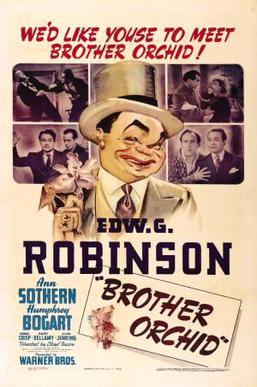
When Little Johnny S. Got “Religion”-Edward G. Robinson’s Brother Orchid  


DVD Review

From The Pen Of Frank Jackman

Brother Orchid, starring Edward G. Robinson, Humphrey Bogart, Ann Sothern, 1940

A lot of guys around New York City, a lot of guys on the island of Manhattan especially couldn’t figure it out, tough guys all in their own little “grift,” con, shake-down world, couldn’t figure out the how and why when they heard Little Johnny S., Little Johnny without the “S”  to guys in the know, yeah, just Little Johnny was enough to make a lot of guys, wise guys, yeah, all those wondering grifters, con-men, and leg-breakers sweat, wondered why he walked away from his kingpin crime boss job that was just minting dough after the hard times flaked away when the Great Depression hit and the, worse, worst of all, liquor became free and easy to get and that cut the tail out of that racket. Walked away mind you and not carried away by six guys and a hearse provided by some up and coming guy like Jack Buck who was his viper sidekick on the way up, walked away without “Uncle” laying a hand on him, getting him to sweat and fink to get out from under some heavy pall in Atlanta or the “rock,” nada, walked away, get this, so he could “spread the good word,” could do good deeds without reward, and really pay attention to this one, to get by with no dough, no dough of his own anyway. Yeah, Little Johnny S. sure got “religion,” sure bought that one-way ticket. And that, dear friends, is the central theme behind the film under review, Brother Orchid (the brother part is because he got all twisted up with a bunch of guys living poor, living real poor together under some religious drive, by choice on the outskirts of the city growing orchids for the market to make their small ends meet. That part at least made sense, the orchid part, the Johnny buy in part, Little Johnny S. always loved orchids, always loved to give his lady friends that flower to let them know he cared).           

Here is what I was able to gather from a few guys who knew Little Johnny S. better than I did, knew the ins and outs of the guy, and the ins and outs of what brought Johnny low (besides the obviously dame problem that has sent more than one guy to do screwy stuff, sent more than one guy screaming to high heaven, although they usually didn’t take the big step fall down to the skids like Johnny). Most of the information came from Willie “The Knife” so I know it has to be pretty close to the truth because Little Johnny and he were tight at the end and because Willie was telling his tale before his own big step-off, his own nickel to a dime up at Sing Sing and Flo, Flo Addams, you remember her right, Little Johnny’s old flame who wound up on easy street with a big time cattle rancher once Little Johnny saw her as spoiled goods, saw her as an impediment to his new “life.”

Here is what we cobbled together and it makes as much sense as the real story as what the guy did who we are talking about. No question, Little Johnny Sarto (yeah, that’s his real name, or was, before that Brother Orchid moniker got laid on him), played by the old time classic shoot-‘em-up-and-ask-questions-later gangster actor Edward G. Robinson, had grown up on some mean streets in the old city, old New Jack City when the immigrants flooded in a few, a Johnny few, played the percentages and tried to get off of cheap street in one generation. No question either that like every guy (and gal for that matter) who grew up on “the wrong side of the tracks,” grew up “from hunger” poor, had serious wanting habits and was not particular about how he moved up the organized crime food chain during his younger days as a “torpedo” for “Red” Rizzo’s crowd in Flatbush. Illegal liquor, drugs, serious drugs like heroin that guys would go through hell to get (and when it got to be getting off time going through that same hell, some of them anyway, the rest wound up face down in some needle alley), not that silly cocaine that you could buy at any drugstore and sniff your brains out, transporting women, pimping them off too, numbers, a few armed robberies and so on. And Johnny was smart, smart and tough, so he rose pretty swiftly up the chain until one day he was king of his own operation. All without spending day one in some cooped-up jailhouse. As he rose, and as the ways of criminal activity took different turns in the end he confined himself to the very lucrative and safe “protection” racket, you know, not busting up Mr. and Mrs. Jones’ mom and pop variety store or letting anybody else do so for a a little cash pay-off. Easy work, low overhead, out in the mean streets not paved with gold like mom and pop though.                           

But see, and this I know, know from personal experience, poor boys, poor street urchins, getting to the top of the rackets only goes so far and so Johnny got to thinking about getting the pedigree to be a high-class guy, a high-class guy who guys (and gals) looked up to just because he was high-class. Without sticking a gun, or some fists, in their face to prove the point. And that is what “The Knife,” ever-lovin’ Flo and I think was Little Johnny’s downfall.  

One day Johnny checked his bank account, thought he saw that he had more dough than he could use in a lifetime and just walked away from his organization, gone fishing, done. Of course in the rackets, the food chain rackets, leaving doesn’t mean that is the end of the rackets but rather that Johnny was leaving his operation to his lizard right hand man Jack Buck, played by tough guy gangster roles starting with Duke Mantee in The Petrified Forest Humphrey Bogart. Jack who came up the same way as Little Johnny except his way was meaner, tougher and more likely to use a little gunplay to settle any problems. (He was also tough on his women, not afraid to throw a punch or two to keep them in line according to Flo.) So Johnny fled the city for Europe, leaving everything, and everybody, including his longtime girlfriend, Flo, played by Ann Sothern, who was left in the lurch because, well, because she loved Johnny and expected him to marry her. Silly girl.       

Naturally a guy like Johnny from the mean streets figured he could buy class, buy that upscale thing with just enough money but here his instincts played him dirty. He did not know rule number one about how the rich and high class got that way, got there over a mountain of skulls, and so Johnny was an easy pick-off once it got around to the high-class grifters that he was in the “high-class” market. Poor sap, many a guy had been put face down in the East River, for doing less that those master thieves of Europe did to Little Johnny. So he busted out, went flat broke, and decided that he needed to get back to his own kind, get back to easy street, get back his old making money hand over fist operation. Good idea. And so he headed home.   

But Johnny had a problem, well, really two problems, kind of inter-related. First was one Jack Buck who had built up his operation far beyond the cheapjack operation Johnny ran and so he was not inclined, very much not inclined, to give it up just because some old-time hood, a has-been in the dog-eat dog world of big time criminal activity was making some noises, and second, Johnny with his soft living had lost a step or two and did not have the current capacity to strong-arm Jack out of his place in the food chain. Christ in the end all Johnny had was “The Knife” and while he was a good guy to have in a fight he was not enough to take on Jack’s wrecking crew, including a couple of new age “torpedoes” who shot first and asked questions later. So, one way or the other Johnny was on the lam.

That on the lam part is where things were hazy for Willie and Flo, the part about Johnny getting all shot up by Jack’s goons, being able to escape the worst of it, and finding sanctuary in that brotherhood monastery where he got his new moniker. I could understand where Willie and Flo would have trouble with figuring out Johnny’s new thing, it is hard to get inside a guy’s mind and see what he is up to, especially when he is on the lam and some guys, good guys but naïve is what he thought for a long time show him a different way of looking at life. It was not like Johnny went looking for something, he was just hiding out at the beginning, planning his Jack revenge and getting back on top. Well, he did get his Jack revenge in a funny way, funny since he got help from Flo’s rancher friend whom she wound up marrying and wound up on easy street as a result. Jack’s is now doing from one to ninety-nine at Sing Sing, Flo is married to her Big Sky rancher and raking in whatever she wants, Willie “The Knife” is doing the best he can. And Johnny, oops, Brother Orchid is up there in the woods working for nada, or maybe his soul. Poor sap.        
***Coming Of Age, Political Age, In The Cold War Red Scare 1960s Night- A Baptism Of Fire-Making War On The War-Makers-The Struggle Against Nuclear War


From The Pen Of Frank Jackman


Click on the headline to link to a Wikipedia entry for Peace Action (successor organization to the SANE organization mentioned below).


He was scared. All of fourteen year old Peter Paul Markin’s body was scared. Of course he knew, knew just as well as anybody else, if anybody thought to ask, that he was really afraid not scared, but Peter Paul was scared anyway. No, not scared (or afraid for the literary correct types), not Frannie DeAngelo demon neighborhood tough boy, schoolboy nemesis scared, scared that he would be kicked in the groin, bent over to the ground in pain for no reason, no reason except Frannie deep psycho hard boy reasons known only to himself. Markin was used to that kind of scared, not liking it “used to it” but used to it. And this certainly was not his usual girl scared-ness (yes, girls scared him, except in the comfortable confines of a classroom where he could show off to no avail) on the off chance that one, one girl that is, might say something to him and he would have no “cool” rejoinder. This was different. This, and his handkerchief-dabbed wet palms and forehead did not lie, was an unknown scared.


See, Peter Paul had taken a bet, a “put your money where your mouth is" bet, from best high school friend Frankie, Francis Xavier Riley, if you want to know the full name. Now these guys had previously bet on everything under the sun since middle school, practically, from sports game spreads to how high the master pizza man and owner at Salducci’s Pizza Parlor, Tonio, would throw his pizza dough one strange night when Frankie needed dough (money dough that is) for his hot date with girlfriend Joanne. So no bet was too strange for this pair, although this proposition was probably way too solemn to be bet on.


What got it started, the need for a bet started, this time, really had to do with school, or maybe better, the world situation in 1960. Peter Paul, a bundle of two thousand facts that he guarded like a king’s ransom, went off the deep end in 9th grade Civics class when he, during a current events discussion, exploded upon his fellow classmates with the observation that there were too many missiles, too many nuclear bomb-loaded guided missiles, in the world and that both sides in the Cold War (The United States and the Soviet Union and their respective hangers-on) should “ban the bomb.” But you have not heard the most provocative part yet, Peter Paul then argued that, as a good-will gesture and having more of them, the United States should destroy a few of its own. Unilaterally.


Pandemonium ensued as smarts guys and gals, simps and stups also, even those who never uttered a word in class, took aim at Peter Paul’s head. The least of it was that he was called a “commie” and a "dupe" and the discussion degenerated from there. Mr. Merck was barely able to contain the class, and nobody usually stepped out line in his class, or else. Somehow order was restored by the end of class and within a few days the class was back to normal, smart guys and girls chirping away with all kinds of flutter answers and the simps and stups, well the simps and stups did their simp and stup thing, as always.


Frankie always maintained that that particular day was one of the few that he wasn’t, and he really wasn’t, glad that Peter Paul was his friend. And during that class discussion he made a point, a big point, of not entering the fray in defense of his misbegotten friend. He thought Peter Paul was off the wall, way off the wall, on this one and let him know it after class. Of course, Peter Paul could not leave well enough alone and started badgering friend Frankie about it some more. But this was stone wall time because Frankie, irreverent, most of the time irreligious, and usually just happy to be girl-smitten in the world, and doing stuff about that, and not worried about its larger problems really believed, like the hard Roman Catholic-bred boy that he was underneath, that the evil Soviet Union should be nuclear fizzled-today.


But Peter Paul kept egging the situation on. And here is the problem with a purist, a fourteen year old purist, a wet behind the ears fourteen year old purist when you think about it. Peter Paul was as Roman Catholic-bred underneath as Frankie but with this not so slight difference. Peter Paul’s grandmother, Anna, was, and everybody who came in contact with her agreed, a saint. A saint in the true-believer catholic social gospel sense and who was a fervent admirer of Dorothy Day’s Catholic Worker for social justice movement started in the 1930s. So frequently The Catholic Worker, the movement newspaper, would be lying around her house. And just as frequently Peter Paul, taking grandmother refuge from the hell-bend storms at his own house, would read the articles. And in almost every issue there would be an article bemoaning the incredible increase in nuclear weapons by both sides, the cold war freeze-out that escalated that spiral and the hard fact that the tipping point beyond no return was right around the corner. And something had to be done about it, and fast, by rational people who did not want the world blown up by someone’s ill-tempered whim. Yah, heady stuff, no question, but just the kind of thing that a certain fourteen year old boy could add to his collection of now two thousand plus facts.


Heady stuff, yah, but also stuff that carried some contradictions. Not in grandmother Anna, not in Dorothy Day so much as in Peter Paul and through him Frankie. See, the Catholic Worker movement had no truck, not known truck, anyway with “commies" and "dupes”, although that movement too, more than once, and by fellow Catholics too, was tarred with that brush. They were as fervent in their denunciation of the atheistic Soviet Union as any 1950s red-baiter. But they also saw that that stance alone was not going to make the world safer for believers, or anybody else. And that tension between the two strands is where Frankie and Peter Paul kind of got mixed up in the world’s affairs. Especially when Peter Paul said that the Catholic Worker had an announcement in their last issue that in October (1960) they were going to help sponsor an anti-nuclear proliferation rally on the Boston Common as part of a group called SANE two weeks before the presidential elections.

Frankie took that information as manna from heaven. See, Frankie was just as interested in knowing two thousand facts in this world as Peter Paul. Except Frankie didn’t guard them like a king’s ransom but rather used them, and then discarded them like a tissue. And old Frankie, even then, even in 1960 starting to spread his wings as the corner boy king of the North Adamsville high school class of 1964, knew how to use his stockpile of facts better than Peter Paul ever could. So one night, one fiercely debated night, when Frankie could take no more, he said “bet.” And he bet that Peter Paul would not have the courage to travel from North Adamsville to Park Street Station in Boston to attend that SANE rally by himself (who else would go from old working- class, patriotic, red-scare scared, North Adamsville anyway). And as is the nature of fourteen year old boy relationships, or was, failure to take the bet, whatever bet was social suicide. “Bet,” said Peter Paul quickly before too much thinking time would elapse and destroy the fact of the bet marred by the hint of hesitation.


But nothing is ever just one thing in this wicked old world. Peter Paul believed, believed fervently, in the social message of the Catholic Worker movement especially on this nuclear war issue. But this was also 1960 and Irish Jack Kennedy was running, and running hard, to be President of the United States against bad man Richard Milhous Nixon and Peter Paul was crazy for Jack (really for younger brother, Bobby, the ruthless organizer behind the throne which is the way he saw his own future as a political operative). And, of course, October in election year presidential politics is crunch time, a time to be out hustling votes, out on Saturday hustling votes, especially every Irish vote, every Catholic vote, hell, every youth vote for your man.


On top of that Jack, old Irish Jack Kennedy, war hero, good-looking guy with a good-looking wife (not Irish though not as far as anyone could tell), rich as hell, was trying to out-Cold War Nixon, a Cold War warrior of the first degree. And the way he was trying to outgun Nixon was by haranguing everyone who would listen that there was a “missile gap,” and the United was falling behind. And when one talked about a missile gap in 1960 that only meant one thing, only brooked only one solution- order up more, many more, nuclear-bomb loaded guided missiles. So there it was, one of the little quirks of life, of political life. So, Peter Paul, all fourteen year old scared Peter Paul has to make good on his bet with Frankie but in the process put a crimp into his hoped-for political career. And just for that one moment, although with some hesitation, he decided to be on the side of the “angels” and to go.


That Saturday, that October Saturday, was a brisk, clear autumn day and so Peter Paul decided to walk the few miles from his house in North Adamsville over the Neponset Bridge to the first MTA subway station at Fields Corner rather than take the forever Eastern Mass. bus that came by his street erratically. After crossing the bridge he passed through one of the many sections of Boston that could pass for the streets of Dublin. Except on those streets he saw many young Peter Pauls holding signs at street corners for Jack Kennedy, other passing out literature, and others talking up Jack’s name. Even as he approached the subway station he saw signs everywhere proclaiming Jack’s virtues. Hell, the nearby political hang-out Eire Pub looked like a campaign headquarters. What this whole scene did not look like to Peter Paul was a stronghold place to talk to people about an anti-nuclear weapons rally. Peter Paul got even more scared as he thought about the reception likely at the Boston Commons. He pushed on, not without a certain tentative regret, but he pushed on through the turnstile, waited for the on-coming subway to stop, got on, and had an uneventful ride to the Park Street Station, the nearest stop to the Common.


Now Park Street on any given Saturday, especially in October after the college student hordes have descended on Boston, is a madhouse of activity. College student strolling around downtown looking for goods at the shops, other are just rubber-necking, other are sunning themselves on the grass or park benches in the last late sun days before winter arrives with a fury. Beyond the mainly civilized college students (civilized on the streets in the daytime anyway) there are the perennial street people who populate any big city and who when not looking for handouts, a stray cigarette, or a stray drink are talking a mile a minute among themselves about some supposed injustice that has marred their lives and caused their unhappy decline. Lastly, and old town Boston, historic old town Boston, scene of many political battles for every cause from temperance to liberty, is defined by this, there are a motley crew of speakers, soap-box speakers whether on a real soap-box or not, who are holding forth on many subjects, although none that drew Peter Paul’s attention this day. After running that gauntlet, as he heads for the Francis Parkman Bandstand where the SANE rally was to take place he is amused by all that surrounds him putting him in a better mood, although still apprehensive of what the day will bring forth.


Arriving at the bandstand he saw about twenty people milling around with signs, hand-made signs that showed some spunk, the most prominent being a large poster-painted sign that stated boldly, “Ban The Bomb.” He was in the right place, no question. Although he was surprised that there were not more people present he was happy, secretly happy, that those twenty were there, because, frankly, he thought there might be just about two. And among that crowd he spotted a clot of people who were wearing Catholic Worker buttons so he was now more fully at ease, and was starting to be glad that he came here on that day. He went over to the clot and introduced himself and told them how he came to be there. He also noted that one CWer wore the collar of a priest; a surprise because at Sacred Heart, his parish church, it was nothing but “fire and brimstone” from the pulpit against the heathen communist menace.


Get this-he also met a little old lady in tennis sneakers. For real. Now Frankie, devil’s advocate Frankie, baited Peter Paul in their arguments about nuclear disarmament by stating that the “peaceniks” were mainly little old ladies in tennis shoes-meaning, of course, batty and of no account, no main chance political account, no manly Jack Kennedy stand up to the Russians account. Peter Paul thought to himself wait until I see Frankie and tell him that this little old lady knew more about politics, and history, than even his two thousand facts. And was funny too boot. Moreover, and this was something that he had privately noticed, as the youngest person by far at the rally she, and later others, would make a fuss over him for that very reason talking about young bravery and courage and stuff like that.


Over the course of the two hours or so of the rally the crowd may have swelled to about fifty, especially when a dynamic black speaker from the W.E.B. Dubois club at Harvard University linked up the struggle against nuclear weapons with the black struggle down South for voting rights that those in the North had been hearing more about lately. It was not until later, much later, that Peter Paul found out that this Dubois club business was really the name of the youth group of the American Communist Party (CP) at the time but by that time he was knowledgeable enough to say “so what.” And it was not until later that he found out that the little old lady with the tennis sneakers was a CPer, although she had said at the time he talked to her she was with some committee, some women’s peace committee, within the Democratic Party. Oh, well. But then he would also be able to say “so what” to that accusation in proper “family of the left” fashion.


But forget all that later stuff, and what he knew or did not know later. See, that day, that October 1960 autumn day, Peter Paul learned something about serious politics. If you are on the right side of the angels on an issue, a central issue of the day, you are kindred. And although there were more than a few catcalls from the passers-by about “commies”, “dupes”, and “go back to Russia” he was glad, glad as hell that he came over. Although nothing turned inside him, noticeably turned inside him that day, about his politics and his determination to see Jack Kennedy and the Democrats take the White House he thought about those brave people at the bandstand and what they were standing for a lot for a long time after the event faded from memory. Oh yah, it was good to be on the side of the angels. And it didn’t hurt that he won that Frankie bet, either.

 
The Intellectuals Or The Jocks?-With The Late Norman Mailer In Mind


From The Pen Of Sam Lowell


Every school since back in Socrates’ time, maybe before, has had discernable social groupings within so that I was not surprised when I was asked recently what group(s) I hung around with, if any, at Carver High back in the mid-1960s. Here is my answer and I solicit yours as well…      

I did not then, nor do I now, know Fredda Kostoff (I think I spelled that right although it might be Kostov all I remember is that she was Russian and I don’t know if she came from there or some forebears did but my apologies to her if I misspelled her name),  Melinda Malloy ( I know I spelled that one right since beside her being smart I had a from a distance “crush” on her although the most I ever did about it was have her exchange yearbook good luck notes with me and so I did not “know” her), or Irvin Jack Stein (a wild man who made his friends laugh form what I had heard beside being what would later be called nerd or dweeb at MIT I think but by far the smartest guy in the class), fellow classmates at Carver High, Class of 1966, and among the class geniuses, the intellectuals. I don’t remember if my old “jock” running buddy Charles William Badger, Bill (nobody called him Charles, his drunken father’s name, not if you wanted grief about it so Bill), whose very existence learned after years of statutory neglect and recent reuniting prompted me to recently write some teary-eyed thing about him running amok on the back streets of Carver and down toward the Plymouth shores in the old days knew them or not, but it was with them in mind that I wrote the following. I, today, strongly believe that I could have learned a lot from that trio and maybe Bill believes that as well but you will have to ask him that question yourself. No way, no way on god’s good green earth in the year 2015 and while I am still breathing, old time “jock” buddies or not, am I going to vouch for that maniac. Here goes:

Every September, like clockwork, I am transported to a place called the beginning of the year. No, not New Year’s Day like any rational person would expect, but the school year for most students, younger or older. That is a frame of reference that I have not changed in all these years. And every year at that time, or in many of those years anyway, my thoughts go back to the road not taken, or really not taken then, when I ask myself the following question that I am posing in such a way here so that you can ask it to yourself as well: What group(s) did you hang around with in high school?

This question is meant to be generic and more expansive that the two categories listed in the headline. The “intellectuals” and the “jocks” were hardly the only social groupings that existed at our high school (or any high school, then or now, for that matter) but the ones that I am interested in personally for the purpose of this sketch. The list of other possibilities is long: white tee-shirt, denim jeans, leather jacket, engineer boots complete with whipsaw chain corner boy devotees; wanna-be gangster hoods hanging out one knee bent against the school wall menacing all who entered; the latest Seventeen magazine-attired social butterflies, girl social butterflies, populating the spirit and dance committees and come senior year that prized prom committee looking down their noses at us, the peasantry, below;  teases, male and female, also a sub-genre of social butterflies, avoiding furtive glances thrown their way and then “hurt” when no one pays attention to them after a while; school administration “brown noses” (really “snitches,” the bastards) who had been in that sorry condition since some ill-disposed elementary school-teacher made them hall monitor; nerdy four-eyed science nuts ready to blow the whole school up in order to satisfy some morbid curiosity (including one time I heard Irvin Jack but that might just have been just be a vicious rumor by some forgotten science bug who couldn’t make lemonade without threatening World War III); oil-stained auto mechanics grease monkeys forever talking about engine compression, riding around town in their customized ‘57 Chevys, and strangely leaving a trail of broken-hearted lovely foxy girls behind; incipient Bolsheviks just waiting for the word from Moscow; black-sweatered  faux “beats” ready to hang “square” on a candid world; choral music nation devotees (okay, okay glee club) ready to sing at the drop of a hat; could-care-less-if-school-keeps-or-not-ers, no explanation necessary; chronic school skippers; drop-outs, religious nuts, and who knows what other “social network” combines, maybe bowling. If any of these groups read like your experiences you can relate your own thoughts on behalf of your high school “community.” I have other thoughts this day.

You, fellow alumni from Carver High School, Carver, Massachusetts, U.S.A. may also feel free to present your own categories of hang-out groups in case I missed anything above like baton-twirlers, infamous band members (by the way the stories I have heard about what went on after practice in the band room shocked me, made me blush), square-dancers, bird-watchers, or stamp collectors, or all of them intertwined, if your tastes ran that way then. However, for me, and perhaps some of you, there was an unequal running battle between the two choices presented in the title. Or maybe the choice I wished I had chosen is a better way to put the matter.

I did not hang out with the intellectuals, formerly known as the "smart kids.” You know, the ones that your mother was always, usually unfavorably, comparing you to come report card time in order to embarrass you or get you to buckle down in the great getting out from under the graying nowhere working- class night and make something of yourself that she (and dad) could be proud of. Yes, those kids who could be seen at the library after school, and even on Saturday, Saturdays if you can believe that, and endlessly trudging, trudging like some Promethean wanderers with about forty- six pounds of books, books large and small, books in all colors, and here is the kicker, well-thumbed, very well-thumbed.

I did hang with the “jocks, to the extent I could be identified with any school group. You know, the guys and in those days it was almost exclusively guys (girls came in as cheer-leaders or girlfriends-sometimes the same thing) who lived to throw, heave, punch, pull, leap upon, trample, block, jump, pummel, everything in sight but, ah, books. You know too, mainly, the Goliaths of the gridiron, their hangers-on, wannabes and "slaves." The guys who were not carrying any forty-six pounds of books, although maybe they were wearing that much poundage in sports gear. And any books that needed carrying was done by either girlfriends or the previously mentioned slaves. Other sports may have had some shine but the “big men” on campus were the fall classic guys. Some sports such as cross-country and track and field, my sports, didn’t usually rate even honorable mention compared to say a social butterfly-driven senior bake sale or some high school confidential school dance in the school social pecking order.

Frankly, although I was in one grouping and thought about the other in high school I was mainly a "loner" for reasons that are beyond what I want to discuss here except it very definitely had to do with confusion about the way to get out from under that graying working- class nowhere night. And about “fitting in” somewhere in the school social order that had little room for guys (or girls for that matter) who did not fit into some classifiable niche. Little room for teen angst and alienated guys, 1960s shorts-wearing track guys, running the streets of old Carver to the honks of automobiles trying to scare us off the road (no “share the road with a runner” then) and jeers, the awful jeers of the girls, that space was very small. The most I could hope for was a “nod” from the football guys (or basketball in winter) in recognition that I was a fellow athlete, of sorts. Yeah, times were tough.

But as this is a confessional age I can now come out of the closet, at last. I read books back then. Yes, I read them, no, devoured them endlessly (and still do), and as frequently as I could (can). I LIKED reading, let’s say, “max daddy” English poet John Milton’s tangled Paradise Lost. I lived to read footnotes in arcane history books. You know, for example, the sources for the big controversy over whether in Cromwell’s time, the time of the 17th century English Revolution that event was driven by declining or rising gentry. Yeah stuff like that.

Did you see me carrying tons of books over my shoulder in public though? Be serious, please. Here is the long held secret (even from Bill). I used to go over to the library on the other side of town, the Carver Commons side, where no one, no one who counted anyway (meaning no jock, of course), would know me. One summer I did that almost every day for at least part of the day. So there you have it. Well, not quite.

In recent perusals of our class yearbook I have been drawn continually to the page where the description of the Great Books Club is presented. I was unaware of this club, did not know it existed, at the time but, apparently, it met after school and discussed Plato, John Stuart Mill, Shakespeare, Karl Marx and others. (See below.) Fredda and the others were members. Hell, after I read the description of what went on there that club sounded like great fun. One of the defining characteristics of my life has been, not always to my benefit, an overweening attachment to books and ideas. So what was the problem? What didn't I hang with that group?

Well, uh..., you know, they were, uh, nerds, dweebs, squares, not cool (although we did not use some of those exact terms in those days). That, at least, was the public reason, but here are some other more valid possibilities. Coming from my “shanty” background, where the corner boys had a certain cachet, I was somewhat afraid of mixing in with the "smart kids." The corner boys counted, after school anyway, and if they didn’t count then it was better to keep a wide, down low berth from anything that looked like a book reader in their eyes. I, moreover, feared that I wouldn't measure up, that the intellectuals seemed more virtuous somehow. I might also add that a little religiously-driven plebeian Irish Catholic anti-intellectualism might have entered into the mix as well (you know, be “street” smart but not too “book” smart in order to get ahead in one version of that getting out from under graying working -class nowhere night my family kept harping on).


But, damn, I sure could have used the discussions and fighting for ideas that such groups like that book club would have provided. I had to do it the hard way later. As for the jocks I have not mentioned a thing about their long- term effects on me. And, in the scheme of things, that is about right. So now you know my belated choice, except to steal a phrase from something that I wrote recently honoring my senior English teacher, Miss (Ms.) Lenora Somos-"Literature matters. Words matter." I would only add here that ideas matter as well. Hats Off to the Carver High  Class of 1966 intellectuals!


This list is from a letter written in the early 1950s by the late American writer, Norman Mailer, and printed in The New York Review Of Books a few years ago, detailing his choices for "must reads" in the American literary canon. What would your ten choices be?


Norman Mailer


Ten Favorite American Novels

U.S.A.- John Dos Passos

Huckleberry Finn- Mark Twain

Studs Lonigan -James T. Farrell

Look Homeward, Angel- Thomas Wolfe

The Grapes of Wrath- John Steinbeck

The Great Gatsby- F. Scott Fitzgerald-1st on my list

The Sun Also Rises- Ernest Hemingway

Appointment in Samarra- John O'Hara

The Postman Always Rings Twice- James M. Cain

Moby-Dick- Herman Melville

This would be my list as well sticking to Mailer’s early 1950s selection time period except instead of Moby Dick I would put Nelson Algren’s Walk On The Wild Side and instead of Huckleberry Finn I would put J.D. Salinger’s Catcher in the Rye.


Tuesday, February 24, 2015

On The “Premature Anti-Fascists”- Lillian Hellman’s Watch On The Rhine     


DVD Review

From The Pen Of Frank Jackman

Watch On The Rhine, starring Bette Davis, Paul Lukas, based on the play by Lillian Hellman, screenplay by Dashiell Hammett, 1943

No question these times are tough times for those who speak out against the current wave of America’s Bush-Obama endless war spiral, and we may soon be entering the name Clinton in that mix, again, tough times for those who speak out against the dark clouds of eternal war that hover over many other lands, tough times as well for those who speak out in defense of basic liberties, to be free from fears about speech, about searches, and a sense of privacy. Above all as a European court recently said –“the right to be left alone, to be forgotten” by the nosey state. Such times, tough times, breed few defenders of what is right in the tussle, the ebb and flow of human progress, and more than its fair share of evil humans, and worse, those who depend on the leavings of others’ evils. The instinct is to bow one’s head in or out of sand, let the next door guy worry about it, or let the government hated under ordinary times without opposition do what they feel they need to do, lying or not.      

But these times, our times, have not been the only times when humankind had had to search its soul and has had to take a stand by the righteous as the film under review, the Dashiell Hammett screenplay adaption of Lillian Hellman’s (his lover and companion) stage play, Watch On The Rhine, from the period when in the later 1930s evil lured full-blown and mostly unchecked in the world and every conscious person knew the hammer was coming down on their “peaceful little worlds” and were forced to do, or not do, something about it. The theme of this film is a little cautionary tale about some people who did something, some small thing in the great scheme of things in troubled times, and about that little peek of what humankind might look like if we did not always have to hide the better angels of our natures, and other did not mock us for trying.   

Of course Europe in the late 1930s was in desperate shape trying to avoid the war everybody knew Hitler’s Germany (and others) were more than willing to impose on an area that had only generation before had the flower of its youth slaughtered in the trenches and battlefields of the Great War (World War I for those who came after when big-time wars had to be numbered).  As I have repeatedly noted before in this space in other book and film reviews those who fought in Spain, those “pre-mature anti-fascists” have always been kindred spirits. And that desperate struggle in Spain, a defeat for working and oppressed people and not just in Spain, set the background for the action in this film. If it was dangerous to be an anti-fascist before the defeat in Spain then what was to come, what state-less condition was to come would test many. Many including the leading figure here the German resistance fighter, Kurt (played by Paul Lukas who won an Oscar for the performance), his upper-class American wife, Sara, (played by Bette Davis), and their three children who had to flee Europe and come to America before the hammer fell.

In the year 1940 though in America, far from European woes, deliberately or not, most people did not believe, or consciously did not want to believe, the European crises would hit American shores.  And so Kurt and Sara seemed with their European sensibilities and shattered dreams a bit out of place, seemed to be relics from another time and place on these shores. Until that  “hammer” I warned about before came down to affect the whole family, Sara’s Pollyanna-ish mother and brother and their connections in the first instance when the pro-Nazi Count who is reside in the home  does his dirty work, works in complicity with the evil-doers of the word. In that sense this film’s plotline is fairly straight forward. A known ant-fascist fighter, once exposed as such by the Count, and his deeply supportive wife and children are to be “thrown under the bus” for money, or else. Kurt, wise to the world of the hangers-on of evil knows that the payment of money will not solve his problem with the Count, and that his work will fail as long as the Count draws breathe. So in a nasty hard-bitten world where the moral options that work easily in peacetime shrink qualitatively, he takes matters into his own hands and murders the Count. Murders him for the greater good as the far as he was concerned. And that was the moral dilemma he had to face and solve. In a better world he would not have had to make such a choice but just maybe if we could defeat the fascists we would have some breathing room. Whatever else has happened in the seventy plus years since this dilemma was placed on the table we are still facing the modern version of that dilemma. And so there you have it.        

Well not quite, since those of my generation, as well as my parents’ generation would have been all too familiar with the decisions to be made by Kurt and Sara. But I also note with interest that this film, the screenplay, and stage play are associated with the names Lillian Hellman, the Lillian Hellman of the 1950s red scare disputes with the novelist Mary McCarthy and an ardent Stalinist during all that time. And Dashiell Hammett as well, although we honor him for his forthright stand against “finking” to the HUAC and taking his toothbrush to prison as a result. I need not speak of his literary works since I have long paid homage to them, especially The Maltese Falcon. What does interest me though is how the film, screenplay, play would have been written say in the period from September 1939 to June 1941, the period of the Hitler-Stalin pact when the line from Moscow to New York would have been very different. Yeah, modern times are tough times, tough times to keep a moral compass intact indeed.                  

This Land IS Your Land- With Folk Troubadour Woody Guthrie In Mind.                   


Some songs, no, let’s go a little wider, some music sticks with you from an early age which even fifty years later you can sing the words out chapter and verse. Like those church hymns that you were forced to sit through (when you would have rather been outside playing before you got that good dose of religion which made the hymns make sense), like the bits of music you picked up in school from silly children’s songs in elementary school to that latter time in junior high school when you got your first does of the survey of the American and world songbook once a week for the school year, or more pleasantly your coming of age music, maybe like me that 1950s classic age of rock and roll when certain songs were associated with certain rites of passage, mainly about boy-girl things. One such song from my youth, and maybe yours too, was Woody Guthrie surrogate “national anthem,” This Land is Your Land. (Surrogate in response to Irving Berlin’s God Bless America in the throes of the Great Depression that came through America, came through his Oklahoma like a blazing dust ball wind.    

Although I had immersed myself in the folk minute scene of the early 1960s as it passed through the coffeehouses and clubs of Harvard Square (and got full program play complete with folk DJs and for a time on television via the Hootenanny show) that is not where I first heard or learned the song. No for that one song I think the time and place was in seventh grade in junior high school where Mr. Dasher would each week in Music Appreciation teach us a song and then the next week expect us to be able to sing it without looking at a paper. He was kind of a nut for this kind of thing, for making us learn songs from difference genres (except the loathed, his, rock and roll) like Some Enchanted Evening from South Pacific, Stephen Foster’s My Old Kentucky Home, or Irving Berlin’s Easter Parade and stuff like that. So that is where I learned it.

Mr. Dasher might have mentioned some information about the songwriter on these things but I did not really pick up on Woody Guthrie’s importance to the American songbook until I got to that folk minute I mentioned where everybody revered him (including most prominently Bob Dylan, Pete Seeger, and Ramblin’ Jack Elliott) not so much for that song but for the million other songs that he produced seemingly at the drop of a hat before the dreaded Huntington’s disease got the better of him. Almost everybody covered him then, wrote poems and songs about him, sat at his feet in order to learn the simple way that he took song to entertain the people with.                 

It was not until some time later that I got the drift of his early life, the life of a nomadic troubadour singing and writing his way across the land. That is what the serious folk singers were trying to emulate, that keep on moving thing that Woody perfected as he headed out of the played-out dustbowl Oklahoma night, wrote plenty of good dustbowl ballads about that too, evoking the ghost of Tom Joad in John Steinbeck’s’ The Grapes Of Wrath  as he went along. Wrote of the hard life of the generations drifting West to scratch out some kind of existence on the land, tame that West a bit. Wrote too of political things going on, the need for working people to unionize, the need to take care of the desperate Mexico braceros brought in to bring in the harvest and then abused and left hanging, spoke too of true to power about some men robbing you with a gun others with a fountain pen, about the beauty of America if only the robber barons, the greedy, the spirit-destroyers would let it be. Wrote too about the wide continent called America and how this land was ours, if we knew how to keep it. No wonder I remembered that song chapter and verse.             

Monday, February 23, 2015


The Ghost Of Tom Joad, Indeed


A Sketch From The Pen Of Frank Jackman

A while back, maybe a year or so ago, early in 2014, Josh Breslin, the old-time writer for some of the alternative presses and publishing houses that started up in the throes of the 1960s counter-cultural explosion did a book review of John Steinbeck’s skid row classic, Cannery Row. Back in the 1960s there had been a plethora of both which had surfaced and flowered in order to give out a different view of the world, different cultural takes, and different activist politics than the ones that were presented by mainstream media and Josh’s book and record reviews had a certain following in those alternative oases around the country. Yes, I can see the scratching of heads about the rationale for this recent effort as readers are unable for the life of them to figure out why anybody would review such a book now, even such a classic book, which was published in 1945. As if the book had not been thoroughly reviewed unto death at the time, a timely time in any case, unlike his belated project, but Josh, as usual and I have known him long enough to be able to say the words, had a certain method to his madness.

See, Josh, although theoretically and quite reasonably retired, still writes occasionally for the dwindling remnant of alternatives presses and publishing houses which produce many of the radical and progressive magazines, newspapers, and books, which lay around today on some hipster’s coffee table, unread, as a show that, well, the owner is hip. Or had been back in the day when names like the Village Voice, City Lights, Rolling Stone, New Directions, and Free Press meant sometime to anybody with any pretenses to hip-dom. Fair enough though, since Josh still has things to write that are worth reading, especially by the younger set who seem to studiously avoid to their regret, as we did in our time a subject we continually return to over a drink or two on a cold night, learning any lessons provided by, well, older folk. Besides you cannot teach an old dog new tricks, or Josh anyway, and a guy who writes is like some old general who refuses to fade away and so he still writes for some of those outlets. But in addition to his writerly habits this Cannery Row review that he did was not done by happenstance but had followed shortly thereafter as a result of Josh having a vision, a vision of Tom Joad, or shades of the ghost of Tom Joad, out on the California highway, out on the Pacific Coast Highway, no lie.

Needless to say nobody, certainly no reader who does not know or remember Josh when he was in the full flower of his youth, has to believe that an old man, now in his turn an old time writer himself, actually saw Tom Joad, actually saw a fictional character on that coast highway road (or even a Henry Fonda trance who played Joad in the original film adaptation of John Steinbeck’s The Grapes Of Wrath). Nor does one have to believe in some legend of Tom Joad even though folksinger Woody Guthrie wrote songs about the man back in the dust bowl back-breaking 1930s. Nor for modern sensibilities even though rocker Bruce Springsteen wrote about Joad’s ghost in the 1990s. Hear me out though, or rather hear Josh out as he presents his case like he presented it to me one night a couple of weeks ago in the bar at the Sunnyville Grille in Cambridge where he lives mostly lives now, Cambridge that is not the bar, although he still maintains the old family house where he grew up in Olde Saco, Maine.

Let me set the context first to enlighten those who do not the Josh history which led to this “vision.” Josh, having lived out in California back in the 1970s and 1980s off and on, in some good times and bad, now likes to go back out there every once in a while. Usually when he has time to spent a week or two, more importantly, when he has some extra dough in his pockets to fly out since the old hitchhiking days when he thought nothing of holding out his thumb, a small green rucksack on one shoulder and bedroll, complete with canvass groundcover to guard against wet blanket sleepless night, on the other and head across the country holds no appeal these days. Besides the roads are now dangerous with all kinds of off-hand weirdoes that provide the 24/7/365 news outlets with plenty of copy; American psychos who have always been with us but who seem now to be more visible and vicious, malcontents of every description and pleading, grifters always on the hustle, and beady-eyed cops, looking to fill their monthly quotas, ready to pounce on you if you breathe wrong. He had lived mostly in Oakland (then as now infinitely cheaper than Frisco) while doing some political work, some political writing, usually involving as well raising dough for things like the Black Panther Defense Fund, although do not ask Josh even today the manner in which he raised the dough just in case the statute of limitations has not run out. Just say that the Panthers were under murderous assault then by every itchy law enforcement agency from some Podunk deputy sheriff to J. Edgar Hoover and his G-men, needed money for legal defense constantly as the governmental agencies honed in on them, and nobody was too particular, nobody could afford to be too particular, about how the money was raised when the deal went down.

Usually in those days accompanying that political work was some complicated adventure in Josh’s topsy-turvy relationship with women. In Oakland, at least when I visited him in those days he almost always had some woman friend living with him (or a wife, having been married three times, one of them during the California days but that marriage trance doesn’t have anything to do, or little to do, with this story so we will move on) because he said he had to have a stable place to reside. Those days, those early 1970s days when will all knew, or most all of us knew the ebb tide of the 1960s was swooping down on us were still good times, good times to write about then, and now, especially about the mad monk happenings in California.

But there was another side to the Josh living in California story which will help better explain his how he came to his Tom Joad vision. That side was about living  out in the air in the mid-1970s, out for a while with the “brothers under bridge” along the railroad tracks, down in the arroyos, and wherever else he could find kindred , to steal a phrase from a later Bruce Springsteen song about Vietnam veterans who for their own reasons could not make it in the “real” world after ‘Nam. The times that due to his own hubris, to his own “from hunger” genetic code, to his own outlandish “wanting” habits he found himself when he ran out of money, women, or luck. Previously those hardtack times in places like Big Sur beach south of Monterey, Todo el Mundo just south of Big Sur, Point Magoo above Malibu, and down near the caves in La Jolla meant living “free,” free meaning camping out for weeks at a time, some old army tent (World War II surplus, not the ‘Nam stuff which was not fashionable then, for ex-soldiers or renegade writers), an old Coleman stove (and sometimes just sterno cups) for cooking and a few toilet articles. Then when his world crashed in the mid-1970s, when his school boy days wanting habits got the best of him, a later side after the hubbub had died down from the 1960s jail break-out which had ebbed before its rightful time and which he could not accept gracefully then he found himself in the hobo “jungle.” Under the same impetus in the early 1980s when his addictions, mainly but not exclusively drugs, had gotten the better of him he had wound up living out in Jack K.’s cabin rent free in that same Todo el Mundo where they earlier had all thought they had found the paradise they had been California looking for when they had headed West, trying to dry out, trying to unsuccessfully go “cold turkey.”  Hell he could not recount the infinite number of times in those days that he cadged floor space in too many locales to mention, mostly in Frisco though, laying down low in flophouses all over the coast, and finally, when the bottom totally fell out, when he had cynically and dishonestly called in every favor he could and had run out of friends to con (including me when he was really desperate), a few tours in skid row, Cannery Row skid row, in Monterey. He had also written about those experiences recently in a short piece in the East Bay Eye under the title In Search Of Todo el Mundo.                 

So as luck would have it Josh had been out in Monterey this recent time that we are talking about in order to retrace some ancient steps about what had happened to him in those dreaded 1980s before he got sober in the 1990s after another unsuccessful love affair had run its course (a little more germane to the story than the three divorced wives but it should not hog the space since it had become somewhat faded and somewhat weird on reflection by the time of this adventure although earlier it caused many sword thrusts to his heart). He had not been in Monterey since the late 1980s, since just before he finally got his dope addictions mercifully under control with the help of Melissa, Melissa of the straight talk and straight arrow life which held him together for a while before she moved on when another guy, a less “dramatic” guy as she called him upon breaking up with Josh swept her away, adios mi corazon. And Monterey had automatically brought Big Sur and Todo el Mundo into mind as places to go to and reflect on those ancient times and how they had formed him, and formed his life. Hell, it’s his story let him tell you what he was up to instead of me trying to remember every tidbit that Sunnyville night when I was filled with too many high-shelf scotches. Let him tell about his vision:         

“A blonde long-haired and long unkempt bearded young man was standing on the side of the highway in a light rain, the Pacific Coast Highway to be exact, in the dead heart of Big Sur out in ocean California with his thumb out heading north toward Monterey. I noticed as I drove by heading south that the young guy had a trusty old rucksack and bedroll stacked a bit away from his person (that bedroll looked to be in proper order from a quick look, sheet, blanket and most important of all learned from more than one wet night’s sleep, or rather half-sleep, a sturdy ground cover against those nights, the inevitable nights on the road when such support is necessary). That placing your gear away from the road is important too, shows career hitchhiker savvy since an average driver, usually a guy back in the day and probably more so now with all the news of weirdoes and psychos out there bothering average drivers foolish enough to pick them up, will more likely take a chance on stopping for a guy who looks like he is just stranded for the moment a few miles from home rather than a notorious fully-life’s possessions road bum, or worse.

All of this information, all of this sullen knowledge, learned long ago when I hitched my own hitchhike road. I must say that I was startled to see that young man of the roads standing there since rarely, even in California, do I see anybody hitching anymore, certainly not on highways but not even on back roads like the one in Big Sur. The last time I had picked up hitchhikers I had been driving up U.S. 5 around Carlsbad from San Diego when I spotted a young guy and young gal on the entrance ramp and immediately jumped three lanes and pulled over. They were heading toward L.A. while I was heading to Laguna for some art show and as we talked, or rather as I talked about the old days on the road I decided to drive them up to L.A. probably motivated by the many rides I had accumulated back in the day and I was merely passing the torch.

That rainy day though I was heading toward Todo El Mundo just south of Big Sur to meet someone or I would have stopped, turned around, and driven the young bearded guy back to Carmel anyway since he didn’t appear to be having any luck with the drivers passing back, it was raining and I was gathering strength to do another good turn in memory of my old hitchhike days. All of this introduction of course to set up what I really wanted to talk about when I thought about that guy later, thought about seeing a vision of old Tom Joad.

My first thought later when I began to think about the old days after reaching the hard to find and extreme back road even now Todo el Mundo and the guy was to meet to get a story from was that I probably had hitched a ride from around that very spot where the younger hitchhiker stood on the side of the road which if you are familiar with that section of the Pacific Coast Highway was not that far from Big Sur beach. You know Jack Kerouac’s beach, featured in every retro “beat” film about the place, featured on every Big Sur photo shoot, featured on every hot spot places of California where he wrote a famous zen-like poem in honor of the sound of the ocean at that particular place when he was trying to dry out and when he wrote a book about the experience. That had been in the days before a bunch of us, including Jack K. the old small press publisher and bookstore owner from Mendocino who would eventually own a cabin there and Larry, another small press publisher who had owned a big bookstore in Frisco,  who then had a cabin in Big Sur found the even more remote and severe Todo El Mundo. I had my own addiction drying out experiences there later in the 1980s but the time I am talking about is not the 1980s when Jack K. saved my bacon, or tried to, and got nothing but heartache and rebuff for his trouble but back in the bright days, back in the 1960s days when everybody who roamed the highways had some stories to tell, owed some debt to Kerouac and the “beats” and who lived to tell about it.

Back then there was no way, no way on this good green earth that my blonde-haired young hitcher would have been out on the road for long not   when the roads were full of “heads” travelling up and down the coast just to travel, just to see what the world was all about and would have snagged that brother in a minute, hell, maybe before he even stuck his thumb out. I know a couple of time that happened to me when I was standing on the side of the road and once when I was standing there and not looking for a ride but took one anyway since the scene looked righteous. Oh yeah, I forgot that time too when I had Butterfly Swirl with me and the way she looked, all sunflower dress, all real California girl and some guy must have gotten a whiff of her jasmine scent because he stopped just past us and put the old Volkswagen bus in reverse and told us to climb in (Butterfly Swirl, we all used little monikers like that then, had been slumming away from her usual haunts, the Carlsbad surfer scene, looking to find out about what everybody was talking about in the great jail break-out, about what everybody was doing before going back to her perfect wave surfer boy and life, such were the times).                

Funny the first time I hit the California highway roads (first time starting in California not the east-west cross-country trips from New England) I didn’t think I would get a ride because some trucker, a real good guy who fed me at the trucker diner stops, gave me plenty of cigarettes, and some bennies that he practically lived on left me out in the lurch. He was going to see his girlfriend in Modesto and so that is where he left me off. But that is a tough spot to hitch from with traffic flying by (by the way also maybe a sign of the times then this Mr. America straight arrow by-the book-trucker had a wife and kids beside the gal, so there). A state trooper passed by, passed by twice, and then let it go but I wound up grabbing some sleep on the side of the road, a little off in some trees really, before I got a ride to Frisco from another lonely truck-driver the next morning.       


But enough of the Breslin hitchhike road. That road has been inspected, dissected, introspected, reflected enough so let’s get to what I was able to envision on that rainy day trip back from Todo el Mundo. As I headed back to Monterey later that day my hitchhiker was still there, a little wetter for the experience so I naturally had to stop and pick him up. As he entered the passenger side after placing  his gear in the back of the rental car I noticed that he looked considerably younger than I had thought passing him by on the way down to Todo. As he settled into the passenger seat and I got back on the road after telling me his name, Cliff Adams, he thanked me a couple of times for picking him up. He also told me how nobody would even look in his direction as the rain got thicker and I then mentioned that I had seen him on my way south and had assumed since he had rightly stored his gear away from the road and so looked like a guy who just needed a lift somewhere local and did not have the look of a career road bum who strikes fear in the hearts of even old time hippies he would have been picked up by then. Cliff laughed at that remark since he had only picked up that trick of the road the day before when a guy going in the other direction called over to him around Sam Simeon to put his gear out of sight if he wanted a ride on this road. The guy had looked like he knew what he was doing (he did) and so he had done so but had almost given up hope when I stopped.   

As we rode along he told me that he had headed west a few months before from Oklahoma, from some Podunk town outside of Topeka that I had never heard of although I had passed through that town a few times when I was working my thumb on the southern route west.  Cliff had hit the road after some fallout with parents over taking over the family grain business which he could have cared less about and hated every harvest he every had to participant in, fallout over some heartthrob girlfriend who found another boyfriend (or he had found another girlfriend who had found another boyfriend I did not follow the whole train of thought on that except to silently express solidarity over the woman question fallout), and fallout over with everybody else he knew of his desire, his instinctual desire, to get the dust (his term) of Oklahoma out of his nostrils, if not out of his blood. And so one moonless night (I assume it was a moonless night since the moon was missing when I had first hit the hitchhike road west he took down his rucksack from its peg, threw some utilitarian necessities, rolled his bedroll (forgetting to his dismay one rainy night when until he was on the road that he needed a waterproof ground cover to protect against a tough night’s half-sleep from being soaked to the bone) and headed out leaving a short note to his parents not to worry. (Thoughtful lad since I had left no note and only telephoned weeks later a definite wrong move on my part whatever the justice of my sulks.)

His running through those conversational points was when I noticed that his whole demeanor reminded me of those sons and daughters, hell, now grandsons and granddaughters of those Okies who came out to settle in California after the land played out back home in Muskogee, Tulsa, Norman or wherever it played out in the Great Depression dustbowl saga. So I asked him all kinds of questions about his kin and about his days in Oklahoma to compare notes with a previously generation of Okie/Arkie kids who had headed west in my time rather than going on and on about how in my day the pickings on the hitchhike road, especially along the Pacific Coast Highway, were like finding money on the ground. As he spoke in that bashful Okie drawl that some pretty sophisticated women find appealing and which is a relic from the old cowboy days I noticed that he had the same “from hunger” look of those by-gone highway travelers who I ran into back in the day.              

They are peculiarly an American lot those “from hunger” boys (and occasional young women), oh sure, they are all immigrant stock like almost everybody here now in America, Northwest Europe immigrant stock going back several generations, but still immigrant stock. More importantly they are still marked by the traces of the half- forgotten stories (or half-suppressed at this remove) that brought their forbears to this continent, mainly having been run out their countries of origin for cattle, horse, pig, deer stealing, or having run when the land ran out, or having to have to run when the lure of thriving thieving cities got to be too much and the high sheriff was hot on the trail, a few too having run for religious or political reasons but all with the wanderlust, the travelling gene. One academic guy I read, a Harvard professor if I recall, when talking about an early wave of this immigrants around the time of Andrew Jackson called them “master-less” men. Maybe, but here is my take which I think is closer to the nub. Jack Kerouac the previously mentioned great American writer of the travel road, physical and spiritual, from a couple of generations back startled me at first when in On The Road he spoke of the fellahin, those mired deep down in the base of society barely hanging on, and of his spiritual kinship for the wretched of the earth (being a Lowell mill town boy he knew of where he spoke). That designation however only makes sense if you don’t take the term literally and apply it to some eternal scratching welded to a lone piece of land but except for that the observation holds. They, the fellahin, settled in the East for a while, the landing point on the shorelines where working the rugged cross land was tough and many fell into the human sink, but once they heard there was land, lots of land beyond the outposts they moved, and moved fast, westward playing off the energy of that old country wanderlust gene. They kept stopping for a while, sometimes for a long while but they were born restless and their thing was movement, the push to leave when the helter-skelter not well-tended land played out. But like all things geographic there is a land’s end and that is where things got kind of squirrely, there was no more land to farm play out, no more moving westward unless you wanted to swim the Japan seas.

So those Okie/Arkie/fellahin drifters turned inward, turned in the generation before mine to sullenly and languidly riding on the edge of the world movement after World War II with their souped-up coups built from old jalopies, junkyard stuff turned into expressions of that strange California fast lane syrup with sweat and fervor, raced after midnight in rural highway drag strips filled with “chicken run” bravado and some fast chase girl sitting jammed next to that stick-shift, turned to challenging the seas (if not the Japan seas by swimming out to them) in golden boy waxed surfboards seeking the perfect way complete then with waiting golden girl surfer girls on shore once the day’s search for the perfect wave ebbed with the night (and those pruned boys sought to have those golden girls “curl their toes” as my one surfer girl conquest explained the matter one night when stoned I had asked her about the ethos of surfer culture, turned to outlaw motorcycle-dom with the hog (a Harley or else proud patriots all although an Indian or a Vincent Black Shadow would leave them in the dust, no problem) complete with tough tight-sweatered “mamas” and the jailhouse alternating for attention. And a few wanderers caught the Eastern bug, caught the Howl in the night bug especially around Frisco. And that younger brother hitchhiker on that rainy Big Sur day whether he knew it or not, for the forbears after all left no coda to lure later generations to all of that spoke of that Tom Joad Great Depression need to break West. I could see it in his rain washed-out blue eyes and in that laconic pattern of speech that spoke of restlessness and wonder.                      


As we approached Monterey coming up over the hill at Carmel (oops, sorry  Carmel-by-the-Sea where all the Mid-Coast swells congregate and show off their pedigree, pedigree dogs on sullen Sundays in June) I realized that the young brother could back about twenty, thirty years before, ah, maybe a few more than that, been my own boon companion. Been brethren just like in the days when the late Peter Markin and I whom I met out in California on Russian Hill in Frisco town raised holy hell with women, drugs, life and who subsequently because he never really could get off the road of his own “from hunger” wanting habits wound up face down in a Sonora dusty back alley when a drug deal he was trying to organize on his own went bell-up. Or when Sam Lowell before he got “square” and went back to law school and some success went west with me several times and we did things up right. Or Billy Bradley from even further back who wound up with his own wanting habit troubles from robbing too many stores and banks.

Yes, that young Okie brother would have fit in with my Eastern-etched corner boys in the days when I was riding the hobo “jungle,” when the railroad track (what did somebody call those tracks, oh yeah, “filled with train smoke and dreams,”), the cavern encampment (reminding me of the time when Peter and I stoned to the gills on peyote buttons found ourselves in a Joshua Tree canyon wall one night when we, dancing like whirling dervishes “saw” the ghosts of the Apache warriors who souls could never be appeased until future warriors came along, and we thought that was us), the ocean front tent complete with sweet all-Midwestern dish, Angelica, Saint Angelica of my boyhood dreams riding a borrowed Vincent Black Lightning roaring out in the Pacific Coast Highway not worrying about anything but being young, alive and splashed by ten thousand ocean waves like they were never going to end were what sustained my days.

I let Cliff off at Lighthouse Drive near the Sally soup kitchen spot. Sallies being the Salvation Army who if you could put up with a sermon and some good-natured but firm cajoling about changing your lifestyle, of searching for god or maybe the godhead I forget which, of getting “religion” and donning the uniform of the lord to beat drums out in the mission mean streets down in any hobo end of town would give you a bed for a few days and three squares with just a hard-hearted story of woe. I still tip my hat to that brethren for bailing me out a few times when things were very tough, very tough indeed. Yeah, I had my own “from hunger” wanting habits which for a while couldn’t be appeased, it was a close thing. As I drove off I wondered what was ahead for that young brother, would he break-down like Peter and Billy of yore, wondered whether he in his turn when he got older “see” a vision of Tom Joad on the side of a Big Sur highway and stop to move a fellow wanderer along.