Saturday, August 13, 2011

***The Stuff Of Dreams- Harry Madden, “The Grifter,” R.I.P.

“Hey, Peter Paul, long time no see,” yelled Harry Madden, seemingly forever known as “The Grifter” in North Adamsville childhood lore, from across Commonwealth Avenue near Kenmore Square, or better for those who do not know Boston, near Fenway Park, the home of the Red Sox, on a hot summer’s day in 1967. Peter Paul Markin, a little high and in a funk thinking about his latest also seemingly endless problems with Joyell, took a couple flashes to recognized the Grifter, not having seen him in a couple of years. A couple of youth-changing 1960s years so that the Grifter’s eternal sharkskin suit, white shirt, thin, really almost stringy brown tie, and pattern leather black shoes, shined to a mirror look see, short 1950s style hair, short, with no facial hair showing anywhere, seemed strange in the new faded blue jeans, ratty tee-shirt, long-haired, bearded, scraggly or not, hard rock night.

What was not strange was the Grifter’s request, or rather demand, as he crossed the street and met up with Peter Paul, “Markin, lend me a hundred dollars, I’ve got a hot deal, a hot grass (marijuana, for the innocent, or unworldly) deal going down coming in straight from Mexico where I can make a score, a big score, and be on easy street, finally on easy street just like I said I would be back in those North Adamsville days when we dreamed our dreams. I‘ll pay you back double, hey, why don’t you give me two hundred and we can be partners and split down the right down the middle.”

Markin, warily and wearily in equal parts, replied quickly that he did not have two hundred dollars but that he could see his way clear to lending the hundred, for old times sake, and because, frankly, although not every word of their conversation is being restated here, the Grifter held a spell over the usually rational Markin, and everybody else whom he had ever encountered for more than two minutes. That was the Grifter’s charm, and his claim to North Adamsville fame. So the pair made their way a few blocks over to Markin’s tiny student ghetto apartment on Westland Avenue to get the money, share a little something for the head(that aforementioned grass, okay) from Markin’s stash, and talk over old times. That was the last time Markin saw Harry Madden, blessed childhood Harry Madden, alive.

Who knows when Harry became the Grifter. Maybe it was when they, along with a couple of other Adamsville South Elementary School classmates, decided that they would sell Kool-Aid one hot summer’s day in the early 1950s, Markin was not exactly sure of the year but it was when they were very young, in order to raise enough of a stake to go down to Carter’s Variety Store and load up on penny candy. Penny candy being the po’ boy’s (and girl’s too) way of satisfying their sweet tooth by buying it by the piece. Things like tootsie rolls, necco wafers, mary janes (no, not dope), chunkies, and so on. Stuff that dear mothers would not throw by the bagful into shopping carts on shopping days.

Well, the boys set up the Kool-Aid stand without much of a problem, using an old wooden crate for a stand, placing cups, and pitchers of Orange and Grape Kool-Aid on display for thirsty customers to dare to walk by at two cents a glass. And that day was a very hot one, and the neighborhood kids had a great thirst, a great thirst for those pitchers of Kool-Aid coming off the playing fields behind the old school. Harry, and he was just Harry then, came up with the bright idea that they could increase their profits and make enough money to get ice cream cones rather than just cheapjack penny candy if they added water, and, well, really just diluted the product a little. And that night, as they licked their chocolate, strawberry or vanilla cones amid satisfied chuckles, Harry had a band of brother that would follow him through hell.

Maybe it was when the band of brothers was twelve, perhaps thirteen, Markin again was not sure, when Harry, now already called the Grifter, came up with the idea that they should pool their lunch money together and buy a lottery ticket. And to hear the Grifter give his spiel they would thereafter all be on easy street, and maybe have so much money that they could leave dreary old school for the has-beens (the Grifter’s term for anybody who did not get in on one his schemes, without questions). Sold, idea sold as usual, when the Grifter put on the press for one of his “hot” ideas.

And the idea was sold solidly when they “hit,” for twenty dollars a few days later. What the others, Markin included, did not know was that the Grifter had just said they had made that hit, what after all did they know of lotteries except as the road to easy street. The Grifter had used his own money as the first prize, and all the later funds collected from his boys that whole school year went into his pocket for his real scheme- working some shell game that he lost the money on when a couple of rough customers stole his dough after telling him the facts of life. The facts of life being in this case that Lefty Looney held the exclusive rights to who and who did not promote shell games in Adamsville. It was only by accident that one of the band, Bizarre Benny not Markin, found out from a cousin the details of the Grifter’s game, having lost a few bucks at it.

Or maybe it was just from the womb that the Grifter had some gene, some grifter X or Y or G gene, embedded in his life system that made him an such an easy mark for the lure of easy street, for the bright lights of “being somebody,” some easy way somebody. In any case, in the end it was not pretty, as Markin heard the story a couple of years after that Kenmore Square chance meeting (or was it), while the Grifter’s friends and family were standing around the funeral home talking about his various schemes over the years, and about how he could have been somebody, somebody no question, if he had spent just a little less time worrying about easy street.

Apparently Harry, Markin says let’s call him Harry now at least to show a little respect for what he could have been and to kind of wash the grifter thing away from his memory, actually did use Markin’s hundred dollars to finance a wholesale drug purchase (marijuana, ganja, herb, weed, whatever you may have called it then, or call it now), sold the stuff on the street, making enough of a profit to make a bigger purchase, and more profit. Things looked very much like easy street just then. And in those early days selling dope to students, young working class kids, and even adults who hated their day jobs was as easy as hanging around the Boston Common, whispering a few words, and having people flock to you like lemmings to the sea. Especially if you had the good stuff, stuff like Acapulco Gold and Columbian Red, and Harry had it.

Then, as usual, Harry had to go one step beyond, although if you follow a certain logic Harry’s idea was not that crazy, starting out anyway. See the streets were okay for a while, but the legal questions, the surfeit of dealers and the decline of quality was killing the street market, or driving it indoors. Harry, sensing this, decided that he would take his tidy profits and buy into distributorship, a free lance distributorship. In short, sell to the street dealers and go indoors himself. And for a while he was again successful but the two things happened. The drug cartels at the higher levels were squeezing the Harrys out and putting their own people in the distribution system, and were moreover beginning to push high profit cocaine more than weed, and the profit margins at Harry’s level for the good stuff (that Gold and Red) were declining. Harry could daily see himself sinking, sinking back into Adamsville oblivion.

Harry though was never short of ideas, especially ideas on the fly. Harry came up with an idea, actually two inter-related ideas. First, to raise more capital he would cut his dope, cut it with oregano, twigs, whatever, to his street dealers. Second, he would, cut through the system and bring his own dope out of Mexico. Now cutting dope was generally something street punks did, did for the weekend “hippies” who were glad, glad as hell, to even have the idea, the essence of dope. However for a distributor this was poison. Now a lot of people have the image that your average street dealer, dealing out of his or her pocket, is just a mellow head spreading the good news.

But see Harry was dealing with street dealers from the ghetto and barrio then and cutting product on them was well, death. And before long Harry was forced to leave town or face the unknown wrath of several important street dealers who would just as soon cut up a skinny white hustler like Harry as look at him. According to one report, one unconfirmed report but with the ring of truth about it, Harry was within a day or two of “as look at him.”

And, of course, by then Harry had, straight-out had, to flee to Mexico to get right. Of course as well in Mexico, Sonora, Mexico as it turned out, Harry found out to his regret, while one could have all the money in the drug world if one was not connected, and more importantly as the structure of the cartels was getting in order, not part of the distribution system you were out of luck. Harry, naturally, believed he was born under a lucky star, he was still alive wasn’t he, and tried to arrange a large purchase to take out of Mexico, to make things right in Boston. But see in Sonora every drug deal went through Pablo Sanchez, or it didn’t go down.

When Senor Sanchez, or one of his agents, heard about it (through a guy who worked for the guy Harry was putting the deal together with from what was gathered) Harry was a marked man. The rest of the story is plain as day to see coming and, moreover, Markin got pretty shaky telling the rest of it but they found Harry looking very much like Swiss cheese in a back-alley Sonora street, face down. Yes, Harry, R.I.P.

Note: Markin wants one and all to know that Harry Madden was a grifter not a grafter. Harry was no ten-percent man taking some small piece of some other guy’s action, and practically on bended knees praying for that cut. No Harry, like a true grifter, small or large, made his own deals, big or small, good or bad, and he was the guy who gave the cuts, if that was his pleasure. Got it.

Friday, August 12, 2011

***Poet's Corner- T.S. Eliot's "The Hollow Men"- A Poem For Our Hard Times-The World Ends With A Bang, The Bang Of Revolution, Not A Whimper Though


Click on the headline to link to a Wikipedia entry for poet T.S. Eliot's The Hollow Men.

Markin comment:

Praise be that Marxists take no particular notice of preferences in literature(or poetry, music, art, and other cultural tastes) except as literary figures are active counter-revolutionaries, etc., of course otherwise I would be in deep trouble here. T.S. Eliot "spoke" to me with The Hollow Men in high school and still does in these troubled times.
*******

The Hollow Men
T. S. Eliot

Mistah Kurtz—he dead.

A penny for the Old Guy

I

We are the hollow men
We are the stuffed men
Leaning together
Headpiece filled with straw. Alas!
Our dried voices, when
We whisper together
Are quiet and meaningless
As wind in dry grass
Or rats’ feet over broken glass
In our dry cellar

Shape without form, shade without colour,
Paralysed force, gesture without motion;

Those who have crossed
With direct eyes, to death’s other Kingdom
Remember us—if at all—not as lost
Violent souls, but only
As the hollow men
The stuffed men.

II

Eyes I dare not meet in dreams
In death’s dream kingdom
These do not appear:
There, the eyes are
Sunlight on a broken column
There, is a tree swinging
And voices are
In the wind’s singing
More distant and more solemn
Than a fading star.

Let me be no nearer
In death’s dream kingdom
Let me also wear
Such deliberate disguises
Rat’s coat, crowskin, crossed staves
In a field
Behaving as the wind behaves
No nearer—

Not that final meeting
In the twilight kingdom

III

This is the dead land
This is cactus land
Here the stone images
Are raised, here they receive
The supplication of a dead man’s hand
Under the twinkle of a fading star.

Is it like this
In death’s other kingdom
Waking alone
At the hour when we are
Trembling with tenderness
Lips that would kiss
Form prayers to broken stone.

IV

The eyes are not here
There are no eyes here
In this valley of dying stars
In this hollow valley
This broken jaw of our lost kingdoms

In this last of meeting places
We grope together
And avoid speech
Gathered on this beach of the tumid river

Sightless, unless
The eyes reappear
As the perpetual star
Multifoliate rose
Of death’s twilight kingdom
The hope only
Of empty men.

V

Here we go round the prickly pear
Prickly pear prickly pear
Here we go round the prickly pear
At five o’clock in the morning.

Between the idea
And the reality
Between the motion
And the act
Falls the Shadow
For Thine is the Kingdom

Between the conception
And the creation
Between the emotion
And the response
Falls the Shadow
Life is very long

Between the desire
And the spasm
Between the potency
And the existence
Between the essence
And the descent
Falls the Shadow
For Thine is the Kingdom

For Thine is
Life is
For Thine is the

This is the way the world ends
Not with a bang but a whimper.


Online text © 1998-2011 Poetry X. All rights reserved.
From The Hollow Men | 1925

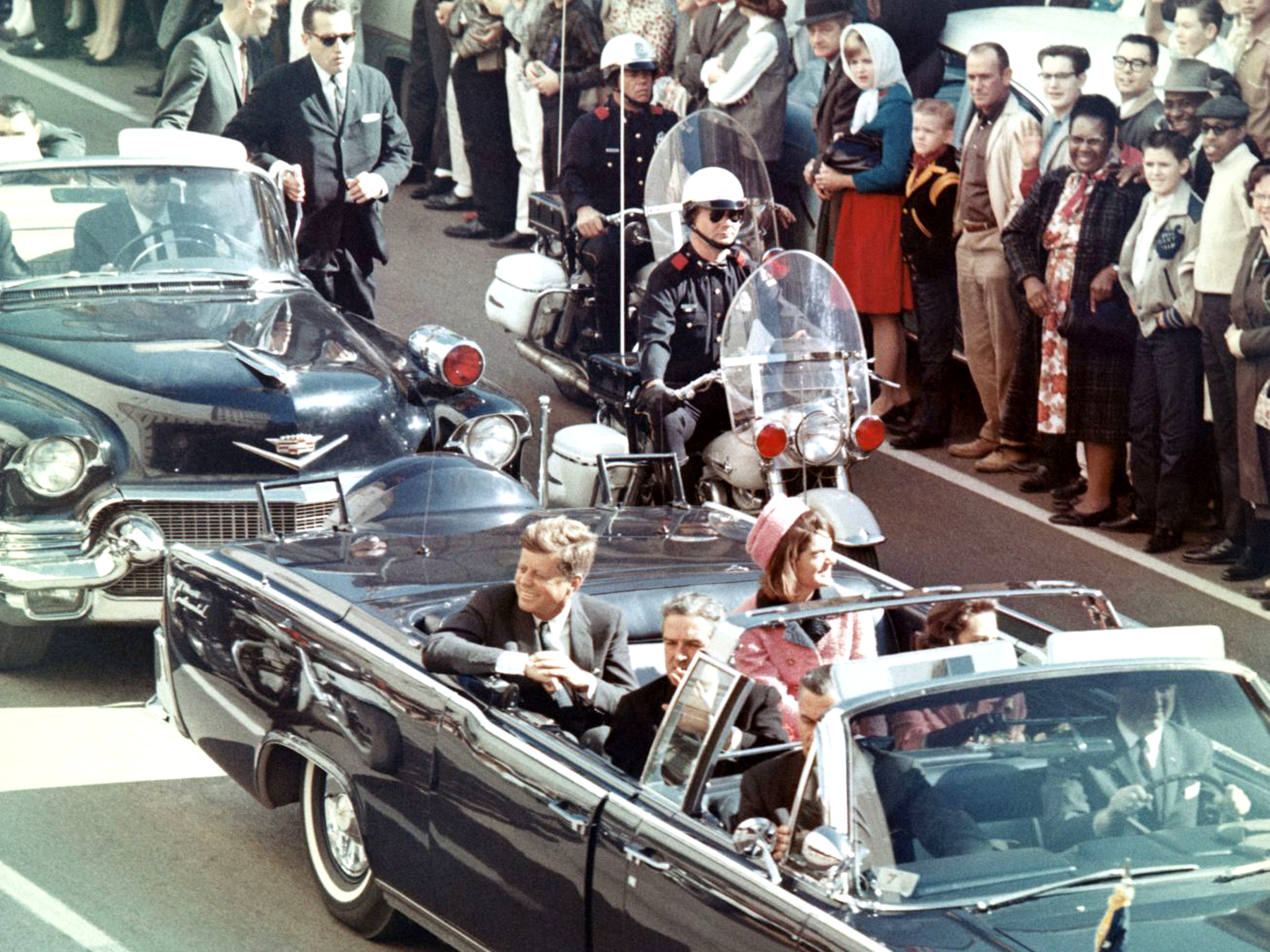
***November 22, 1963-Frankie’s Cry Of The Banshee-For The Class Of 1964 Everywhere


Click on the headline to link to a Wikipedia entry covering the background to the assassination of American President John F. Kennedy on November 22, 1963 for those too young to remember that event.

Frankie Riley comment:

Well you, the North Adamsville High School Class of 1964, knew this was coming at some point. That date, November 22, 1963, is etched, one way or another, is the minds of the generation of ’68 forever. Some events form the signposts for every generation. For our parents, the Class of 1964 parents, it was starving or semi-starving, hitting the western roads or just marking time through the Great Depression and slogging, gun in hand, through World War II, or waiting anxiously at home, waiting for the other shoe to drop. For today's kids it is the dastardly heinous criminal acts around 9/11 and the permanent "war against terrorism" that seems to color every political move made these days. For us it was the Cold War “red menace” Soviet Union space race throw-up satellite Sputnik and, in the end, the political horrors emanating from the Irish tragic Kennedy assassination. The cry of the banshee out in the wilds, on the wild oceans, and careening the wild winds.

Usually, when discussing these milestone events the question asked centers on where you were or what you were doing on that fateful day. I do not need to ask that question here. I know where you were, at least most of you. Unless you were sick, legitimately or otherwise, playing hooky, legitimately or otherwise, or on a field trip, legitimately or otherwise, you were sitting in some dank classroom as the old craggy-faced, rum-besotten (as least we all suspected that and which was later confirmed when he was arrested for drunk driving about seven times), headmaster, one Mr. Donald O’Toole, came over the P.A. system to announce the news of the shooting of President Kennedy. What I would find interesting is not what your current take is on that event, whether you were a Kennedy partisan or not, but how you reacted at the time. Here is the story of my reaction:

In the fall of 1960, for most of us our first year at North, a new wind was blowing over the political landscape in America with the Kennedy nomination and later his election victory over Richard Nixon. If you want the feel of that same wind pay attention to the breezes that I sense coming from today's youth, a little anyway if they can stop that eternal, infernal texting and look up for a minute. Maybe that wind grabbed you in 1960. It did me. Although some people that I have met and worked with over the years swear that I was born a “political junkie” the truth is that 1960 marked my political coming of age.

One of my forms of 'fun' as a kid was to write little 'essays' on political questions. You know, like-Should Red China (remember that term) be admitted into the United Nations? Or, are computers going to replace workers and create high unemployment? (I swear that I wrote stuff like that. I do not have that good an imagination to make this up. It also might explain one part of a very troubled childhood.)

In any case, I kept these little 'pearls of wisdom' in a little notebook. Within a couple of days after the Kennedy assassination I threw them all away, swearing off politics forever. Well, I did not hold to that promise. I have also moved away from that youthful admiration for JFK (although I will always hold a little spot open for brother Robert-oh, what might have been.) but I can still hear the clang as I threw those papers in the trash barrel.
*******
So naturally if Frank Riley has anything to say on any subject, from dung beetles to one-worldism, just like in the old North Adamsville Salducci’s Pizza Parlor nights, one Peter Paul Markin has to put his face into the conversation. Here, as usual, is his lame take on the Kennedy days from an entry he wrote in 2010. In other words he refuses to give us any new stuff but, christ, just the same old, same old. Here it is if you can stand it:

Peter Paul Markin, Class of 1964:

A while back [October, 2010] I mentioned, in an entry that amounted to a nostalgic 1960s Boston kid time trip down political memory lane, the following that links in with this entry posted under the sign of the 50th anniversary of Jack Kennedy’s presidential election victory election over one Richard Milhous Nixon, the arch-political villain of the age:

“During the course of the afternoon that event [the Massachusetts governor’s race where President Obama was to speak at a rally in behalf of Deval Patrick’s reelection at the Hines Center in Boston], and the particular locale where it was staged, brought back a flood of memories of my first serious organized political actions in 1960 when, as a lad of fourteen, I set out to “save the world.” And my soul, or so I thought at the time, as well. That was the campaign of one of our own, Jack Kennedy, as he ran for president against the nefarious sitting Vice President, one Richard Milhous Nixon. In the course of that long ago campaign he gave one of his most stirring speeches not far from where I stood on this Saturday.

Although gathering troops (read: high school and college students) for that long ago speech was not my first public political action of that year, a small SANE-sponsored demonstration against nuclear proliferation further up the same street was but I did not help to organize that one, the Kennedy campaign was the first one that hinted that I might, against all good sense, become a serious political junkie. Ya, I know, every mother warns their sons (then and now) and daughters (now) against such foolhardiness but what can you do. And, mercifully, I am still at it. And have wound up on the right side of the angels, to boot.

The funny thing about those triggered remembrances is that as far removed from bourgeois politics as I have been for about the last forty years I noticed many young politicos doing their youthful thing just as I did back then; passing out leaflets, holding banners, rousing the crowd, making extemporaneous little soapbox speeches, arguing with an occasional right wing Tea Party advocate, and making themselves hoarse in the process. In short, exhibiting all the skills (except the techno-savvy computer indoor stuff you do these days before such rallies) of a street organizer from any age, including communist street organizers. Now if those young organizers only had the extra-parliamentary left-wing politics to merge with those organizational skills. In short, come over to the side of the angels.

But that is where we come back to old Jack Kennedy and that 1960 campaign. Who would have thought that a kid, me, who started out walking door to door stuffing Jack Kennedy literature in every available door in 1960 but who turned off that road long ago would be saying thanks, Jack. Thanks for teaching me those political skills.”

And not just that thanks for heralding the break-out, or at least the attempted break-out of my 1960s generation from the Eisenhower-Nixon cold war death trap. See, at the time of the great attempted break-out from the confines of bourgeois society and the tracked career path all kinds of people seemed like they could be allies, and Jack Kennedy seemed a kindred spirit. I will not even mention Bobby, that one still brings a little tear to my eye. But enough of nostalgia we still have to fight to seek that newer world, to hear that high white note before everything comes crashing down on us.”
*******
And here is more from Mr. Markin under cover of a book review from 2007. This guy is too much, way too much-Frank Riley.

On Coming Of Political Age-Norman Mailer's "The Presidential Papers"

Commentary/Book Review

The Presidential Papers, Norman Mailer, Viking, 1963


At one time, as with Ernest Hemingway, I tried to get my hands on everything that Norman Mailer wrote. In his prime he held out promise to match Hemingway as the preeminent male American prose writer of the 20th century. Mailer certainly has the ambition, ego and skill to do so. Although he wrote several good novels, like The Deer Park, in his time I believe that his journalistic work, as he himself might partially admit, especially his political, social and philosophical musings are what will insure his place in the literary pantheon. With that in mind I recently re-read his work on the 1960 political campaign-the one that pitted John F. Kennedy against Richard M. Nixon- that is the center of the book under review. There are other essays in this work, some of merely passing topical value, but what remains of interest today is a very perceptive analysis of the forces at work in that pivotal election. Theodore White won his spurs breaking down the mechanics of the campaign and made a niche for himself with The Making of a President, 1960. Mailer in a few pithy articles gave the overview of the personalities and the stakes involved for the America of that time.

Needless to say the Kennedy victory of that year has interest today mainly for the forces that it unleashed in the base of society, especially, but not exclusively, among the youth. His rather conventional bourgeois Cold War foreign policy and haphazard domestic politics never transcended those of the New and Fair Deals of Roosevelt and Truman but his style, his youth and his élan seemingly gave the go ahead to all sorts of projects in order to ‘‘seek a newer world.” And we took him up on this. This writer counted himself among those youth who saw the potential to change the world. We also knew that if the main villain of the age , one Richard Milhous Nixon, had been successful in 1960 as he graphically demonstrated when he later became president we would not be seeing any new world but the same old, same old.

I have been, by hook or by crook, interested in politics from an early age. Names like Julius and Ethel Rosenberg, Joseph McCarthy, Khrushchev and organizations like Americans for Democratic Action (ADA) and the like were familiar to me if not fully understood then. I came of political age with the 1960 presidential campaign. Mailer addresses the malaise of American political life during the stodgy Eisenhower years that created the opening for change-and Kennedy and his superb organization happily rushed in. These chances, as a cursory perusal of the last 40 odd years of bourgeois presidential politics makes painfully clear, do not come often. The funny thing is that during most of 1960 I was actually ‘Madly for Adlai’, that is I preferred Adlai Stevenson the twice- defeated previous Democratic candidate, but when the deal went down at the advanced age of 14 I walked door to door talking up Kennedy. Of course, in Massachusetts that was not a big deal but I still recall today that I had a very strong sense I did not want to be left out of the new age ‘aborning.’ That, my friends, in a small way is the start of that slippery road to the ‘lesser evil’ practice that dominates American politics and a habit that took me a fairly long time to break.

Mailer has some very cutting, but true, remarks about the kind of people who populate the political milieu down at the base of bourgeois politics, those who make it to the political conventions. Except that today they are better dressed and more media savvy nothing has changed. Why? Bourgeois politics, not being based on any fidelity to program except as a throwaway, is all about winning (and fighting to keep on winning). This does not bring out the "better angels of our nature." For those old enough to remember that little spark of youth that urged us on to seek that "newer world" and for those too young to have acquired knowledge of anything but the myth Mailer’s little book makes for interesting and well-written reading.

Thursday, August 11, 2011

***Out In The 1940s Crime Noir Night-The Stuff Of Dreams- Harry’s Dreams- Richard Widmark's “Night And The City"


Click on the headline to link to a Wikipedia entry for the film noir Night and the City.

DVD Review

Night And The City , Richard Widmark, Gene Tierney, Herbert Lom, directed by George Dassin, Paramount Studios, 1946


No question I am a film noir, especially a crime film noir, aficionado. Recently I have been on a tear reviewing various crime noir efforts and drawing comparisons between the ones that “speak” to me and those that, perhaps, should have been better left on the cutting room floor. The classics are easy: films like Out Of the Past, Gilda, The Lady From Shang-hai, and The Big Sleep need no additional comment from me as their plot lines stand on their own merits. Others, because they have a fetching, or wicked, for that matter, femme fatale to muddy the waters also get a pass, or as in Gilda a double nod for the plot and for the femme fatale. (Be still my heart, at the thought of Rita Hayworth, ah, dancing and singing, okay lip- synching, and looking, well, fetching while doing those difficult tasks.) Some, like the film reviewed here, Night and the City, while not strong on plot line or femme fatale-ness (ouch) get a nod for other reasons. Little reasons like having a young Harry Fabian, oops, Richard Widmark, practically scream out his grifter’s dreams with his expressive face. And have that face, the faces of other characters in the film, and places beautifully directed and captured on film. Not bad for a B-rated movie.

But now to the characterizations that make this such an interesting and well-acted (by Richard Widmark anyway) film. You know, know deep in your bones, if you were brought up in a working class or poor neighborhood, and maybe in other neighborhoods too, the grifter Harry Fabian played here by Widmark, The guy, and it was almost always a guy back in the days, who was smart, well smart enough, friendly, almost too friendly, always willing to accept a little dough, a little touch dough for his endeavor, always with a little larceny in his heart, always looking for easy street, always looking for the short cut to glory, and never quite getting there. And always, always, having to be fast of foot, and fast of sneak away to stay just the south side of the law when that surefire scheme also goes south. That’s our Harry.

And Harry was the guy that your mother warned you about from early on to not be like or you would "wind up just like him." And that was the magic mantra that held you in check, for a while anyway until you got your own Harry thoughts. And if I had to visualize my neighborhood Harrys then one Richard Widmark, a young Widmark would not be a bad way to do so. No question jut-jawed, slightly hazy wide-eyed, made for no heavy-lifting, light of foot and made to slip into small dark places Widmark would make the top of any crime noir aficionados idea of guy that fits the bill in this genre.

And grifter Harry had a dream which is central to the plot. The dream like those of a million other grifters, drifters and midnight sifters, hell just every poor guy looking to get out from under, to get out from under, and to, as Harry constantly put it, “be somebody.” Yes, that's the ticket, and that idea drives the story line (and Harry’s angst). See Harry’s dreams, Harry's immediate post World War II London-set dreams are not earth- shattering to say the least, at least on the face of it. Just to corner the wrestling racket market and become an important impresario to the plebeian masses that throng to such events. Problem is, as is always the grifter’s fate, the market s already cornered, already sewed up and already underworld muscle-protected.

So Harry tried an end-around using the head wrestling mobster’s (Herbert Lom) father to promote real wrestling, that is Greco-Roman wrestling which is said head mobster’s father’s specialty. Yes, I know already you can see Harry’s problem a mile away, even if he cannot. Other than about twelve hard-core Olympic Games aficionados nobody cares, wants to care, or will ever care about Greco-Roman wrestling. Certainly not against the masked marvel, bad boys, “real” wrestling that is (now) driven by teenage boys (and teenage girls, a little). But that is Harry’s opening and he is bound to take it, working his “magic” on the father who is some kind of Greco-roman aficionado maniac himself. The clash is on, including a stellar defense of Greco-Roman wrestling in the flesh by the old man.

Of course like all old men who try to do a young man’s work he overexerts himself and dies after the heat of battle. Such things happen, but for Harry this is the kiss of death because as it turns out head mobster was fond of his father, very fond. Harry’s number is therefore up. And watching the scenes and gritty faces of the actors in the process of that number being up drives the last portion of the film and makes this a true noir classic.

Note: No femme fatales here, obviously, but there are women who enter Harry’s life. One, an unhappy wife of a mid-level grafter, wants to use Harry to get out from under her own heavy burden of marriage to said grafter. More importantly, and a little incongruously, Harry has a straight girlfriend, of sorts, played by Gene Tierney, who loves/protects him through think and thin. And who Harry doesn’t have enough sense to stick by, except when he is in trouble- needing quick dough mainly. It was painful from my own knowledge of such things to see Harry rummaging through her pocketbook looking for dough to make some awry deal right, to allow him to “be somebody” for another five minutes. Whoa.

***From Out In The Be-Bop Blues Night- Sippie Wallace's "Women Be Wise"


Click on the headline to link to a YouTube film clip of Sippie Wallace performing her classic, Women Be Wise (also covered by Bonnie Raitt and Maria Muldaur among others).

Markin comment:

Well I will just let Sippie tell it like it is for once. Truth. Without further comment. Okay. lol in cyber-slang.
******
Sippie Wallace

Women Be Wise

Women be wise, keep your mouth shut
Don't advertise your man
Don't sit around gossiping
Explaining what he really can do
Some women now days
Lord they ain't no good
They will laugh in your face
They'll try to steal your man from you

Women be wise, keep your mouth shut
Don't advertise your man

Your best girlfriend
Oh she might be a highbrow
Changes clothes three time a day
But what do you think she's doing now
While you're so far away?
You know she's lovin your man
In your own damn bed...
You better call for the doctor
Try to investigate your head

Women be wise, keep your mouth shut
Don't advertise your man

Women be wise, keep your mouth shut
Don't advertise your man
Now don't sit around girls
Telling all your secrets
Telling all those good things he really can do
Cause if you talk about your baby
Yeah you tell me he's so fine
Honey I might just sneak up
And try to make him mine

Women be wise, keep your mouth shut
Don't advertise your man --
Don't be no fool!
Don't advertise your man
Baby don't do it!


Wednesday, August 10, 2011

***The Intellectuals Or The Jocks?-For Fredda Cohen, North Adamsville High, Class Of 1964-Phil Larkin’s View

Click on the headline to link to a letter written by the late American writer, Norman Mailer, and printed in The New York Review Of Books, detailing his choices for "must reads" in the American literary canon. What would your ten choices be? See below.

Phil Larkin guest comment:

I did not then, nor do I now, know Fredda Cohen, a fellow classmate at North Adamsville High, Class of 1964. I don’t remember if old track buddy Markin, Peter Paul Markin, who prompted me to write some teary-eyed thing for him knew her or not, but it was with her in mind that I wrote the following. I, today, strongly believe that I could have learned a lot from her and maybe Markin does too but you will have to ask him that yourself. No way, no way on god’s good green earth in the year 2011 and while I am still breathing, old time “jock” buddies or not, am I going to vouch for that maniac. Here goes:

Every September, like clockwork, I am transported to a place called the beginning of the year. No, not New Year’s Day like any real person would expect, but the school year for most students, younger or older. That is a frame of reference that I have not changed in all these years. And every year, or many years anyway, my thoughts come back to the road not taken, or really not taken then, when I ask myself the following question that I am posing in such a way here so that you can ask it to yourself as well: What group(s) did you hang around with in high school?

This question is meant to be generic and more expansive that the two categories listed in the headline. These were hardly the only social groupings that existed at our high school (or any public high school, then or now, for that matter) but the ones that I am interested in personally for the purpose of this thing. Corner boy devotees and hoods, social butterflies, teases (actually that is covered that under social butterflies, girl social butterflies), school administration “brown noses,” science nuts, auto mechanics grease monkeys, bolsheviks, hippies, beats, hip-hop nation devotees, could-care-if-school-kept-or-not-ers, school skippers, drop-outs, and religious nuts can speak your own piece for your “community.”

You, fellow alumni from Anyway U.S.A. High, can also feel free to present your own extra categories in case I missed anything above like S&M or B&D devotees or stamp club members or both intertwined, if your you were aware of such types. However, for this writer, and perhaps some of you, here were my choices. The intellectuals, formerly known as the "smart kids.” You know, the ones that your mother was always, usually unfavorably, comparing you to come report card time in order to embarrass you or get you to buckle down in the great getting out from under the graying nowhere working class night and make something of yourself that she (and dad) could be proud of. Yes, those kids at the library after school, and even on Saturday, Saturdays if you can believe that, and endlessly trudging, trudging like some Promethean wanderers about forty six pounds of books, books large and small, books in all colors, mainly, and here is the kicker, well-thumbed, very well-thumbed. Or, on the other hand the jocks, the guys and in those days it was almost exclusively guys (girls came in as cheer-leaders or, well, girlfriends-sometimes the same thing). You know, mainly, the Goliaths of the gridiron, their hangers-on, wannabes and "slaves." The guys who were not carrying any forty-six pounds of books, although maybe were wearing that much poundage in gear. And any books that needed carrying was done by either girlfriends or the previously mentioned slaves. Other sports may have had some shine but the “big men” on campus were the fall classic guys. Some sports such as the old buddies, Markin and Larkin, track and field events didn’t usually rate even honorable mention compared to say a senior bake sale or high school confidential school dance.

Frankly, although I was drawn to both groupings in high school I was mainly a "loner" for reasons that are beyond what I want to discuss here except it very definitely had to do with confusion about the way to get out from under that graying working class nowhere night. And about “fitting” in somewhere in the school social order that had little room for guys (or girls for that matter) who didn’t fit into some classifiable niche. And for guys, 1960s shorts-wearing track guys, running the streets of old North Adamsville to the honks of automobiles trying to scare us off the road (no share the road with a runner then) and jeers, the awful jeers of girls, that space was very small. The most one could hope for was a “nod” from the football guys (or basketball in winter) in recognition that you were a fellow athlete, of sorts. Ya, times were tough but we survived.

But now I can come out of the closet, at last. I read books. Yes, I read them, no devoured them endlessly (and still do), and as frequently as I could. Did you see me carrying tons of books over my shoulder in public. Be serious, please. Here is the long held secret (even from Markin). I used to go over to the library on the other side of town, the Adamsville side where no one, no one who counted anyway (meaning no jock, of course), would know me. One summer I did that almost every day. So there you have it. Well, not quite.

In recent perusals of my class yearbook I have been drawn continually to the page where the description of the Great Books Club is presented. I believe that I was hardly aware of this club at the time but, apparently, it met after school and discussed Plato, John Stuart Mill, Max Weber, Karl Marx and others. Fredda Cohen ran that operation. Hell, that sounded like great fun. One of the defining characteristics of my life has been, not always to my benefit, an overweening attachment to books and ideas. So what was the problem? What didn't I hang with that group?

Well, uh..., you know, they were, uh, nerds, dweebs, squares, not cool (although we did not use those exact terms in those days). That, at least, was the public reason, but here are some other more valid possibilities. Coming from my 'shanty' background, where the corner boys had a certain cachet, I was somewhat afraid of mixing with the "smart kids." The corner boys counted, after school anyway, and if they didn’t count then it was better to keep a wide, down low berth from anything that looked like a book reader in their eyes. I, moreover, feared that I wouldn't measure up, that the intellectuals seemed more virtuous somehow. I might also add that a little religiously-driven plebeian Irish Catholic anti-intellectualism (you know, be 'street' smart but not too 'book' smart in order to get ahead in one version of that graying working class nowhere night) might have entered into the mix as well.

But, damn, I sure could have used the discussions and fighting for ideas that such groups would have provided. I had to do it the hard way later. As for the jocks one should notice, by the way, that in the last few paragraphs that I have not mentioned a thing about their virtues. And, in the scheme of things, that is about right. So now you know my choice, except to steal a phrase from something that madman Markin wrote honoring his senior English teacher, Ms. Lenora Sonos- "Literature matters. Words matter." (I wish now that I had had her as well). I would only add here that ideas matter, as well. Hats Off to the North Adamsville Class of 1964 intellectuals!
*****

Norman Mailer

Ten Favorite American Novels


U.S.A. John Dos Passos
Huckleberry Finn Mark Twain
Studs Lonigan James T. Farrell
Look Homeward, Angel Thomas Wolfe
The Grapes of Wrath John Steinbeck
The Great Gatsby F. Scott Fitzgerald-1st A.J.
The Sun Also Rises Ernest Hemingway
Appointment in Samarra John O'Hara
The Postman Always Rings Twice James M. Cain
Moby-Dick Herman Melville

This would be my list, as well, except instead of Moby Dick I would put Jack Kerouac's On The Road

***From Out In The Be-Bop 1950s Rock Night-Carl Perkin's "Boppin' The Blues"


Markin comment:

Hell, I don't need to comment here. Carl Perkins says it all- bop, bop the blues-get it.
******
Boppin' The Blues Lyrics- Carl Perkins

Well, all my friends are boppin' the blues; it must be goin' round
All my friends are boppin' the blues; it must be goin' round
I love you, baby, but I must be rhythm bound

Well, the doctor told me, Carl you need no pills.
Yes, the doctor told me, boy, you don't need no pills.

Just a handful of nickels, the juke box will cure your ills.

Well, all my friends are boppin' the blues; it must be goin' round
All them cats are boppin' the blues; it must be goin' round
I love you, baby, but I must be rhythm bound

Well, the old cat bug bit me, man, I don't feel no pain
Yeah, that jitterbug caught me, man, I don't feel no pain.
I still love you baby, but I'll never be the same.

I said, all my friends are boppin' the blues; it must be goin' round
All my friends are boppin' the blues; it must be goin' round
I love you, baby, but I must be rhythm bound

Well, all my friends are boppin' the blues; it must be goin' round
All them cats are boppin' the blues; it must be goin' round
I love you, baby, but I must be rhythm bound

Well, grand-pa Don got rhythm and he threw his crutches down.
Oh the old boy Don got rhythm and blues and he threw that crutches down
Grand-ma, he ain't triflin', well the old boy's rhythm bound.

Well, all them cats are boppin' the blues; it must be goin' round
All my friends are boppin' the blues; it must be goin' round
I love you, baby, but I must be rhythm bound.

A rock bop, rhythm and blues.
A rock rock, rhythm and blues.
Rhythm and blues, it must be goin' round.